Last week Chad Waterbury very kindly sent me a copy of his latest eBook, called THE 10/10 TRANSFORMATION (available here, which is a nutrition and workout program designed to get you to lose 10 pounds of fat AND gain 10 pounds of muscle over the course of nine weeks. It’s a nifty program, and looking it over I can see that it would be effective: the workouts are varied, and progressive, and, (this being Waterbury) shot through with challengingly counterintuitive touches.
The nutrition advice is really novel, though. Not because it’s particularly esoteric or groundbreaking in its principles, but because it’s about as simply and clearly laid out as any eating plan I’ve ever encountered.
He covers pretty much everything you need to know in about four pages.
At first, I couldn’t believe it. I kept scrolling back and forth looking for something he’d missed. But checking carefully, I could see that he’d managed to cover it all: composition of meals, meal frequency, timing, macronutrients, supplementation, water consumption, cheat meals, pre-and post-workout nutrition—it was all there in enough detail to make it patently obvious what you should and shouldn’t be eating day in and day out.
Apparently no one remembered to tell Chad that a complete eating and nutritional program has to take the form of a hefty, hardback book long on whys, wherefores, and esoteric formulae, and short on usable, practical advice. About ten pages of these books are useful; the other 240 are filler. I’ve bought a couple such books over the years, and read several more, and I think there’s something in their hardback-tome quality, and the rules and measures and devotion to carbless sacraments they contain, that reminds people of a religious text: buy this book, and ye shall sin no more.
I’d love to author one of these books just so I could include a sentence like “For Pete’s sake, just lay off the Krispy Kremes at 2 AM and you’ll be good to go, you Fat Cow,” round about page 210, because I know that no one will read that far.
Good lord above, it’s a lucrative formula, though: just how long was THE SOUTH BEACH DIET the #1 best-selling nonfiction book in America, its shiny green cover and Harlequin-romance logo gleaming at us from the window display of Barnes & Nobles everywhere? Only the adventures of a mythical boy wizard would dare challenge its reign…said wizard, of course, being one Dr. Atkins, may he now rest in carb-free peace.
What hit me like a ton of bricks when I read Chad’s eBook was that the concepts of good eating, as we now understand them, Just Aren’t That Complicated. That doesn’t mean they’re easy to adhere to—just that it doesn’t take a PhD to understand them. A few million books and articles and careers spent exploring our place in the universe and the nature of mankind, I understand. But a million works on how to eat right, when, as Chad and a few other anti-B.S. stalwarts have shown us, the information can be more or less contained in a handful of pages that a second-grader could comprehend? Unbelievable.
Now look here: I know that everyone has a different metabolism, preferences, and tolerance for things like sugar, meats and carbohydrates. So, yeah, different individuals may respond differently to the same diet. But we’re pretty much talking inches here, not miles—NO ONE’S going to do particularly well eating what my mother used to call “Nothing but paste” all day (bread, pasta, white rice), just as no one’s going to go too far wrong loading up on veggies and healthy animal proteins while avoiding processed foods. So, as with weight training, the basics are the basics; they’ve worked forever and will probably continue to form the backbone of every healthy eating program from now till the next ice age.
The rest is filler and packaging. I’ve always done best with a program that’s so simple a child could understand it, and failed on diet programs designed to provide fodder for cocktail-party chitchat. Simple diets just don’t allow you to get away with much. You know when you’ve screwed up. It’s the long, complex ones that allow loopholes and cheat weekends and a huge dessert every second Tuesday that get people into trouble.
A few years ago friend of mine who weighed close to 300 pounds suddenly decided to go 100% vegan, and, on top of that, to cease eating every day after 8 PM. Within a shockingly brief period, he was down to 180, and looked and felt fantastic. And this is a guy whose entire family is obese: a guy who’s waging a down-and-dirty war not only against the everyday gastronomic temptations the rest of us face, but against the very forces of his own DNA.
Now I’m not saying “Go Vegan” here; indeed, with apologies to my animal-loving friends, I generally consider animal proteins an important part of a good diet, especially if you exercise frequently or are trying to gain lean muscle mass. But my friend was successful with his vegan diet because the principles to such a diet are about as simple as they come. Just don’t eat any animal-source foods. And you either adhere to it or you don’t. You’re a vegan or you aren’t—no loopholes.
The diets that get confusing—and that fail--are the ones that say, “Eat All Your Favorite Foods and Still Lose Weight!”
Which is pretty much all of them except the ones that only take four pages to explain.
Time to tuck into a steak and some salad.
Andrew
Showing posts with label Chad Waterbury. Show all posts
Showing posts with label Chad Waterbury. Show all posts
Monday, October 08, 2007


Saturday, September 29, 2007
Best Glute Workout Ever!
There are reasons both sublime and ridiculous to build one’s glutes.
On one hand, they’re your largest muscles and therefore deserve some pretty close attention. As I’ve said repeatedly in the past, many, many people suffer from glute inaction, or an inability to literally get their butts moving: their hip flexors are short, tight and overactive from sitting all the time, and as a result, the muscles on the opposite side of the hip joint – the glutes -- become inhibited and weak. The hamstrings step up to fill in, you get a condition called “synergistic dominance,” where the second-stringers are trying to do the work of the starters, and you eventually get injured. Keep the glutes in shape, and you’ll help stave off knee joint problems, back pain, and postural imbalances. So having a nicely-toned set of glutes is good for you, like your proverbial apple a day.
On the other hand, there’s something about a well-shaped set of hip extensors that just screams youth, health, fitness, and, shall we say, fertility. I read a story recently that said that Tour-de-France cyclists are able to evaluate the fitness of their opponents simply by the shape and tone of their rumps. No surprise there: cycling is essentially a series of thousands of single-leg hip-and-knee extensions, so it’s pretty much impossible to be a decent cyclist without walnut-cracking glutes.
My theory about why we’re attracted to the rumps of the opposite sex is that good glutes tend to be the mark of genuine athleticism, not just health-club muscularity. Back when we were spearing mammoths for food, being able to run fast and jump high meant you were a good provider, not just that guy on the office basketball team with the decent jump shot. So Elga the cavewoman was attracted to Oog the caveman because his firm butt made her think he’d be able to climb mountain passes with buckets of water on his back or carry their five children across the rushing river in springtime. Show me someone with a muscular bum and I’ll show you someone who most likely can actually DO athletic things, not just someone whose mirror muscles make them look like they might be able to. There’s a big difference.
So, below is a quick but effective trio of exercises that, taken together, are unbeatable as glute-builders. If you’re putting together a lower-body routine with an emphasis on the rear kinetic chain—that is to say, your glutes and hamstrings, as well as your lower and mid-back musculature—I contend that your time is best spent on the following three movements:
1) The Deadlift
2) The Bulgarian Split Squat
3) The single-leg Romanian Deadlift.
Your quads, hip flexors, adductors and abductors will also get pretty fried by these three moves, so if you have a lower-body “day” in your workout schedule, you won’t need to do much more to make it a complete waist-down torture-fest. I am, however, also a big fan of traditional barbell squats, and so I’d make sure to cycle those in at least once a week in lieu of the deadlifts.
Right away I hear keyboards firing up. People will say, “what, no hyperextensions or reverse hyperextensions? No “butt-blaster-machine extensions”? No donkey cable-kicks? Didn’t you just write about the value of isolation exercises? We thought you were on OUR side!”
Well, yes, I do think isolation moves have their place. But when it comes to butt-building I don’t think they’re much good. If you have REALLY tight hip flexors and just don’t know how to get your glutes to contract at all (and some professional athletes have this condition!), you MIGHT consider using some isolation moves until you feel like those muscles are “wired in” and your brain knows how to make them fire without having to think about it too hard (I sometimes forget how easy it is to get so caught up in the heady world of sedentary brainwork that you actually forget how your body works!)
But as soon as you can, you need to step up and attack these compound moves.
The glutes seem happiest when they are working in conjunction with other muscles, not just contracting on their own. Sprinters, gymnasts, Olympic weightlifters, and the aforementioned pro cyclists all spend the bulk of their training time on movements that require them to extend the knee and the hip simultaneously, and all of them have glutes of steel. So even if you’re far more concerned with filling out a pair of jeans than you are with running 48-second 400 meters, it’s real athletic movement that makes the body look and feel athletic—especially when it comes to lower-body training, and glute-training in particular. You’re got to train like an athlete in order to look like one.
A couple of finer point before you rush off to the gym to attack the those deads, Bulgarians and Romanians (with exercise names like these, I should rename it the “Dracula” workout):
1) DEADLIFTING. The best two pieces of advice I’ve ever received about deadlifting are a) that you should feel like as if you were “falling back onto your heels” when you lift and b) that you should visualize the bar as freshly glued to the floor with so that you have to “peel it” off the floor, gradually ramping your efforts up to the full force required to hoist the weight rather than jerking abruptly it off the floor (I’m pretty sure that’s a Chad Waterbury tip, just giving credit where it’s due). The chest should be high and the gaze should be straight ahead or a tad above for good focus and alignment. To ensure that the bar is really “dead” at the beginning of the movement—and to give my gripping muscles a break—I ‘reset’ between each rep, setting the bar fully down and relaxing my hold each time the bar hits the floor.
2) BULGARIAN SPLIT SQUATS. Bulgarians are typically seen as a quad-builder, and they work beautifully as such, but I’ve found that in conjunction with the other two movements they also work well as a glute exercise provided—and this is a crucial point—you go low enough. If you’re weak in this movement, and can’t descend till the back knee grazes the floor, you won’t really nail the glutes. If that’s the case with you, work up to it carefully. It’s okay if your knee goes past the much-feared 90-degree point as long as your front knee doesn’t wobble to either side as you ascend. If you do have a case of wobbly-knee syndrome, lighten your load, shorten your range of motion, or both until you can manage the full motion without the extraneous movement. Otherwise, go deep in your Bulgarians, find a real tightness in the glute of the front leg at the bottom of the movement, and push off quickly from the “down” position.
3) SINGLE-LEG ROMANIAN DEADLIFTS. Every list of “favorites” has to include at least one unexpected element—sort of like including an album by “Weird Al” Yankovic on your list of desert island CD’s just so you can feel fresh and unpredictable--and this is it in my list of top three moves for the glutes (for the record, ALL of my desert island CD’s would be by “Weird Al” Yankovic, perhaps with an extra copy of WEIRD AL IN 3-D just in case one gets scratched). Most trainers would put the two-leg version above this one, but for many reasons, I disagree. Single-Leg Romanians are more functional (in that we are almost always on one foot when we are in motion); they’re safer (because you can use half the weight and still get the benefit of the two-leg version); and they’re a more complete hip-extensor workout (because you have to both stabilize AND contract during the movement). Finally, the single-leg Romanian deadlift is the closest thing to a direct glute move among these exercises, and even still, the hamstrings, quads, calves, core, and gripping muscles all contribute significantly to its successful execution. I like holding a dumbbell in each hand, though some trainers prefer their clients use just one in the hand opposite the foot they’re standing on. Stand, hold the weights, bend forward one one foot, allowing your other leg to extend back behind you, as if picking up a piece of loose change off the floor. Touch the dumbbells lightly to the floor—they should touch the floor at the same instant--and return to the starting position. Alternate legs for sets of 8-12 reps.
The angle of the knee of the supporting leg is key! Keep a 10-20 degree knee bend in order to optimize glute activation. Any straighter and the move will be almost pure hamstring and lower back. The move requires a fair amount of concentration to get right and to maximize the hip extension movement, but once you find the right groove of stability, bend in the supporting leg, and core activation, it becomes one of the most effective glute-builders out there.
Perform the workout twice a week, and vary your rep and set configurations from more standard parameters of 3x 8-12 and 5 x 5 to 2 x 25 or 6 x 4, always working with impeccable form.
Good luck, and, as ever, feel free to write me with questions or comments.
On one hand, they’re your largest muscles and therefore deserve some pretty close attention. As I’ve said repeatedly in the past, many, many people suffer from glute inaction, or an inability to literally get their butts moving: their hip flexors are short, tight and overactive from sitting all the time, and as a result, the muscles on the opposite side of the hip joint – the glutes -- become inhibited and weak. The hamstrings step up to fill in, you get a condition called “synergistic dominance,” where the second-stringers are trying to do the work of the starters, and you eventually get injured. Keep the glutes in shape, and you’ll help stave off knee joint problems, back pain, and postural imbalances. So having a nicely-toned set of glutes is good for you, like your proverbial apple a day.
On the other hand, there’s something about a well-shaped set of hip extensors that just screams youth, health, fitness, and, shall we say, fertility. I read a story recently that said that Tour-de-France cyclists are able to evaluate the fitness of their opponents simply by the shape and tone of their rumps. No surprise there: cycling is essentially a series of thousands of single-leg hip-and-knee extensions, so it’s pretty much impossible to be a decent cyclist without walnut-cracking glutes.
My theory about why we’re attracted to the rumps of the opposite sex is that good glutes tend to be the mark of genuine athleticism, not just health-club muscularity. Back when we were spearing mammoths for food, being able to run fast and jump high meant you were a good provider, not just that guy on the office basketball team with the decent jump shot. So Elga the cavewoman was attracted to Oog the caveman because his firm butt made her think he’d be able to climb mountain passes with buckets of water on his back or carry their five children across the rushing river in springtime. Show me someone with a muscular bum and I’ll show you someone who most likely can actually DO athletic things, not just someone whose mirror muscles make them look like they might be able to. There’s a big difference.
So, below is a quick but effective trio of exercises that, taken together, are unbeatable as glute-builders. If you’re putting together a lower-body routine with an emphasis on the rear kinetic chain—that is to say, your glutes and hamstrings, as well as your lower and mid-back musculature—I contend that your time is best spent on the following three movements:
1) The Deadlift
2) The Bulgarian Split Squat
3) The single-leg Romanian Deadlift.
Your quads, hip flexors, adductors and abductors will also get pretty fried by these three moves, so if you have a lower-body “day” in your workout schedule, you won’t need to do much more to make it a complete waist-down torture-fest. I am, however, also a big fan of traditional barbell squats, and so I’d make sure to cycle those in at least once a week in lieu of the deadlifts.
Right away I hear keyboards firing up. People will say, “what, no hyperextensions or reverse hyperextensions? No “butt-blaster-machine extensions”? No donkey cable-kicks? Didn’t you just write about the value of isolation exercises? We thought you were on OUR side!”
Well, yes, I do think isolation moves have their place. But when it comes to butt-building I don’t think they’re much good. If you have REALLY tight hip flexors and just don’t know how to get your glutes to contract at all (and some professional athletes have this condition!), you MIGHT consider using some isolation moves until you feel like those muscles are “wired in” and your brain knows how to make them fire without having to think about it too hard (I sometimes forget how easy it is to get so caught up in the heady world of sedentary brainwork that you actually forget how your body works!)
But as soon as you can, you need to step up and attack these compound moves.
The glutes seem happiest when they are working in conjunction with other muscles, not just contracting on their own. Sprinters, gymnasts, Olympic weightlifters, and the aforementioned pro cyclists all spend the bulk of their training time on movements that require them to extend the knee and the hip simultaneously, and all of them have glutes of steel. So even if you’re far more concerned with filling out a pair of jeans than you are with running 48-second 400 meters, it’s real athletic movement that makes the body look and feel athletic—especially when it comes to lower-body training, and glute-training in particular. You’re got to train like an athlete in order to look like one.
A couple of finer point before you rush off to the gym to attack the those deads, Bulgarians and Romanians (with exercise names like these, I should rename it the “Dracula” workout):
1) DEADLIFTING. The best two pieces of advice I’ve ever received about deadlifting are a) that you should feel like as if you were “falling back onto your heels” when you lift and b) that you should visualize the bar as freshly glued to the floor with so that you have to “peel it” off the floor, gradually ramping your efforts up to the full force required to hoist the weight rather than jerking abruptly it off the floor (I’m pretty sure that’s a Chad Waterbury tip, just giving credit where it’s due). The chest should be high and the gaze should be straight ahead or a tad above for good focus and alignment. To ensure that the bar is really “dead” at the beginning of the movement—and to give my gripping muscles a break—I ‘reset’ between each rep, setting the bar fully down and relaxing my hold each time the bar hits the floor.
2) BULGARIAN SPLIT SQUATS. Bulgarians are typically seen as a quad-builder, and they work beautifully as such, but I’ve found that in conjunction with the other two movements they also work well as a glute exercise provided—and this is a crucial point—you go low enough. If you’re weak in this movement, and can’t descend till the back knee grazes the floor, you won’t really nail the glutes. If that’s the case with you, work up to it carefully. It’s okay if your knee goes past the much-feared 90-degree point as long as your front knee doesn’t wobble to either side as you ascend. If you do have a case of wobbly-knee syndrome, lighten your load, shorten your range of motion, or both until you can manage the full motion without the extraneous movement. Otherwise, go deep in your Bulgarians, find a real tightness in the glute of the front leg at the bottom of the movement, and push off quickly from the “down” position.
3) SINGLE-LEG ROMANIAN DEADLIFTS. Every list of “favorites” has to include at least one unexpected element—sort of like including an album by “Weird Al” Yankovic on your list of desert island CD’s just so you can feel fresh and unpredictable--and this is it in my list of top three moves for the glutes (for the record, ALL of my desert island CD’s would be by “Weird Al” Yankovic, perhaps with an extra copy of WEIRD AL IN 3-D just in case one gets scratched). Most trainers would put the two-leg version above this one, but for many reasons, I disagree. Single-Leg Romanians are more functional (in that we are almost always on one foot when we are in motion); they’re safer (because you can use half the weight and still get the benefit of the two-leg version); and they’re a more complete hip-extensor workout (because you have to both stabilize AND contract during the movement). Finally, the single-leg Romanian deadlift is the closest thing to a direct glute move among these exercises, and even still, the hamstrings, quads, calves, core, and gripping muscles all contribute significantly to its successful execution. I like holding a dumbbell in each hand, though some trainers prefer their clients use just one in the hand opposite the foot they’re standing on. Stand, hold the weights, bend forward one one foot, allowing your other leg to extend back behind you, as if picking up a piece of loose change off the floor. Touch the dumbbells lightly to the floor—they should touch the floor at the same instant--and return to the starting position. Alternate legs for sets of 8-12 reps.
The angle of the knee of the supporting leg is key! Keep a 10-20 degree knee bend in order to optimize glute activation. Any straighter and the move will be almost pure hamstring and lower back. The move requires a fair amount of concentration to get right and to maximize the hip extension movement, but once you find the right groove of stability, bend in the supporting leg, and core activation, it becomes one of the most effective glute-builders out there.
Perform the workout twice a week, and vary your rep and set configurations from more standard parameters of 3x 8-12 and 5 x 5 to 2 x 25 or 6 x 4, always working with impeccable form.
Good luck, and, as ever, feel free to write me with questions or comments.
Tuesday, August 14, 2007
Chiro-Skeptic
Well, as seems to happen on occasion over here at www.blog.dynamicfitness.us, I'm going to be tucking into a nice slice of humble pie today. Lemmie splain.
About a month ago I was thrashing away in the gym, very excited about the new program I was embarking on by my colleague (in the sense that Pop Warner footballers are 'colleagues' with guys like Tom Brady) Chad Waterbury. Now I was coming off something of a layoff, after several months of work on the bike, in the water, and on the road in pursuit of shaving a few seconds off my sprint-distance triathlon time, and as a result, I should have been careful.
Needless to say, I wasn't. After a too-short warmup, I jumped to near maximum weight on the incline dumbell press, shooting for a set of six reps. Right around rep four, I felt something give and a friendly little stab of pain in the front of my right shoulder. I put the weights down, pretended that it was not a big deal, and limped through the rest of my workout with minuscule weights.
I kept up the pretending for a few weeks, wincing when I had to hand anything over 30 pounds to a client, and hoping I'd wake up one day with the pain miraculously gone.
Didn't happen. A couple of times I leaned on my right arm while lying down and felt like my shoulder had dislocated (which has happened to me, twice. Very painful.) So finally I decided to go see a professional, and I opted for... a chiropractor.
I made that choice for a couple of reasons:
1) This particular D.C. came highly recommended by a very knowledgeable trainer whom I trust and
2) He came cheap, presumably because if he does a good job on me I'll recommend him to my clients, and they'll tell their friends, and they'll tell their friends, and so on, and perhaps, most importantly,
3) Whatever happened, I figured I could blog about it and write about my personal experience with chiropractic, which up to now has been exactly zero.
In part, my chiropractic experience has been limited because I've been a chiro-skeptic. It doesn't really make sense to me that ALL physical ailments can be traced to issues with the spinal column. I don't know much about physiology (or history, or biology, or any of those Sam Cooke topics) compared to some people, but a theme that seems to emerge over and over again is that it's hard to reduce the intricacy of the human body. So many systems, hormones, chemicals, moving parts. Remedies seem very condition-specific. So the idea that you could fix a bad knee by cracking the back seemed counter-intuitive to me.
Another reason I've been wary of chiropractic is that it involves manipulation of the body from the outside, which has always struck me something of an exercise in futility. In my experience, habitual movement patterns will eventually trump whatever external manipulation you impose on the body. Sure, as this video shows, you can grab your biceps tendon and thread it over the end of your clavicle (its optimal position, from which it often slips), but how long will it stay there if you keep repeating the behaviors that pulled it off course in the first place?
Here's a little SAT analogy: stone : river :: body structure : physical movement. That is to say, what you do habitually will eventually imprint itself on your bones, muscles and connective tissues just as surely as rushing water wears away at the rocks in the riverbed. So my strongest resistance to chiropractic medicine has been that whatever the chiropractor does to the body will shortly be undone by your usual physical activities.
Finally, I had the usual fear-of-the-unknown resistance to the idea that all that snapping and popping could really be all that good for you.
In sum I was the Sir Thomas More of chiropractic medicine.
But I was -- and remain -- willing to suspend disbelief in order to come up with a dispassionate assessment of the practice. So that's what this, and probably a few posts in the near future, will be about. Call it a little case-study.
Here's what I've learned so far:
1) My shoulder problem is only part of the equation. The doctor, whose name I won't give here right now because I don't want to slander the guy if my course of treatment is unsuccessful, explained that my habitual neck position was largely responsible for my shoulder problem. This was encouraging, but unsurprising, to hear. I knew going in that chiropractors believe that all problems are ultimately spinal. Some even believe that they're all tracable to L1 or C4 or T2 or some other individual vertebra, which seems like a rather extreme position. But in this case, the doc's assessment makes sense to me. Despite all my efforts to avoid such problems, I have "forward head syndrome," which -- I'll save you the Google search on such a confusing name--means that I crane my head forward habitually. This tendency compresses some nerves in my neck, which itself can cause shoulder pain, but also causes the gears of my clavicle and shoulder joints to grind a bit, like a bicycle with a slipped chain.
2) I need to do all the stuff that I tell my clients to do. This was a weird one. I mean, I figured just telling a few dozen people a week to do some stuff pretty much counted as me actually doing it, but no, apparently I've got to actually be aware of my own posture. Aware, for instance, that when I type away at my computer I shouldn't strain my head forward to see the screen better. And that poking my head out three inches when I'm driving at night probably won't help me see the road signs all that much better. So as I sit here typing away--which, I'm told is one of the root causes of my condition (which means I can blame everyone reading this for my FHS) I'm trying also to be aware of perching my head directly over my shoulders and not jamming it forward like some kind of nearsighted turtle.
3) Chiropractic isn't just about snapping and popping. On the first day, all the chiropractor did was massage the hell out of the front of my right shoulder. To the point of extreme pain, actually, so that my shoulder was sore for a couple of days. I didn't mind, really, and was glad that he didn't just jump to cracking me in half like a pretzel. On my second treatment, he did do some adjusting of my neck and spine (which was weird but actually felt pretty good), but he also handed me a couple of sheets detailing some exercises I could do to help tone up the muscles that keep my head comfortably in retracted-turtle position, and to help rehabilitate my tweaked shoulder. In a way, this was what I was hoping for: some suggestion that retraining behavior was at least as important as manipulating the body from the outside.
I have to admit, though, that after the neck-popping yesterday, my shoulder feels better than it has since my injury, and I don't have the weird radiating pains that I was getting right up until the appointment. Coincidence?
Today's cliffhanger will be, if I do these exercises religiously (and I don't know of any other way to do physical exercises of any kind), will my FHS and shoulder pain really go away?
Watch this space to find out.
About a month ago I was thrashing away in the gym, very excited about the new program I was embarking on by my colleague (in the sense that Pop Warner footballers are 'colleagues' with guys like Tom Brady) Chad Waterbury. Now I was coming off something of a layoff, after several months of work on the bike, in the water, and on the road in pursuit of shaving a few seconds off my sprint-distance triathlon time, and as a result, I should have been careful.
Needless to say, I wasn't. After a too-short warmup, I jumped to near maximum weight on the incline dumbell press, shooting for a set of six reps. Right around rep four, I felt something give and a friendly little stab of pain in the front of my right shoulder. I put the weights down, pretended that it was not a big deal, and limped through the rest of my workout with minuscule weights.
I kept up the pretending for a few weeks, wincing when I had to hand anything over 30 pounds to a client, and hoping I'd wake up one day with the pain miraculously gone.
Didn't happen. A couple of times I leaned on my right arm while lying down and felt like my shoulder had dislocated (which has happened to me, twice. Very painful.) So finally I decided to go see a professional, and I opted for... a chiropractor.
I made that choice for a couple of reasons:
1) This particular D.C. came highly recommended by a very knowledgeable trainer whom I trust and
2) He came cheap, presumably because if he does a good job on me I'll recommend him to my clients, and they'll tell their friends, and they'll tell their friends, and so on, and perhaps, most importantly,
3) Whatever happened, I figured I could blog about it and write about my personal experience with chiropractic, which up to now has been exactly zero.
In part, my chiropractic experience has been limited because I've been a chiro-skeptic. It doesn't really make sense to me that ALL physical ailments can be traced to issues with the spinal column. I don't know much about physiology (or history, or biology, or any of those Sam Cooke topics) compared to some people, but a theme that seems to emerge over and over again is that it's hard to reduce the intricacy of the human body. So many systems, hormones, chemicals, moving parts. Remedies seem very condition-specific. So the idea that you could fix a bad knee by cracking the back seemed counter-intuitive to me.
Another reason I've been wary of chiropractic is that it involves manipulation of the body from the outside, which has always struck me something of an exercise in futility. In my experience, habitual movement patterns will eventually trump whatever external manipulation you impose on the body. Sure, as this video shows, you can grab your biceps tendon and thread it over the end of your clavicle (its optimal position, from which it often slips), but how long will it stay there if you keep repeating the behaviors that pulled it off course in the first place?
Here's a little SAT analogy: stone : river :: body structure : physical movement. That is to say, what you do habitually will eventually imprint itself on your bones, muscles and connective tissues just as surely as rushing water wears away at the rocks in the riverbed. So my strongest resistance to chiropractic medicine has been that whatever the chiropractor does to the body will shortly be undone by your usual physical activities.
Finally, I had the usual fear-of-the-unknown resistance to the idea that all that snapping and popping could really be all that good for you.
In sum I was the Sir Thomas More of chiropractic medicine.
But I was -- and remain -- willing to suspend disbelief in order to come up with a dispassionate assessment of the practice. So that's what this, and probably a few posts in the near future, will be about. Call it a little case-study.
Here's what I've learned so far:
1) My shoulder problem is only part of the equation. The doctor, whose name I won't give here right now because I don't want to slander the guy if my course of treatment is unsuccessful, explained that my habitual neck position was largely responsible for my shoulder problem. This was encouraging, but unsurprising, to hear. I knew going in that chiropractors believe that all problems are ultimately spinal. Some even believe that they're all tracable to L1 or C4 or T2 or some other individual vertebra, which seems like a rather extreme position. But in this case, the doc's assessment makes sense to me. Despite all my efforts to avoid such problems, I have "forward head syndrome," which -- I'll save you the Google search on such a confusing name--means that I crane my head forward habitually. This tendency compresses some nerves in my neck, which itself can cause shoulder pain, but also causes the gears of my clavicle and shoulder joints to grind a bit, like a bicycle with a slipped chain.
2) I need to do all the stuff that I tell my clients to do. This was a weird one. I mean, I figured just telling a few dozen people a week to do some stuff pretty much counted as me actually doing it, but no, apparently I've got to actually be aware of my own posture. Aware, for instance, that when I type away at my computer I shouldn't strain my head forward to see the screen better. And that poking my head out three inches when I'm driving at night probably won't help me see the road signs all that much better. So as I sit here typing away--which, I'm told is one of the root causes of my condition (which means I can blame everyone reading this for my FHS) I'm trying also to be aware of perching my head directly over my shoulders and not jamming it forward like some kind of nearsighted turtle.
3) Chiropractic isn't just about snapping and popping. On the first day, all the chiropractor did was massage the hell out of the front of my right shoulder. To the point of extreme pain, actually, so that my shoulder was sore for a couple of days. I didn't mind, really, and was glad that he didn't just jump to cracking me in half like a pretzel. On my second treatment, he did do some adjusting of my neck and spine (which was weird but actually felt pretty good), but he also handed me a couple of sheets detailing some exercises I could do to help tone up the muscles that keep my head comfortably in retracted-turtle position, and to help rehabilitate my tweaked shoulder. In a way, this was what I was hoping for: some suggestion that retraining behavior was at least as important as manipulating the body from the outside.
I have to admit, though, that after the neck-popping yesterday, my shoulder feels better than it has since my injury, and I don't have the weird radiating pains that I was getting right up until the appointment. Coincidence?
Today's cliffhanger will be, if I do these exercises religiously (and I don't know of any other way to do physical exercises of any kind), will my FHS and shoulder pain really go away?
Watch this space to find out.
Tuesday, July 24, 2007
Hero of the Beach
 When President George H. W. Bush described Saddam Hussein's initial aggression in the first Gulf war as 'kicking sand in the face' of Kuwait, pretty much everyone knew that he was alluding to the story of 'Mac' in the Charles Atlas ads. Indeed, to anyone who picked up a comic book during most of last century, the sand-kicking phrase remains about as familiar as ad copy gets. In readers of superhero comic books, Charles Atlas and his business partner, Charles Roman, had found their perfect target audience: one that was overwhelmingly male, of an age to be very concerned about issues of manliness, and primed to buy into the hero mythology that the ad depicts.
 As Gene Kannenberg Jr. points out in a terrific essay about the ad, the story of Mac is really a miniature version of the stories of Spider-Man, the Incredible Hulk, or Captain America, which are themselves the stuff of male adolescent fantasy. One day you're small and weak 'boy' -- as Mac's lady friend ('Grace' in other versions) calls him in the ad -- the next, you're a muscular 'he-man,' fully in charge of your own fate, a willing and able protector of the oppressed, and an object of universal admiration. It's a primal and undeniably appealing fantasy: maybe, just maybe I could be the biggest and the strongest guy on the block -- the Hero of the Beach.
Mac's physical change is all the more attractive to a reader because it occasions an almost complete change in personality, social status, confidence and outlook. Grace, formerly condescending, now gazes longingly at him, as do other women, attached and unattached alike. For his part, Mac is suddenly more interested in flaunting his new muscles and drinking in the newfound attention they bring him than he is in cultivating a monogamous relationship with the now-fawning Grace: he appreciates her, certainly, but he no longer needs her, because, as a 'real man,' he stands on his own. Funniest of all is the fact that the final caption, "HERO OF THE BEACH!" appears written across the sky, as if decreed from above that Mac's muscles confer upon him the virtue and courage of heroism.
Significantly, the means by which Mac achieves his transformation are completely omitted from the ad -- all we see is the ambiguous caption "Later" beneath the picture of the new Mac admiring himself in the mirror. For all the detail we get about his metamorphosis, Mac's newly muscle-bound condition might as well have been brought on on by a radioactive spider bite.
It's a complete fantasy, an exaggerated picture of how Atlas's program works, and a transparent play on the insecurity and vanity of the reader.
And you know, I'm okay with that. "The Insult" in fact, remains the alpha and omega of fitness advertising: 'exercise,' ads still claim directly or suggest with all the subtlety of a sledgehammer, 'will make you desirable, powerful, rich, popular, and, depending on your preference, hypermasculine OR hyperfeminine.' Lou Schuler wrote last week that vanity is underrated as an impetus to get us exercising; I would add that fantasy, perfectly encapsulated in the story of Mac, is similarly underrated, and in fact, remains the primary driving force that gets us to the gym. What is vanity, after all, but a narcissistic fantasy with ourselves as the object of admiration and desire?
Look, I'm happy that exercise and fitness is healthy and will give me a longer, happier life, but that's not what keeps my client list full. Most people come in wanting to look like a particular actor or actress -- they want to become objects of desire themselves. And again -- that's fine, because I get that. I love sports movies (even though I'm largely indifferent to sports) in large part because they inspire me in the gym; there's almost always an image or two that conveys something heroic or mythic in the admittedly silly compulsion I have to thrash my body frantically about several times each week.
As persuasive as the news is about superior blood lipid profiles, cardiac functioning, longevity, joint health and bone density in exercisers, it doesn't really motivate me. I may have outgrown Mac, but the heroic myths are what get my blood pumping. Carl Weathers as Apollo Creed. Jason Statham implacably kicking everyone's ass. Even Daniel Day-Lewis effortlessly skipping rope at 200 rpm in the underrated movie THE BOXER. (He may have been skinny, but you wouldn't have wanted to get in the ring with him.) Somehow the physical strength and competence that these guys possessed on screeen seemed inextricably linked with their confidence, drive, focus, groundedness -- all qualities that I strove to cultivate as a kid. Let's face it: I'm still striving to cultivate them, and guys like these still inspire me to do it.
They're actors, granted, and not "real" athletes (though Weathers played professional football for a time). But they and many other have kept me fired up over the years, kept me getting up early, pushing the weights, hitting the bag, getting in the ring to spar, putting in 20 miles on my bike on Sunday mornings. And I know that no fitness magazine would sell more than a half-dozen copies each month if, next to each article about exercise and liver health, there weren't twelve digitally-enhanced photos of tanned, shapely young men and women frolicking on the beach, ecstatically jaundice-free. We may be mature, educated, secure in our careers, but the fantasy that athleticism and muscularity make men courageous and heroic -- and women some elusive combination of beautiful, desirable, AND tough and strong -- is hard to shake. It appeals to us on a pretty primal level.
So I've just come clean with my superficiality -- anyone care to join me? Who has inspired you over the years? What image, body, moment, face, personality has fired you up?
Comments welcome.
PS: Since Alwyn Cosgrove gave me a plug recently, I thought I'd give him one here: on September 15th, Cosgrove, Chad Waterbury, and Russian Kettleball conditioning expert Pavel Tsatsouline will be giving an all-day seminar in Los Angeles. It pains me that I'm unable to attend, but with these three world-class experts working hands-on with everyone in attendance, it promises to be a pretty amazing workshop, and I'd highly recommend it to anyone who wants to get fitter, stronger, leaner, and healthier. Someone go, take notes, and send me a report, please! --Andrew
Wednesday, July 18, 2007
A Ph.D Asks ME a Question
A few weeks ago I mentioned an old buddy and lifting partner of mine in this blog. As Internet karma would have it, he wrote me shortly after that and we started up some online fitness gabbing. Now Deano's no fitness aficionado like me, just a lowly, barely-literate Ph.D in biology, so, predictably, he had a few questions for me. I thought I'd post a piece of our back-and-forth here.
A track-and-fielder in school, Deano's currently trying to break the 5-minute mile barrier, his own personal Everest. (In a previous email to Deano I mentioned Chad Waterbury, the iconoclastic strength coach I mention here, and that's the "Chad" he's referring to):
It seems like Chad favors exercises that use multiple muscle groups simultaneously to build strength and mass in any given group. You and I used to talk about isolating muscle groups to really hit them. His approach does make a lot of sense to me when the goal is to perform a task efficiently: My training for the mile is largely about learning to run a 5 minute mile pace without putting any needless stress on any one part of the body. But I'm surprised that his approach works better if the goal is to bulk up a particular muscle group. In other words, I'm saying that his philosophy sounds like what I do, not what I thought a weight lifter does.
The idea of isolating a single muscle group -- which is not physiologically possible -- comes from bodybuilding. Most people seeking to add the maximum amount of muscle to their frames perform lots of single-joint exercises like curls, calf raises, leg extensions and the like, in addition to old-school compound moves like squats and presses. Some coaches and online lifting junkies may dispute me on this, but, based on what I know of the training protocols of most serious bodybuilders, and from my own personal experience, performing some single-joint training is crucial if getting maximally buff is your number one training goal.
Much of the thinking about muscle isolation comes out of the Weider school, where every common-sensical lifting axiom has "Weider" stuck in front of it, as in "The Weider 'Gravity Exists' Principle," or "The Weider 'Oceans are Wet' Theory." Weider's books and magazines were certainly my main source of lifting advice back when you and I were pumping iron back in Hanover, so that's why I trained that way: I didn't know any different!
Weider has been taking a lot of heat lately, but lots of guys get effectively huge using those methods (with perhaps some help from a needle or two) and as I said, the majority of people who are big for a living seem to continue to use them. However, Waterbury and many of the other pioneers these days, like Alwyn Cosgrove and Mike Boyle, come at things from a slightly more functional/athletic standpoint (though Boyle's blood might boil if he read 'functional' next to his name!). They are less interested in muscle for muscle's sake than in health, strength, and athletic performance with improved appearance as a desirable side effect.
But there are subtle differences even among the approaches of this new wave as well. Waterbury's background is in weightlifting (more concerned with strength than appearance); Cosgrove is a fat-loss expert (mostly concerned with body composition); and Boyle is an athletic coach (mostly concerned with keeping pro athletes healthy and strong). So all these heavy hitters have their own angle, and none of them are focused as exclusively with turning you into Quadzilla as Weider was -- or as you and I were back in the throes of our 1980's teenage machismo.
Again, the faithful will claim that the system devised by their respective figureheads works best for everything: strength, muscle mass, body composition, power, sports performance, looking good naked. But I don't find that to be true. I've never been as big as I was in college, when I was using a Weider-esque body part split, but I got very lean using Cosgrove's methods and felt quick and athletic on Boyle's programs. I'm only a few weeks into using Waterbury's methods, but I can already feel myself getting stronger on key lifts.
Obviously there's some convergence among all these methods: Boyle's athletes still look great; Waterbury's charges still get lean; Weider devotees still get strong. It's more of a question of emphasis than developing one quality to the exclusion of all others. But if a band of evil robots came to Earth and threatened to devour anyone with over 10% bodyfat, I'd put Cosgrove in charge of the worldwide fat-loss blitz. If the same robots said they had a hankerin' for any puny earthlings who couldn't bench press twice their bodyweight, I'd elect Waterbury to Benching Czar. And if the robots gave us a sporting chance and said they'd let us go if we could best them at a human-on-robot game of flag football, I'd nominate Mike Boyle to head up the strength-and-conditioning department of Earth's Beat The Robots team.
The other guys would be deputies, no question. But even specialists have specialties.
As pretty much every great coach has acknowledged, it's easy to get caught up in the small variations that make up 15% of the experts' programs, such as whether an isolation move or two is worth the time in the gym. Far more productive is to focus on the 85% that they DO agree on and make sure you're getting plenty of that. What this all goes to show is that, unsurprisingly, there is no single best way to train for every individual for every goal. And frankly I like it that way: without a little variation, without even -- dare I say -- a little good-natured frisson among the experts and their acolytes, I'd probably have to pack up my blog and go home.
A track-and-fielder in school, Deano's currently trying to break the 5-minute mile barrier, his own personal Everest. (In a previous email to Deano I mentioned Chad Waterbury, the iconoclastic strength coach I mention here, and that's the "Chad" he's referring to):
It seems like Chad favors exercises that use multiple muscle groups simultaneously to build strength and mass in any given group. You and I used to talk about isolating muscle groups to really hit them. His approach does make a lot of sense to me when the goal is to perform a task efficiently: My training for the mile is largely about learning to run a 5 minute mile pace without putting any needless stress on any one part of the body. But I'm surprised that his approach works better if the goal is to bulk up a particular muscle group. In other words, I'm saying that his philosophy sounds like what I do, not what I thought a weight lifter does.
The idea of isolating a single muscle group -- which is not physiologically possible -- comes from bodybuilding. Most people seeking to add the maximum amount of muscle to their frames perform lots of single-joint exercises like curls, calf raises, leg extensions and the like, in addition to old-school compound moves like squats and presses. Some coaches and online lifting junkies may dispute me on this, but, based on what I know of the training protocols of most serious bodybuilders, and from my own personal experience, performing some single-joint training is crucial if getting maximally buff is your number one training goal.
Much of the thinking about muscle isolation comes out of the Weider school, where every common-sensical lifting axiom has "Weider" stuck in front of it, as in "The Weider 'Gravity Exists' Principle," or "The Weider 'Oceans are Wet' Theory." Weider's books and magazines were certainly my main source of lifting advice back when you and I were pumping iron back in Hanover, so that's why I trained that way: I didn't know any different!
Weider has been taking a lot of heat lately, but lots of guys get effectively huge using those methods (with perhaps some help from a needle or two) and as I said, the majority of people who are big for a living seem to continue to use them. However, Waterbury and many of the other pioneers these days, like Alwyn Cosgrove and Mike Boyle, come at things from a slightly more functional/athletic standpoint (though Boyle's blood might boil if he read 'functional' next to his name!). They are less interested in muscle for muscle's sake than in health, strength, and athletic performance with improved appearance as a desirable side effect.
But there are subtle differences even among the approaches of this new wave as well. Waterbury's background is in weightlifting (more concerned with strength than appearance); Cosgrove is a fat-loss expert (mostly concerned with body composition); and Boyle is an athletic coach (mostly concerned with keeping pro athletes healthy and strong). So all these heavy hitters have their own angle, and none of them are focused as exclusively with turning you into Quadzilla as Weider was -- or as you and I were back in the throes of our 1980's teenage machismo.
Again, the faithful will claim that the system devised by their respective figureheads works best for everything: strength, muscle mass, body composition, power, sports performance, looking good naked. But I don't find that to be true. I've never been as big as I was in college, when I was using a Weider-esque body part split, but I got very lean using Cosgrove's methods and felt quick and athletic on Boyle's programs. I'm only a few weeks into using Waterbury's methods, but I can already feel myself getting stronger on key lifts.
Obviously there's some convergence among all these methods: Boyle's athletes still look great; Waterbury's charges still get lean; Weider devotees still get strong. It's more of a question of emphasis than developing one quality to the exclusion of all others. But if a band of evil robots came to Earth and threatened to devour anyone with over 10% bodyfat, I'd put Cosgrove in charge of the worldwide fat-loss blitz. If the same robots said they had a hankerin' for any puny earthlings who couldn't bench press twice their bodyweight, I'd elect Waterbury to Benching Czar. And if the robots gave us a sporting chance and said they'd let us go if we could best them at a human-on-robot game of flag football, I'd nominate Mike Boyle to head up the strength-and-conditioning department of Earth's Beat The Robots team.
The other guys would be deputies, no question. But even specialists have specialties.
As pretty much every great coach has acknowledged, it's easy to get caught up in the small variations that make up 15% of the experts' programs, such as whether an isolation move or two is worth the time in the gym. Far more productive is to focus on the 85% that they DO agree on and make sure you're getting plenty of that. What this all goes to show is that, unsurprisingly, there is no single best way to train for every individual for every goal. And frankly I like it that way: without a little variation, without even -- dare I say -- a little good-natured frisson among the experts and their acolytes, I'd probably have to pack up my blog and go home.
Tuesday, July 10, 2007
Frankenstein No More!
I have to admit that I'm pretty abnormal in that a new workout program or idea gets me really excited, especially when it's one that I can incorporate into my own regimen. I certainly like hearing about the latest trends in resistance training for seniors, but it's nothing like when I read an article by a coach I respect who says, "Descending sets have magical properties!" or "Seven sets of four reps will give you the ability to turn invisible!" Heck, I even get excited when some coach I haven't heard of, or actively despise for the dishonor he's visited upon my family, says something weird and off-the-wall about exercise that I think just might work. I can barely wait to get to the gym and put it to work (Disclaimer: the invisible thing doesn't work; I only became slightly translucent).
The one exception has been a training method that's been getting a lot of play during the last few years. It's called total body training, which, as the name suggests, is a method whereby you work all major muscle groups in the course of a single workout session.
This method will strike few people as novel: it's been around since the fifties, and I've used it on clients since I first started training professionally. But the alternative, a "split" system, has always seemed cooler, more advanced, more intense. Total body training seems almost quaint by comparison, partly because it's so simple: go in the gym, work out all your muscles, go home, rest and eat, come back a couple of days later and repeat. In a split system, you divide the body into parts, working some parts one day, some parts another day. An upper-lower split is common; so is what's called a push-pull split, but the possibilities are endless, including what I like to call the "Frankenstein" split, wherein your body is divided into so many sections that you only get around to training the entire thing about once every ten days or so.
The complexity of the split system is what makes it perfect for obsessive exercisers like me: you can fret about the acute variables till you're blue in the face. When I'm planning a new routine for myself, Heidi will often find little scraps of paper strewn about the house with little workout charts and calendars on them, filled in and scratched out as I search obsessively for the better mousetrap of strength-training routines.
But there's really no obsessing with total body training. It's about as straightforward as it gets.
It just seems too easy, I'd think. I'm too advanced for this first-day-of-school stuff. Just six exercises? Just three or four sets each? JUST THREE DAYS A WEEK? What would I do with myself for the other half hour of my daily gym time?
Good old fashioned hubris, folks.
After all the hectoring, all the chat-room talk from the gym rats who have suddenly seen the light, all the disapproving grandmothers at the Y telling me, "You don't need so many sets for your traps, there, son," I decided to give total-body-training a try for, really, the first time since I began working out in the 80s. No more twelve sets for chest, eight for biceps, fifteen for legs. I was going to go by the book, whittling it down to absolute basics.
I decided not to follow any specific coach's system, but basically the workout I devised is a hybrid of the systems of a bunch of guys who are way smarter than I am about this kind of thing, notably Alwyn Cosgrove, Mike Boyle, and Chad Waterbury.I call it my Boylegrovebury routine. I called it the Waterboy-grove routine for awhile but was getting funny looks.
You know where I'm headed here: it works great. It's tough, it's more intense than most split systems I've done, and maybe most useful of all, it's fast. The workouts take about forty minutes, giving me plenty of time to do all those other things in the gym that usually get the short shrift, like dynamic warmups, post-workout stretching and the like. I leave the gym feeling great. Surprisingly, I'm handling weights as heavy as I ever have; recovering well, gaining size in some places, losing it in others as appropriate. It's not just the maintenance routine I expected it would be: I'm making progress, and I'm getting sore.
I wonder if, in a way, all those years of "advanced" training primed the pump for me to return to a lower-volume system. Thanks to all those "chest days" and "leg days," and doing isolation moves till the cows came home, I finally know something about the way my body's put together. I can squat and deadlift with good form, something that I believe took me about ten years to learn to do well. So three working sets is now three real working sets, not two sets of flailing and one set of work. I wonder if it's even possible that that advanced strength trainers in general need LESS volume than intermediates for this very reason.
Presses, chinups, rows, squats, lunges, deadlifts and other basics seem like moves you master with a couple weeks of training. So does the total body training model. The obvious next step seems to be to look for something else, something new, something more advanced. But these moves are really the pliés and straight punches of iron pumping, the things you learn on your first day but will never stop perfecting. When I watch a great athlete in action, it's not so much his ability to call on a thousand obscure techniques and fancy moves that impresses me, nor is that what makes him a good player. It's his mastery of the basics: Tiger's drive, Albert Pujols' swing. Heifetz probably could have made an audience cry playing a G major scale.
Sure, there's a place for advanced techniques in training, but since returning to the oldest of old-school training methods, I'm reminded again that they'll never beat the basics.
PS: I'm going to be offline for a few days -- off to the San Juans for a reunion of my massive Irish-Catholic family till next Monday. In the meantime, check out the various new links to the right of this text! "Greatest Hits of DF," and the video link -- which will be up as a blog entry shortly -- are both free and make great stocking-stuffers!
The one exception has been a training method that's been getting a lot of play during the last few years. It's called total body training, which, as the name suggests, is a method whereby you work all major muscle groups in the course of a single workout session.
This method will strike few people as novel: it's been around since the fifties, and I've used it on clients since I first started training professionally. But the alternative, a "split" system, has always seemed cooler, more advanced, more intense. Total body training seems almost quaint by comparison, partly because it's so simple: go in the gym, work out all your muscles, go home, rest and eat, come back a couple of days later and repeat. In a split system, you divide the body into parts, working some parts one day, some parts another day. An upper-lower split is common; so is what's called a push-pull split, but the possibilities are endless, including what I like to call the "Frankenstein" split, wherein your body is divided into so many sections that you only get around to training the entire thing about once every ten days or so.
The complexity of the split system is what makes it perfect for obsessive exercisers like me: you can fret about the acute variables till you're blue in the face. When I'm planning a new routine for myself, Heidi will often find little scraps of paper strewn about the house with little workout charts and calendars on them, filled in and scratched out as I search obsessively for the better mousetrap of strength-training routines.
But there's really no obsessing with total body training. It's about as straightforward as it gets.
It just seems too easy, I'd think. I'm too advanced for this first-day-of-school stuff. Just six exercises? Just three or four sets each? JUST THREE DAYS A WEEK? What would I do with myself for the other half hour of my daily gym time?
Good old fashioned hubris, folks.
After all the hectoring, all the chat-room talk from the gym rats who have suddenly seen the light, all the disapproving grandmothers at the Y telling me, "You don't need so many sets for your traps, there, son," I decided to give total-body-training a try for, really, the first time since I began working out in the 80s. No more twelve sets for chest, eight for biceps, fifteen for legs. I was going to go by the book, whittling it down to absolute basics.
I decided not to follow any specific coach's system, but basically the workout I devised is a hybrid of the systems of a bunch of guys who are way smarter than I am about this kind of thing, notably Alwyn Cosgrove, Mike Boyle, and Chad Waterbury.I call it my Boylegrovebury routine. I called it the Waterboy-grove routine for awhile but was getting funny looks.
You know where I'm headed here: it works great. It's tough, it's more intense than most split systems I've done, and maybe most useful of all, it's fast. The workouts take about forty minutes, giving me plenty of time to do all those other things in the gym that usually get the short shrift, like dynamic warmups, post-workout stretching and the like. I leave the gym feeling great. Surprisingly, I'm handling weights as heavy as I ever have; recovering well, gaining size in some places, losing it in others as appropriate. It's not just the maintenance routine I expected it would be: I'm making progress, and I'm getting sore.
I wonder if, in a way, all those years of "advanced" training primed the pump for me to return to a lower-volume system. Thanks to all those "chest days" and "leg days," and doing isolation moves till the cows came home, I finally know something about the way my body's put together. I can squat and deadlift with good form, something that I believe took me about ten years to learn to do well. So three working sets is now three real working sets, not two sets of flailing and one set of work. I wonder if it's even possible that that advanced strength trainers in general need LESS volume than intermediates for this very reason.
Presses, chinups, rows, squats, lunges, deadlifts and other basics seem like moves you master with a couple weeks of training. So does the total body training model. The obvious next step seems to be to look for something else, something new, something more advanced. But these moves are really the pliés and straight punches of iron pumping, the things you learn on your first day but will never stop perfecting. When I watch a great athlete in action, it's not so much his ability to call on a thousand obscure techniques and fancy moves that impresses me, nor is that what makes him a good player. It's his mastery of the basics: Tiger's drive, Albert Pujols' swing. Heifetz probably could have made an audience cry playing a G major scale.
Sure, there's a place for advanced techniques in training, but since returning to the oldest of old-school training methods, I'm reminded again that they'll never beat the basics.
PS: I'm going to be offline for a few days -- off to the San Juans for a reunion of my massive Irish-Catholic family till next Monday. In the meantime, check out the various new links to the right of this text! "Greatest Hits of DF," and the video link -- which will be up as a blog entry shortly -- are both free and make great stocking-stuffers!
Monday, July 02, 2007
The School of Iconoclasm
There's a lot of dogma around the subject of strength and conditioning, most likely because of all the gurus and hangers-on that swarm around the fitness field. Even the average non-gym goer can rattle off a list of the top fitness crazes that have periodically swept the nation like angry locusts over the last decades: aerobics, core training, Tae Bo, Pilates, spinning, yoga, Step... a new religion crops up every few years, led by the requisite charismatic carnival-barker, reinventing the wheel with a vengeance.
In the field of weight training, the same advice has been repeated so often it's almost exhausting to write it: "Do three sets of 8-12 reps to failure of exercises for all your major body parts. After a few months, divide your body into sections, as if you were the Frankenstein monster, and work one section a day so that you're working every muscle group over the course of a week."
I've got a beer in front of me, so I guess that means I'm officially drinking and blogging here, but in the permissive State of California, that's not a crime...so stick with me.
I've mentioned Chad Waterbury before, and I'm mentioning him again because amidst the faithful, he's an iconoclast. He's got a book called MUSCLE REVOLUTION that, for fitness geeks like myself, is a blast of fresh salt-breeze across the bow of a ship stuck in the doldrums.
Among Chad's more out-there concepts is that it's possible to work a muscle group not just once, not twice or even three times a week. In a program he calls "Perfect 10," he argues that you can work a muscle group TEN times a week for a limited period and still experience growth and improvement. He's got a month-long program just out that, if I'm reading it right, postulates that you can work your entire body seven days a week for a month and STILL experience excellent progress.
I'll give you a moment to get off the floor, since I know you've just fallen out of your chair, just like I did when I first read his book. Waterbury has taken some of the most basic assumptions of strength training and conditioning and rather casually turned them on their ear. Personally I say, it's about time.
Of course, there are iconoclasts whose ideas are field tested and scientifically sound, and there are others who make outlandish claims simply to hear themselves bark. So I recently decided to do some very informal field-testing of my own.
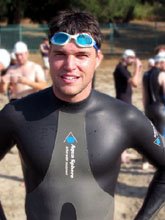
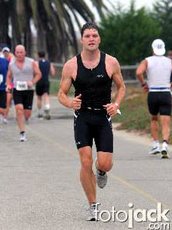
During the months that I was training for my last triathlon (see photo at right), I was doing almost no strength training on a regular basis outside of loading and unloading clients' barbells. So, inspired by Waterbury, I decided to try a Milo-of-Crotona-style experiment: once a day, when I had ten minutes at the gym I'd do the following, brief upper body workout:
One set of dragon-flag leg raises
One set of as many dips as I could
One set of as many underhand-grip pullups as I could
A second set of dragon-flag leg raises.
I did this brief upper-body only workout (my legs were always fried from all the running and biking I was doing) about five days a week for about a month. My goal with each workout was simple: increase the number of reps on pull-ups and dips by a single repetition every day. I wasn't worried about reps on the dragon-flag leg raises; I just tried to get better at doing them. Check out the video -- they're tough.
Strength-training dogmatists would have any number of criticisms for this workout. The typical recommendation is not to train a muscle group more than three times a week, and to train with multiple sets falling in the 8-12 range. By those standards, my training frequency was way too high (5 days a week); my volume way too low (one set per exercise); my reps (over 15) too high to generate any meaningful increases in strength or muscle size.
But I thought of the the guy who invented the malaria vaccine, the man who risked death by injecting himself with his own formula, and forged ahead. It was a daring mission. A fellow trainer I knew, Karen Williams, got wind of what I was trying to do and even started yelling encouragement at me whenever she saw me gearing up for my 10-minute new/old-school muscle blast.
The result? Well, surprisingly good. There were some days when I couldn't get the extra rep and stayed where I'd been the previous day; others where I'd backslide a bit. But all told, I set personal records in both exercises: 26 pull-ups and 28 dips on the day that the insanity ended, when at last I regained my sanity and ceded to the "FREE ANDREW" signs that concerned members had posted all around the gym. As an added bonus, my swimming speed, which is in part, a function of upper-body strength and endurance, improved dramatically.
Now, I remember going to some county fair where they had a Marine Corps recruitment station with a chin-up bar set up, and seeing some soldier crank out something along the lines of 50 chin-ups. And there are guys who can do 100 dips without breaking a sweat. So on an absolute scale, these numbers mean little.
But to me, the importance of these numbers is not that they give me 'bragging rights' to anything special (which is good, because they're not that much to brag about anyway). Science purists--first cousins to the dogmatists--will tell me not to draw conclusions based on my "study": my sample size was too small, my experiment duration too short. Chad Waterbury, himself a scientist, might legitimately protest that I wasn't even following one of his many carefully-crafted programs, so what business do I have invoking him here?
From a science perspective, I'm in total agreement: there hasn't been a study so flawed since those four out of five dentists recommended sugarless gum. Still, before my experiment I would have believed the textbooks: that anyone following such a program would not only lose strength and size, but would very likely injure themselves as well. Instead, the opposite happened: I got stronger and bigger, and, the results had real-world, sports-specific carry-over.
If I had to guess, I'd postulate that the optimal rest between workouts for a given muscle group or movement is based not on a hard number, such as the the oft-cited 48 hours, but varies based on the duration, volume and intensity of the workout, and, lest we forget, on the physiology of the individual athlete. The best workout programs hit the sweet spot between stimulation and recovery, so that a muscle group is re-stimulated just as those muscles have completely recovered from the previous workout.
Conventional wisdom holds that poor workout programs fail because they work the muscles
•too hard, too often, leading to over-training;
•too hard, too infrequently, leading to excessive soreness and possible injury; or
•not hard enough and not often enough, leading to no improvement.
That leaves "not hard enough and too often," which, without realizing it at the time, was exactly what I was road-testing: just one tough-but-doable set per muscle group, performed a whopping five days a week.
Most strength-training programs advance by upping intensity and volume while lowering frequency, leading to the Frankensteinian templates, cited by most bodybuilding magazines, where you do 15 sets for biceps on Monday, 20 sets for shoulders on Tuesday, and so on. My mini-workout program here does the opposite: relative to traditional strength training programs, my volume was lower but my frequency much higher.
Of course, you've got to throw into the mix that I was also doing about 7 hours a week of running, biking, and swimming workouts, plus several hours a day of handing clients weights, loading and unloading barbells, and generally skulking around the gym. So maybe this abbreviated workout was all the additional stress my body could handle, and under different circumstances my results would have been vastly different. The only legitimate conclusion to draw is that, for whatever reason, this unusual combination of volume, intensity and frequency approached the stimulation/recovery 'sweet spot' for this particular athlete at this particular phase in his training life.
Still, this inevitably makes me wonder whether there are other athletes out there who might get equal or greater benefit from a low-intensity, high-frequency program like this one.
Imperfect as my experiment was, to me, the results were further evidence that some of the very basic assumptions about strength and conditioning training may need serious reevaluation. Iconoclasts unite.
In the field of weight training, the same advice has been repeated so often it's almost exhausting to write it: "Do three sets of 8-12 reps to failure of exercises for all your major body parts. After a few months, divide your body into sections, as if you were the Frankenstein monster, and work one section a day so that you're working every muscle group over the course of a week."
I've got a beer in front of me, so I guess that means I'm officially drinking and blogging here, but in the permissive State of California, that's not a crime...so stick with me.
I've mentioned Chad Waterbury before, and I'm mentioning him again because amidst the faithful, he's an iconoclast. He's got a book called MUSCLE REVOLUTION that, for fitness geeks like myself, is a blast of fresh salt-breeze across the bow of a ship stuck in the doldrums.
Among Chad's more out-there concepts is that it's possible to work a muscle group not just once, not twice or even three times a week. In a program he calls "Perfect 10," he argues that you can work a muscle group TEN times a week for a limited period and still experience growth and improvement. He's got a month-long program just out that, if I'm reading it right, postulates that you can work your entire body seven days a week for a month and STILL experience excellent progress.
I'll give you a moment to get off the floor, since I know you've just fallen out of your chair, just like I did when I first read his book. Waterbury has taken some of the most basic assumptions of strength training and conditioning and rather casually turned them on their ear. Personally I say, it's about time.
Of course, there are iconoclasts whose ideas are field tested and scientifically sound, and there are others who make outlandish claims simply to hear themselves bark. So I recently decided to do some very informal field-testing of my own.
During the months that I was training for my last triathlon (see photo at right), I was doing almost no strength training on a regular basis outside of loading and unloading clients' barbells. So, inspired by Waterbury, I decided to try a Milo-of-Crotona-style experiment: once a day, when I had ten minutes at the gym I'd do the following, brief upper body workout:
One set of dragon-flag leg raises
One set of as many dips as I could
One set of as many underhand-grip pullups as I could
A second set of dragon-flag leg raises.
I did this brief upper-body only workout (my legs were always fried from all the running and biking I was doing) about five days a week for about a month. My goal with each workout was simple: increase the number of reps on pull-ups and dips by a single repetition every day. I wasn't worried about reps on the dragon-flag leg raises; I just tried to get better at doing them. Check out the video -- they're tough.
Strength-training dogmatists would have any number of criticisms for this workout. The typical recommendation is not to train a muscle group more than three times a week, and to train with multiple sets falling in the 8-12 range. By those standards, my training frequency was way too high (5 days a week); my volume way too low (one set per exercise); my reps (over 15) too high to generate any meaningful increases in strength or muscle size.
But I thought of the the guy who invented the malaria vaccine, the man who risked death by injecting himself with his own formula, and forged ahead. It was a daring mission. A fellow trainer I knew, Karen Williams, got wind of what I was trying to do and even started yelling encouragement at me whenever she saw me gearing up for my 10-minute new/old-school muscle blast.
The result? Well, surprisingly good. There were some days when I couldn't get the extra rep and stayed where I'd been the previous day; others where I'd backslide a bit. But all told, I set personal records in both exercises: 26 pull-ups and 28 dips on the day that the insanity ended, when at last I regained my sanity and ceded to the "FREE ANDREW" signs that concerned members had posted all around the gym. As an added bonus, my swimming speed, which is in part, a function of upper-body strength and endurance, improved dramatically.
Now, I remember going to some county fair where they had a Marine Corps recruitment station with a chin-up bar set up, and seeing some soldier crank out something along the lines of 50 chin-ups. And there are guys who can do 100 dips without breaking a sweat. So on an absolute scale, these numbers mean little.
But to me, the importance of these numbers is not that they give me 'bragging rights' to anything special (which is good, because they're not that much to brag about anyway). Science purists--first cousins to the dogmatists--will tell me not to draw conclusions based on my "study": my sample size was too small, my experiment duration too short. Chad Waterbury, himself a scientist, might legitimately protest that I wasn't even following one of his many carefully-crafted programs, so what business do I have invoking him here?
From a science perspective, I'm in total agreement: there hasn't been a study so flawed since those four out of five dentists recommended sugarless gum. Still, before my experiment I would have believed the textbooks: that anyone following such a program would not only lose strength and size, but would very likely injure themselves as well. Instead, the opposite happened: I got stronger and bigger, and, the results had real-world, sports-specific carry-over.
If I had to guess, I'd postulate that the optimal rest between workouts for a given muscle group or movement is based not on a hard number, such as the the oft-cited 48 hours, but varies based on the duration, volume and intensity of the workout, and, lest we forget, on the physiology of the individual athlete. The best workout programs hit the sweet spot between stimulation and recovery, so that a muscle group is re-stimulated just as those muscles have completely recovered from the previous workout.
Conventional wisdom holds that poor workout programs fail because they work the muscles
•too hard, too often, leading to over-training;
•too hard, too infrequently, leading to excessive soreness and possible injury; or
•not hard enough and not often enough, leading to no improvement.
That leaves "not hard enough and too often," which, without realizing it at the time, was exactly what I was road-testing: just one tough-but-doable set per muscle group, performed a whopping five days a week.
Most strength-training programs advance by upping intensity and volume while lowering frequency, leading to the Frankensteinian templates, cited by most bodybuilding magazines, where you do 15 sets for biceps on Monday, 20 sets for shoulders on Tuesday, and so on. My mini-workout program here does the opposite: relative to traditional strength training programs, my volume was lower but my frequency much higher.
Of course, you've got to throw into the mix that I was also doing about 7 hours a week of running, biking, and swimming workouts, plus several hours a day of handing clients weights, loading and unloading barbells, and generally skulking around the gym. So maybe this abbreviated workout was all the additional stress my body could handle, and under different circumstances my results would have been vastly different. The only legitimate conclusion to draw is that, for whatever reason, this unusual combination of volume, intensity and frequency approached the stimulation/recovery 'sweet spot' for this particular athlete at this particular phase in his training life.
Still, this inevitably makes me wonder whether there are other athletes out there who might get equal or greater benefit from a low-intensity, high-frequency program like this one.
Imperfect as my experiment was, to me, the results were further evidence that some of the very basic assumptions about strength and conditioning training may need serious reevaluation. Iconoclasts unite.
Tuesday, June 26, 2007
Call the Functional Training Abuse Hotline!
Tell me if you haven't seen this at your local gym: a trainer who has every client perform every set of every exercise standing on some kind of unstable surface, one eye closed, perhaps juggling two balls in one hand and spinning three plates in the other. It doesn't matter whether the client is an overweight, middle-aged woman or a skinny fifteen-year-old boy, the guy looks like he's prepping his client pool to become an acrobatic troupe busking for handouts on the Santa Monica pier.
Ask any of these trainers what they’re doing and they'll tell you, with barely-disguised scorn for your tacky "dumbbells" and antiquated methods, "Oh, this is something called 'Functional Training.'"
The very name is polarizing, isn’t it? Like the terms "Pro-Life" and "Pro-Choice," the name implies that anyone who takes issue with your position must in turn be "pro" something abhorrent. Call your methods "functional" and you suggest that what everyone else is doing has nothing to do with the way the body functions. Which is, of course, absurd -- the body functions in a lot of different ways. "Functional" training emphasizes a handful of them, just as martial arts or racquetball or, for that matter, lying on the beach emphasize a handful of others.
Now, before I continue my hostile, one-sided rant, let me say that not all practitioners of functional training are as out to lunch as the hypothetical bonehead described above. Scroll down a few entries in this very blog and you’ll see my enthusiastic report on the Perform Better seminar, which was run by folks who call themselves functional training practitioners with well-deserved pride. But coaches like Mike Boyle, Gray Cook, and Eric Cressey analyze the physical functioning of their clients with expert scrutiny and base their exercise prescriptions on the specific needs of each athlete; they don’t just throw everyone on a Swiss ball and hope for the best.
Quick quiz: what more closely resembles something you actually do on a daily basis? Raising and lowering your body weight while standing with two feet on the floor -- i.e., squatting -- or lying supine on an inflated rubber ball, alternately pressing two medicine balls while keeping just one foot on the floor? Certainly, the first movement looks a lot more like something we do all the time: getting up out of a chair or a car seat, getting something out of a low cabinet, bending to pick up a child or a bag of groceries, heck, sitting your rump down on the toilet for a few contemplative minutes a day. By all rights the squat should be considered far more "functional" than the seated Swiss ball single-leg alternate medicine ball press, yet it's that second, patently absurd movement that would make the average gym-goer say "Now THAT'S functional training."
As if in order for a movement to have functional value it has to look like something you'd learn at clown college.
Look, I totally get stability balls, though I use them mostly for stretching and ab work. I get single-leg movements, though usually I use these moves in conjunction with conventional squats and deadlifts. My personal training certification forced me to learn so many stability moves that it makes me unstable just thinking about it. If I followed their system to the letter every client would practically have to walk a tightrope blindfolded before they could be trusted with anything so dangerous as a three-pound dumbbell. But why in the Sam Hill is the world of fitness so extreme that whenever an idea or a system either proves popular or has some actual merit or effectiveness -- as functional training admittedly does -- we get dogmatic and say, "Well, everything else must be pointless. Everything we’ve done up to this point is totally and completely wrong. We have to do everything standing on one foot, and once we can do that easily, we have to do it standing on a Bosu ball, then on a Swiss ball, and then on a Swiss ball on a Bosu ball on one foot."
Because for some reason that's functional.
I think what a fair number of otherwise smart people lose sight of while working from the "functional" angle is the fundamental question of WHICH function? In my snarky example above, what function is realistically being trained aside from the ability to perform that particular arcane exercise? For the person performing it, what carry-over will that movement realistically have outside the gym?
The sound idea behind functional training that's somehow gotten lost amongst Swiss balls and balance boards is that we should train movements that are as close as possible to movements that we encounter in everyday life. So adding a twist to an overhead press isn’t a bad idea, because I could picture, without too much effort, having to put an item on a high closet shelf and having to add a twist to get it in there just right. But I have to tie my mind in knots to figure out a life situation analogous to performing barbell curls while standing on a Bosu ball: bilateral butter-churning in an earthquake? Milking two inverted cows while standing on the fence between their pastures?
I sense some functional devotees poisoning their pens already, and I can hear it coming: instability challenges the nervous system, there's more proprioception (sensory feedback) to deal with, it's more challenging and more fun.
Well, regular old hardcore weight training challenges the nervous system as well. Smartypants strength coach Chad Waterbury is doing his best to educate the less gifted among us about that. More fun? Perhaps, for some people, but I'd postulate that the little bit of amusement that some people might get from imitating Cirque du Soleil performers comes at the expense of a lot of fat loss and muscle gain. Some resistance moves with an instability element added are indeed challenging, but the challenge is PRIMARILY going to be neural, not muscular. That is, the hardest part of doing the exercise will be keeping your balance, not lifting the weight, which means you're training yourself to be a better balancer, not a stronger person -- and not a significantly leaner person, either.
Now I'm all for balance work -- and for the fine-motor work that is another integral part of functional training as it's now defined -- but only if, and this is a big if, a person really needs them. My mother came down with a nasty case of the shingles a couple of years ago and had some trouble balancing for a while after that. A neurologist recommended she do some simple balance exercises -- which were essentially variations on some textbook functional training moves -- and they seem to have helped to clear things up. So functional training was valuable for her. Many older, deconditioned exercisers, people recovering from injuries, and those with severe muscular imbalances would be good candidates for this kind of work as well. But once good, healthy, pain-free, symmetrical movement patterns are established, and you no longer walk like Keith Richards coming home from Trader Vic's , it's time to put the Swiss balls away and get to work.
Andrew
PS: For anyone interested in receiving my monthly TIPS via email, shoot me a message here with "Add (your first and last name) to mailing list" in the subject line or go here and fill out the form at the bottom of the page. This is a free, convenient way of keeping up to date with me! Just be sure to continue checking back here every few days for regular blog updates, which I do NOT send out to subscribers -- they just sit here on this site, waiting patiently for you to sign on and read them. (Don't worry: I won't give your information out to anyone else!) Thanks for reading-- A
Ask any of these trainers what they’re doing and they'll tell you, with barely-disguised scorn for your tacky "dumbbells" and antiquated methods, "Oh, this is something called 'Functional Training.'"
The very name is polarizing, isn’t it? Like the terms "Pro-Life" and "Pro-Choice," the name implies that anyone who takes issue with your position must in turn be "pro" something abhorrent. Call your methods "functional" and you suggest that what everyone else is doing has nothing to do with the way the body functions. Which is, of course, absurd -- the body functions in a lot of different ways. "Functional" training emphasizes a handful of them, just as martial arts or racquetball or, for that matter, lying on the beach emphasize a handful of others.
Now, before I continue my hostile, one-sided rant, let me say that not all practitioners of functional training are as out to lunch as the hypothetical bonehead described above. Scroll down a few entries in this very blog and you’ll see my enthusiastic report on the Perform Better seminar, which was run by folks who call themselves functional training practitioners with well-deserved pride. But coaches like Mike Boyle, Gray Cook, and Eric Cressey analyze the physical functioning of their clients with expert scrutiny and base their exercise prescriptions on the specific needs of each athlete; they don’t just throw everyone on a Swiss ball and hope for the best.
Quick quiz: what more closely resembles something you actually do on a daily basis? Raising and lowering your body weight while standing with two feet on the floor -- i.e., squatting -- or lying supine on an inflated rubber ball, alternately pressing two medicine balls while keeping just one foot on the floor? Certainly, the first movement looks a lot more like something we do all the time: getting up out of a chair or a car seat, getting something out of a low cabinet, bending to pick up a child or a bag of groceries, heck, sitting your rump down on the toilet for a few contemplative minutes a day. By all rights the squat should be considered far more "functional" than the seated Swiss ball single-leg alternate medicine ball press, yet it's that second, patently absurd movement that would make the average gym-goer say "Now THAT'S functional training."
As if in order for a movement to have functional value it has to look like something you'd learn at clown college.
Look, I totally get stability balls, though I use them mostly for stretching and ab work. I get single-leg movements, though usually I use these moves in conjunction with conventional squats and deadlifts. My personal training certification forced me to learn so many stability moves that it makes me unstable just thinking about it. If I followed their system to the letter every client would practically have to walk a tightrope blindfolded before they could be trusted with anything so dangerous as a three-pound dumbbell. But why in the Sam Hill is the world of fitness so extreme that whenever an idea or a system either proves popular or has some actual merit or effectiveness -- as functional training admittedly does -- we get dogmatic and say, "Well, everything else must be pointless. Everything we’ve done up to this point is totally and completely wrong. We have to do everything standing on one foot, and once we can do that easily, we have to do it standing on a Bosu ball, then on a Swiss ball, and then on a Swiss ball on a Bosu ball on one foot."
Because for some reason that's functional.
I think what a fair number of otherwise smart people lose sight of while working from the "functional" angle is the fundamental question of WHICH function? In my snarky example above, what function is realistically being trained aside from the ability to perform that particular arcane exercise? For the person performing it, what carry-over will that movement realistically have outside the gym?
The sound idea behind functional training that's somehow gotten lost amongst Swiss balls and balance boards is that we should train movements that are as close as possible to movements that we encounter in everyday life. So adding a twist to an overhead press isn’t a bad idea, because I could picture, without too much effort, having to put an item on a high closet shelf and having to add a twist to get it in there just right. But I have to tie my mind in knots to figure out a life situation analogous to performing barbell curls while standing on a Bosu ball: bilateral butter-churning in an earthquake? Milking two inverted cows while standing on the fence between their pastures?
I sense some functional devotees poisoning their pens already, and I can hear it coming: instability challenges the nervous system, there's more proprioception (sensory feedback) to deal with, it's more challenging and more fun.
Well, regular old hardcore weight training challenges the nervous system as well. Smartypants strength coach Chad Waterbury is doing his best to educate the less gifted among us about that. More fun? Perhaps, for some people, but I'd postulate that the little bit of amusement that some people might get from imitating Cirque du Soleil performers comes at the expense of a lot of fat loss and muscle gain. Some resistance moves with an instability element added are indeed challenging, but the challenge is PRIMARILY going to be neural, not muscular. That is, the hardest part of doing the exercise will be keeping your balance, not lifting the weight, which means you're training yourself to be a better balancer, not a stronger person -- and not a significantly leaner person, either.
Now I'm all for balance work -- and for the fine-motor work that is another integral part of functional training as it's now defined -- but only if, and this is a big if, a person really needs them. My mother came down with a nasty case of the shingles a couple of years ago and had some trouble balancing for a while after that. A neurologist recommended she do some simple balance exercises -- which were essentially variations on some textbook functional training moves -- and they seem to have helped to clear things up. So functional training was valuable for her. Many older, deconditioned exercisers, people recovering from injuries, and those with severe muscular imbalances would be good candidates for this kind of work as well. But once good, healthy, pain-free, symmetrical movement patterns are established, and you no longer walk like Keith Richards coming home from Trader Vic's , it's time to put the Swiss balls away and get to work.
Andrew
PS: For anyone interested in receiving my monthly TIPS via email, shoot me a message here with "Add (your first and last name) to mailing list" in the subject line or go here and fill out the form at the bottom of the page. This is a free, convenient way of keeping up to date with me! Just be sure to continue checking back here every few days for regular blog updates, which I do NOT send out to subscribers -- they just sit here on this site, waiting patiently for you to sign on and read them. (Don't worry: I won't give your information out to anyone else!) Thanks for reading-- A
Subscribe to:
Posts (Atom)