There's a lot of dogma around the subject of strength and conditioning, most likely because of all the gurus and hangers-on that swarm around the fitness field. Even the average non-gym goer can rattle off a list of the top fitness crazes that have periodically swept the nation like angry locusts over the last decades: aerobics, core training, Tae Bo, Pilates, spinning, yoga, Step... a new religion crops up every few years, led by the requisite charismatic carnival-barker, reinventing the wheel with a vengeance.
In the field of weight training, the same advice has been repeated so often it's almost exhausting to write it: "Do three sets of 8-12 reps to failure of exercises for all your major body parts. After a few months, divide your body into sections, as if you were the Frankenstein monster, and work one section a day so that you're working every muscle group over the course of a week."
I've got a beer in front of me, so I guess that means I'm officially drinking and blogging here, but in the permissive State of California, that's not a crime...so stick with me.
I've mentioned Chad Waterbury before, and I'm mentioning him again because amidst the faithful, he's an iconoclast. He's got a book called MUSCLE REVOLUTION that, for fitness geeks like myself, is a blast of fresh salt-breeze across the bow of a ship stuck in the doldrums.
Among Chad's more out-there concepts is that it's possible to work a muscle group not just once, not twice or even three times a week. In a program he calls "Perfect 10," he argues that you can work a muscle group TEN times a week for a limited period and still experience growth and improvement. He's got a month-long program just out that, if I'm reading it right, postulates that you can work your entire body seven days a week for a month and STILL experience excellent progress.
I'll give you a moment to get off the floor, since I know you've just fallen out of your chair, just like I did when I first read his book. Waterbury has taken some of the most basic assumptions of strength training and conditioning and rather casually turned them on their ear. Personally I say, it's about time.
Of course, there are iconoclasts whose ideas are field tested and scientifically sound, and there are others who make outlandish claims simply to hear themselves bark. So I recently decided to do some very informal field-testing of my own.
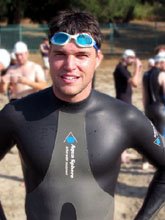
During the months that I was training for my last triathlon (see photo at right), I was doing almost no strength training on a regular basis outside of loading and unloading clients' barbells. So, inspired by Waterbury, I decided to try a Milo-of-Crotona-style experiment: once a day, when I had ten minutes at the gym I'd do the following, brief upper body workout:
One set of dragon-flag leg raises
One set of as many dips as I could
One set of as many underhand-grip pullups as I could
A second set of dragon-flag leg raises.
I did this brief upper-body only workout (my legs were always fried from all the running and biking I was doing) about five days a week for about a month. My goal with each workout was simple: increase the number of reps on pull-ups and dips by a single repetition every day. I wasn't worried about reps on the dragon-flag leg raises; I just tried to get better at doing them. Check out the video -- they're tough.
Strength-training dogmatists would have any number of criticisms for this workout. The typical recommendation is not to train a muscle group more than three times a week, and to train with multiple sets falling in the 8-12 range. By those standards, my training frequency was way too high (5 days a week); my volume way too low (one set per exercise); my reps (over 15) too high to generate any meaningful increases in strength or muscle size.
But I thought of the the guy who invented the malaria vaccine, the man who risked death by injecting himself with his own formula, and forged ahead. It was a daring mission. A fellow trainer I knew, Karen Williams, got wind of what I was trying to do and even started yelling encouragement at me whenever she saw me gearing up for my 10-minute new/old-school muscle blast.
The result? Well, surprisingly good. There were some days when I couldn't get the extra rep and stayed where I'd been the previous day; others where I'd backslide a bit. But all told, I set personal records in both exercises: 26 pull-ups and 28 dips on the day that the insanity ended, when at last I regained my sanity and ceded to the "FREE ANDREW" signs that concerned members had posted all around the gym. As an added bonus, my swimming speed, which is in part, a function of upper-body strength and endurance, improved dramatically.
Now, I remember going to some county fair where they had a Marine Corps recruitment station with a chin-up bar set up, and seeing some soldier crank out something along the lines of 50 chin-ups. And there are guys who can do 100 dips without breaking a sweat. So on an absolute scale, these numbers mean little.
But to me, the importance of these numbers is not that they give me 'bragging rights' to anything special (which is good, because they're not that much to brag about anyway). Science purists--first cousins to the dogmatists--will tell me not to draw conclusions based on my "study": my sample size was too small, my experiment duration too short. Chad Waterbury, himself a scientist, might legitimately protest that I wasn't even following one of his many carefully-crafted programs, so what business do I have invoking him here?
From a science perspective, I'm in total agreement: there hasn't been a study so flawed since those four out of five dentists recommended sugarless gum. Still, before my experiment I would have believed the textbooks: that anyone following such a program would not only lose strength and size, but would very likely injure themselves as well. Instead, the opposite happened: I got stronger and bigger, and, the results had real-world, sports-specific carry-over.
If I had to guess, I'd postulate that the optimal rest between workouts for a given muscle group or movement is based not on a hard number, such as the the oft-cited 48 hours, but varies based on the duration, volume and intensity of the workout, and, lest we forget, on the physiology of the individual athlete. The best workout programs hit the sweet spot between stimulation and recovery, so that a muscle group is re-stimulated just as those muscles have completely recovered from the previous workout.
Conventional wisdom holds that poor workout programs fail because they work the muscles
•too hard, too often, leading to over-training;
•too hard, too infrequently, leading to excessive soreness and possible injury; or
•not hard enough and not often enough, leading to no improvement.
That leaves "not hard enough and too often," which, without realizing it at the time, was exactly what I was road-testing: just one tough-but-doable set per muscle group, performed a whopping five days a week.
Most strength-training programs advance by upping intensity and volume while lowering frequency, leading to the Frankensteinian templates, cited by most bodybuilding magazines, where you do 15 sets for biceps on Monday, 20 sets for shoulders on Tuesday, and so on. My mini-workout program here does the opposite: relative to traditional strength training programs, my volume was lower but my frequency much higher.
Of course, you've got to throw into the mix that I was also doing about 7 hours a week of running, biking, and swimming workouts, plus several hours a day of handing clients weights, loading and unloading barbells, and generally skulking around the gym. So maybe this abbreviated workout was all the additional stress my body could handle, and under different circumstances my results would have been vastly different. The only legitimate conclusion to draw is that, for whatever reason, this unusual combination of volume, intensity and frequency approached the stimulation/recovery 'sweet spot' for this particular athlete at this particular phase in his training life.
Still, this inevitably makes me wonder whether there are other athletes out there who might get equal or greater benefit from a low-intensity, high-frequency program like this one.
Imperfect as my experiment was, to me, the results were further evidence that some of the very basic assumptions about strength and conditioning training may need serious reevaluation. Iconoclasts unite.
Showing posts with label gurus. Show all posts
Showing posts with label gurus. Show all posts
Monday, July 02, 2007


Monday, December 11, 2006
DF Tip #23: Look Out for Gurus!
 This morning I was reading a well-traveled blog by an exercise guru (I'll call him David), who claims that when it comes to fitness, we've got it all -- or most of it, anyway -- wrong. There are very few topics he isn't willing to take on: fitness, genetics, dental care, the movie industry, economics, the Loch Ness Monster... Okay, not that last one. But it's clear that David fancies himself something of a Renaissance man.
Much of his writing on fitness is about what NOT to do: he hates steady-state cardio activity, he doesn't like high reps or high volume weight training, he doesn't believe in veganism or vegetarianism, doesn't believe in sports drinks or post-workout glycogen replacement in general, doesn't like weight machines. He's totally down on carbs and sugar. He thinks that many weight-room warhorses -- full-range bench presses and wide-grip lat pull-downs, as well as most abdominal exercises -- are dangerous.
 In place of these chestnuts, he advocates what I'll call Cro-Magnon Fitness (he calls it something else) -- a training system based on his conception of the activity patterns of our hunter-gatherer ancestors: heavy, fast-paced training, one-arm/one-leg movements, low reps, heavy weights, and explosive movements. He favors jumping, leaping, and throwing medicine balls, movements that he contends mimic ancient, high-intensity activities like escaping predators and taking down prey. He likes eating meat and thinks grains are the scourge of the gastrointestinal world.
David isn't short on self-esteem. He spends one entry going into detail about the reaction a female salesclerk had upon seeing him in an Armani suit she was trying to sell him (SPOILER: her reaction was positive); another on the effect that his bounteous testosterone stores have on women, and, more distressingly, on dogs.
We get it: David is a hunk of virility, and if we'd only adhere to his principles of training, if only the misguided fitness industry would listen to him, then this country, nay, the world, could be populated by men and women whose mere essence drives the opposite sex, and much of the animal kingdom, into fits of uncontrollable lust.
Let me backpedal a bit before David’s disciples, hip to the fact that I’m talking about their messiah, come to my house and expose me for the fitness-drink-swilling, carb-eating, long-distance running fitness hack that I apparently am. David does make some good points. He likes a lot of the same stuff I like in the gym. He rightly cautions against extremism and fanaticism in endurance sport. And at 6'1," 195 pounds, 8% body fat, and almost 70 years old (!), he's clearly found a system that works for him. The problem is that he takes the indisputable fact of his own success and assumes that his methods will work for... pretty much everyone. That's where he and I part ways.
 Anyone with even a rudimentary understanding of fitness can look at the guy and see that he isn't well suited to long-distance anything. He's a mesomorph, a thick-boned, fast-twitch muscle guy, good at short duration exercise and explosive movement (he once played pro baseball), and not much on endurance. So in a way it makes sense that he would benefit from a system of weight training that is particularly suited to that type of physique -- to wit, very high intensity, heavy weights, low volume -- and abhor the kinds of activities that don't agree with this body type -- namely, endurance sport.
But that's no reason to dismiss endurance sport activities -- and the reams of scientific data that support their benefits -- altogether. Nor does it mean there aren't scores of people out there who benefit from long-distance running, or cycling, or swimming. There are: I've known a few thousand of them personally. But David doesn't talk about them; instead, he takes a head-shaking, I-told-you-so pleasure in posting anecdotes about the rare occasion when an apparently-healthy endurance athlete dies from a heart attack while training.
David's advice on weight training is equally short-sighted. In his blog, and in interviews (which are also accessible via his website), he carefully explains how you only need to lift weights twice a week, performing one hard set per body part per week, using a carefully-worked out system of ascending weight and descending repetitions. He claims that using this system three times a week for forty minutes a session is all that is needed for optimal fitness.
I'm sure many of my clients would love to be in and out of the gym in thirty-five minutes, just twice a week. I'm sure many of them would prefer not to do the three or four grueling sets of squats or deadlifts or chinups that leave many of them sore for days afterwards. And I'd be happy to prescribe such a workout regimen if I believed for a minute that it would be effective.
If only. In practice, the truth is that almost everyone needs more stimulation than David recommends. In my experience, this manner of weight training leads to a particularly precarious combination of under- and over-training: the muscles aren't trained with enough volume or frequency to stimulate growth, but during workouts themselves, the tissues are subjected to such extreme stress that the trained muscles wind up either injured, or at the very least, more vulnerable to injury outside the gym, so a trainee will wind up wrenching their back tying their shoes or doing some equally innocuous physical activity.
Moreover, David's revolutionary ideas have already been advanced, touted, and largely relegated to footnote status in most fitness circles, for many of the same reasons I go into above, starting as long as three decades ago. Arthur Jones, the entrepreneur behind the Nautilus craze, and the late bodybuilding champion Mike Mentzer both advocated similar training systems back in the 80’s. Today, there's a good-natured kook on the Internet who calls this training system -- I kid you not -- the "Doggcrapp" method.
It's not that what they say is worthless. Like any other training technique, heavy, high intensity training has its place. But just because this training system has proved useful for a handful of high-profile athletes does NOT mean that all other training systems -- which have been tried and tested and proven effective by athletes and workaday exercisers everywhere -- are useless and should be thrown out.
 If I've learned nothing else in my years as a trainer and athlete, it's that you can't use a cookie cutter to create fitness programs. As ever, it's different strokes for different folks. Sure, David gestures vaguely at the notion of variety in training, but only within the strict parameters of his very limiting recommendations. Maybe some of what's worked for him will work for you, too. But what's misleading about his points, and what I caution all twelve of my readers against, is the one-sidedness of it. He sternly steers us away from one type of fanaticism while slyly advocating another: no machines! No endurance activity! No grains! In pointing out the dangers of overdoing aerobic activity, he effectively makes the point that not all exercise modalities are for everyone -- but then immediately contradicts his own well-taken point by trying to sell us on his own ONE TRUE WAY to fitness. As I've said many times before, there are simply too many bodies out there, and too many useful, effective, and, frankly, really fun ways of exercising, for one system to work optimally for everyone, forever.
 Another word of caution while I'm on it. The systems that fitness gurus advance are, inevitably, a repackaged form of something others have been doing for a long time. Functional training is a souped-up version of the calisthenics we all did in gym class. Balance training is something that circus performers did centuries ago. Spinning classes? Boxing? Tae Bo? Kettleballs, for the love of Pete? There's value in all these things, but let's not pretend that no one ever thought of them before. These guys might have gone sailing in the Atlantic, and maybe they'll come back with a story or two, but that doesn't make them Columbus.
 The lesson here is that there's very little that's new under the sun: you've just got to keep searching till you find the thing that's right for YOUR body and YOUR goals, right now. That's why one of my main principles -- in as far as I can say I have any principles -- is to keep exploring, keep challenging yourself, keep expanding your physical repertoire. Sure, go ahead and take up David's principles for awhile. See how they work for you. Then ignore it all and join a crew club for a year. Then do spinning classes. Cycle Alaska. Then take up competitive power lifting.
The body is too complex and fascinating an organism, too inherently curious and adaptable to stay satisfied with one exercise modality for long. Explore long enough and eventually, you'll become something akin to a guru of your own physiology. Maybe you'll stumble on a series of long-forgotten exercises that you become convinced is by far the best and most effective system in existence, and why has no one thought of it before?
At that point, you might feel inclined to start your own blog about how you've discovered the ONE TRUE WAY to get fit and tell everyone about it. All I'll say is if you do, keep your dukes up.
Have a great week,
Andrew
Subscribe to:
Posts (Atom)