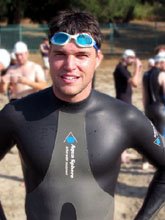
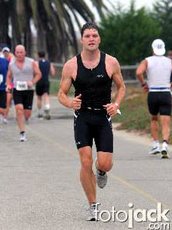
So what if it’s been a million years since you’ve heard from me, you folks are going to fall at my feet when I hit you with THIS: I just got myself a new certification! From now on, when you see me in the ‘food supplement’ aisle at the Piggly Wiggly, mulling over protein/carb rations from behind my cat-eye glasses, you’re going to tell your shopping partner, in awestruck tones, “Look! There’s Andrew Heffernan, Certified Strength and Conditioning Specialist!” (You might also say “C.S.C.S.” if you’re into the brevity thing.)
The bottom line is that as of about 1:25 this afternoon, I’m six to eight times smarter than I was when I woke up this morning.
With that in mind, to better serve you, the following policy changes will be instituted here at dynamicfitness.us (whose name will be changed to “OneManFitnessThinkTank.com):
1) When asked questions about fitness, I will cite EVERYTHING, usually referencing Thomas R. Baechle or Roger W. Earle, co-authors of ESSENTIALS OF STRENGTH TRAINING AND CONDITIONING, usually by saying something like “Uncle Tommy says…” and “Rodger-Dodger postulates…” .
2) My training rates will now go up to 120.00 hourly IF purchased in packages of 20 or more. If you have to ask the price of a single session, honey, you can’t afford it.
3) I’ll now have my own monthly column in MEN’S FITNESS, called “Build Babe-Magnet Muscles,” and one in MEN’S HEALTH called “Make Monogamy Fun with Exercise!”
4) This blog will now be subscription-based only. So anyone reading will have to PAY from now on, per entry. Given my new status, I can’t imagine that will affect readership AT ALL. Right, guys? *
5) …Guys? Anyone still there??
In truth, I’m very happy to have passed this test. It’s the gold standard of fitness certifications—grab any newsstand fitness rag and you’ll see “C.S.C.S.” after just about every author’s name—and after having studied for and taken the test, it’s easy to see why: they put you through your paces in a way that many other certifying bodies do not. The test is a four-hour ordeal, covering some pretty darn in-depth information on anatomy, physiology, cardiovascular function, nutrition, biomechanics, testing procedures, etc, much of which was new to me when I was studying it.
But now that I’ve got it, you can be sure I’m going to flaunt the bejesus out of it.
I will take your questions now.
Andrew Heffernan, C.S.C.S.
* reminder: this is a joke.
Thursday, April 03, 2008


Tuesday, March 11, 2008
The Key to Progress
The last four weeks or so I've put myself on a variation of a program called the "Strength-Focused Mesocycle" from Chad Waterbury's book MUSCLE REVOLUTION, which I've just about worn myself out recommending to anyone interested in strength training.
The SFM, as Waterbury affectionately calls his program, is pretty simple in design (that's one thing I love about Waterbury): three workouts a week, FOUR exercises per workout, THREE sets per exercise, and THREE to EIGHT reps per set. For you 'math people,' that's a whopping 36-96 reps per WORKOUT.
Most gym rats will crank out that many reps for a teensy little muscle group like the forearm flexors. How could anyone progress with so little stimulation, much less a chalky, seasoned gym denizen like myself?
The VERY FIRST weight training program I ever did regularly was the Soloflex workout. Soloflex, for you spring chickens out there, was a sort of precursor to the Bowflex: a compact, high-end home workout machine. Long before I was able to save up enough wadded-up-dollar-and-a-quarters from my after-school job delivering the Valley News to afford the actual machine, I managed to figure out the Soloflex exercise program by watching their promo video. With my DP weight set and a chin-up bar, I simply did the free-weight versions of the exercises they recommended. When my Soloflex finally arrived, I switched over to the machine versions of the free-weight moves I was doing (and, irony of ironies, promptly stopped making progress--but that's the subject for another post).
Anyway, their program, which I started doing at age 16, was a three-day-a-week program consisting of six exercises, done for three sets of twelve reps each. I could almost recite for you the exercise order and rest between sets. As such, it had about 33% more volume than the program I'm now on.
And yet I've managed to build a pretty significant amount of strength on the program, while at the same time experiencing less pain in my joints and back than I had on higher-volume programs. Moreover, I'm now able to spend more time doing warm-up and cool-down moves and high-intensity cardio sessions without neglecting the rest of my life too much.
The key, it seems, is intensity. I was perusing Alwyn Cosgrove's blog this morning, and darned if that little Scotsman didn't drop this brilliant little pearl of wisdom without even thinking about it:
" I think volume is the least important exercise variable. Intensity is number one and frequency is probably number two."
I'm going write that again: INTENSITY IS THE NUMBER ONE MOST IMPORTANT EXERCISE VARIABLE.
In the world of exercise science, you can find about a half-dozen definitions of 'intensity,' but I think that Cosgrove means the word not as "percentage of one-rep maximum," which is how you'll see it defined by exercise-physio-geeks, but in the layman's sense of the 'focus and intention' behind one's efforts. It's ultimately a highly subjective criterion: only you can say if you really worked at your edge.
Now: most fitness bigwigs out there would agree that there is a point of diminishing returns to the pursuit of intensity at all costs (I definitely stop short of recommending extensive use of forced reps and negative repetitions, for example). A quick look around the average gym makes it clear that too much intensity is decidedly NOT the problem with most peoples' workouts, however. The problem is too much emphasis on volume and not enough on intensity.
My progress on the low-volume, high-intensity SFM has brought this point home to me yet again. Bring your volume down, and your intensity will go up. Quality, not quantity.
I read not too long ago that truly elite skaters spend almost 70% of their practice time on unfamiliar activities, whereas lesser athletes spent about half their time on them. Most of the elites' practice time is spend struggling to master new skills rather than belaboring old ones.
Put another way, the really great ones' practice time is spent FAILING and the mortals' practice time is spent SHOWING OFF. Lesser skaters spend more time in the comfort of the known, while the greats do battle with the darkness and frustration of the unfamiliar.
Ironically, the mortals probably look better, more graceful and competent in practice, whereas the greats look awkward and tentative as they test their legs on new moves they haven't quite gotten the hang of yet. Watching them, you might even mistake one group for the other. In competition, however, the bling around the necks of the fearless ones tells the true story.
In the gym the other day, I tried to figure out what percentage of my workout was spent doing things I'd done before, where success was pretty much guaranteed, as opposed to things that made me nervously look around for a spotter if I got myself into trouble. Suffice it to say that, by the standards of the skaters in the study, I'm the mortalest of mortals.
But it's something to shoot for.
The SFM, as Waterbury affectionately calls his program, is pretty simple in design (that's one thing I love about Waterbury): three workouts a week, FOUR exercises per workout, THREE sets per exercise, and THREE to EIGHT reps per set. For you 'math people,' that's a whopping 36-96 reps per WORKOUT.
Most gym rats will crank out that many reps for a teensy little muscle group like the forearm flexors. How could anyone progress with so little stimulation, much less a chalky, seasoned gym denizen like myself?
The VERY FIRST weight training program I ever did regularly was the Soloflex workout. Soloflex, for you spring chickens out there, was a sort of precursor to the Bowflex: a compact, high-end home workout machine. Long before I was able to save up enough wadded-up-dollar-and-a-quarters from my after-school job delivering the Valley News to afford the actual machine, I managed to figure out the Soloflex exercise program by watching their promo video. With my DP weight set and a chin-up bar, I simply did the free-weight versions of the exercises they recommended. When my Soloflex finally arrived, I switched over to the machine versions of the free-weight moves I was doing (and, irony of ironies, promptly stopped making progress--but that's the subject for another post).
Anyway, their program, which I started doing at age 16, was a three-day-a-week program consisting of six exercises, done for three sets of twelve reps each. I could almost recite for you the exercise order and rest between sets. As such, it had about 33% more volume than the program I'm now on.
And yet I've managed to build a pretty significant amount of strength on the program, while at the same time experiencing less pain in my joints and back than I had on higher-volume programs. Moreover, I'm now able to spend more time doing warm-up and cool-down moves and high-intensity cardio sessions without neglecting the rest of my life too much.
The key, it seems, is intensity. I was perusing Alwyn Cosgrove's blog this morning, and darned if that little Scotsman didn't drop this brilliant little pearl of wisdom without even thinking about it:
" I think volume is the least important exercise variable. Intensity is number one and frequency is probably number two."
I'm going write that again: INTENSITY IS THE NUMBER ONE MOST IMPORTANT EXERCISE VARIABLE.
In the world of exercise science, you can find about a half-dozen definitions of 'intensity,' but I think that Cosgrove means the word not as "percentage of one-rep maximum," which is how you'll see it defined by exercise-physio-geeks, but in the layman's sense of the 'focus and intention' behind one's efforts. It's ultimately a highly subjective criterion: only you can say if you really worked at your edge.
Now: most fitness bigwigs out there would agree that there is a point of diminishing returns to the pursuit of intensity at all costs (I definitely stop short of recommending extensive use of forced reps and negative repetitions, for example). A quick look around the average gym makes it clear that too much intensity is decidedly NOT the problem with most peoples' workouts, however. The problem is too much emphasis on volume and not enough on intensity.
My progress on the low-volume, high-intensity SFM has brought this point home to me yet again. Bring your volume down, and your intensity will go up. Quality, not quantity.
I read not too long ago that truly elite skaters spend almost 70% of their practice time on unfamiliar activities, whereas lesser athletes spent about half their time on them. Most of the elites' practice time is spend struggling to master new skills rather than belaboring old ones.
Put another way, the really great ones' practice time is spent FAILING and the mortals' practice time is spent SHOWING OFF. Lesser skaters spend more time in the comfort of the known, while the greats do battle with the darkness and frustration of the unfamiliar.
Ironically, the mortals probably look better, more graceful and competent in practice, whereas the greats look awkward and tentative as they test their legs on new moves they haven't quite gotten the hang of yet. Watching them, you might even mistake one group for the other. In competition, however, the bling around the necks of the fearless ones tells the true story.
In the gym the other day, I tried to figure out what percentage of my workout was spent doing things I'd done before, where success was pretty much guaranteed, as opposed to things that made me nervously look around for a spotter if I got myself into trouble. Suffice it to say that, by the standards of the skaters in the study, I'm the mortalest of mortals.
But it's something to shoot for.
Wednesday, February 27, 2008
Calves of the Gods
Dear Fitness Scavenger: I am trying to make my calves "bigger". I was hoping you would have a few ideas. --"Mary," Hollywood, California
Hi Mary in Hollywood: I get this kind of question all the time: how do I build this and shrink that, how do I get bigger here and smaller there? In addition to her famous red and blue pills, didn't Alice have different multi-colored ointments that you could smear on various parts of the body to make them big or small?
The answer is yes, you can accomplish that goal--fairly directly and easily. But are you going to get an easy answer out of me? Am I going to stretch my answer to this simple, direct question into a huge essay on some arcane aspect of fitness?
You bet your underdeveloped gastrocnemei I am.
I'm going to give you two major solutions to your calf-building quandry. One is the textbook bodybuilding solution, an approach I fully understand but don't fully subscribe to, the other is a more holistic approach. I won't judge you whichever angle you choose, Mary. No, seriously, I won't.
SOLUTION ONE: Quick fix. If your goal is JUST to make your calves a little bigger--and you're not worried about running speed, vertical jump height, etc (and, really, why would you be??), all you gotta do is work that muscle hard in relative isolation. To do that, just flex and extend your ankle joint under resistance. The three exercises I'd recommend, in order of effectiveness, are:
Standing Calf Raises (performed with weight on shoulders, standing, naturally)
Seated Calf Raises (performed seated with weight on knees)
Donkey Calf Raises (performed flexed at the waist, weight at hips).
You should be able to find machines for at least the first two at your standard gym. Exercise number three might be tougher to find but many gyms have them (look for something that looks vaguely like the love-child of a Barcolounger and a torture device).
The final point to make about that movement, which may be either a deterrent or an incentive to do the exercise depending on your disposition, is, well, that it's called the Donkey Calf Raise. I don't know, but for me, that makes the movement more attractive. In our woefully literal world where most exercises have names like the "Incline Close-Grip Bench Press" and the "Seated Leg Extension," I like a little barnyard animal thrown into the exercise-name mix now and again, to go along with movements like the courtly "Good Morning," the repentant "Preacher Curl," and the formidible "Arnold Press."
When performing Donkeys, however, do NOT scream "EEEE-AHWWWW!!" at the top of your lungs with each rep. I've found that gym managers don't like that much. In a few months I'll be allowed back at the Bally's on El Centro to see if I can resist the temptation THIS TIME or risk permanent expulsion. Watch this space.
I digress. As for loading, reps, sets, etc, the most important thing on calves is to GO HEAVY. Your calves schlep you around all day long. Every time you take a step, you're lifting your entire body weight with ONE CALF. Take a trip from the couch to the fridge and back and each calf muscle has lifted about a thousand pounds and you didn't even notice. No other muscle in the body is subjected to so much stress so often (with the possible exception of your heart muscle, which never gets a break, the poor thing), so the stress required to make them grow has got to be pretty extraordinary. Lifting double or triple bodyweight for reps in the standing calf raise is not that unusual with a couple of months of training, so I'd make that your short-term goal.
WORK UP SLOWLY (over the course of three weeks or so) to doing 5-8 sets of 8-10 reps of EITHER standing or seated calf raises 3-4x/week. Just throw them in at the END of your regular workout (you don't want to work your calves before you work your thighs; you'll be too shaky).
You can rest just 20-30 seconds between sets--your calves recover quickly. Pound out about 10 reps per set, stretching and extending as fully as possible on each rep. If you can do much more than 10, up your weight. You'll probably surprise yourself very quickly as to how much you can lift. The whole workout should take less than 10 minutes.
Make sure you stretch your calves thoroughly at the end of your session, and if you think of it, throughout your day. If you don't, he Achilles tendon can get short, which can lead to postural issues down the line if you're not careful. I'm still paying for a year or two of intense calf work back in my teen years when I decided that my lower legs were just too damn skinny and needed punishment five days a week but no stretching. Bad move. Keep your ankles mobile and your calves supple with some hardcore stretching after your workout and on top of that, just as often as you can manage.
So that's solution one: the bodybuilding approach.
SOLUTION TWO: The holistic approach. You can also simply amp up your other activities, making sure they include a fair amount of stress on the calves: long-distance running, sprints, hill runs, stair climbing, steep hikes, and, to a lesser extent, cycling, can all challenge your calves and have the additional benefit of improving c/v health, getting you outside, working your body as a whole, etc. etc. My calves were never so buff as when I was doing triathlons. So that's another way of going about it.
The other advantage is you're not overemphasizing calf work to the exclusion of other body parts. As an "integrationalist" (is that a word?) I prefer this approach but it's longer term and involves more extraneous work. Your results might not be as dramatic or as fast as going the bodybuilding route, but philosophically I prefer this angle.
So I'm offering either a quick, fast solution with pretty much guaranteed results or a long-term, difficult solution with no certain outcome. Whichever way you want to play it, Mary. But once you stray down the path of the Dark Side...
I guess what I'd recommend--reluctantly--is doing approach ONE for a month or so, then seeing how you've progressed and evaluating if you feel you've made enough progress. If so, you could back off and stick to the holistic method for a while. If not, still take a week off from pounding your calves and then hit it for another four weeks at a stretch until you feel you're where you want to be.
Just be sure not to overdo it, and again, build up slowly. Speaking from experience, the calves can get VERY sore and make normal, everyday walking a really fascinating challenge. They can also STAY sore for up to a week, cause a whole herd of Charley Horses to take up residence in your lower legs, and crippling pain whenever you stand up after prolonged sitting. You are forewarned.
So work up slowly.
Good luck--
Andrew
Hi Mary in Hollywood: I get this kind of question all the time: how do I build this and shrink that, how do I get bigger here and smaller there? In addition to her famous red and blue pills, didn't Alice have different multi-colored ointments that you could smear on various parts of the body to make them big or small?
The answer is yes, you can accomplish that goal--fairly directly and easily. But are you going to get an easy answer out of me? Am I going to stretch my answer to this simple, direct question into a huge essay on some arcane aspect of fitness?
You bet your underdeveloped gastrocnemei I am.
I'm going to give you two major solutions to your calf-building quandry. One is the textbook bodybuilding solution, an approach I fully understand but don't fully subscribe to, the other is a more holistic approach. I won't judge you whichever angle you choose, Mary. No, seriously, I won't.
SOLUTION ONE: Quick fix. If your goal is JUST to make your calves a little bigger--and you're not worried about running speed, vertical jump height, etc (and, really, why would you be??), all you gotta do is work that muscle hard in relative isolation. To do that, just flex and extend your ankle joint under resistance. The three exercises I'd recommend, in order of effectiveness, are:
Standing Calf Raises (performed with weight on shoulders, standing, naturally)
Seated Calf Raises (performed seated with weight on knees)
Donkey Calf Raises (performed flexed at the waist, weight at hips).
You should be able to find machines for at least the first two at your standard gym. Exercise number three might be tougher to find but many gyms have them (look for something that looks vaguely like the love-child of a Barcolounger and a torture device).
The final point to make about that movement, which may be either a deterrent or an incentive to do the exercise depending on your disposition, is, well, that it's called the Donkey Calf Raise. I don't know, but for me, that makes the movement more attractive. In our woefully literal world where most exercises have names like the "Incline Close-Grip Bench Press" and the "Seated Leg Extension," I like a little barnyard animal thrown into the exercise-name mix now and again, to go along with movements like the courtly "Good Morning," the repentant "Preacher Curl," and the formidible "Arnold Press."
When performing Donkeys, however, do NOT scream "EEEE-AHWWWW!!" at the top of your lungs with each rep. I've found that gym managers don't like that much. In a few months I'll be allowed back at the Bally's on El Centro to see if I can resist the temptation THIS TIME or risk permanent expulsion. Watch this space.
I digress. As for loading, reps, sets, etc, the most important thing on calves is to GO HEAVY. Your calves schlep you around all day long. Every time you take a step, you're lifting your entire body weight with ONE CALF. Take a trip from the couch to the fridge and back and each calf muscle has lifted about a thousand pounds and you didn't even notice. No other muscle in the body is subjected to so much stress so often (with the possible exception of your heart muscle, which never gets a break, the poor thing), so the stress required to make them grow has got to be pretty extraordinary. Lifting double or triple bodyweight for reps in the standing calf raise is not that unusual with a couple of months of training, so I'd make that your short-term goal.
WORK UP SLOWLY (over the course of three weeks or so) to doing 5-8 sets of 8-10 reps of EITHER standing or seated calf raises 3-4x/week. Just throw them in at the END of your regular workout (you don't want to work your calves before you work your thighs; you'll be too shaky).
You can rest just 20-30 seconds between sets--your calves recover quickly. Pound out about 10 reps per set, stretching and extending as fully as possible on each rep. If you can do much more than 10, up your weight. You'll probably surprise yourself very quickly as to how much you can lift. The whole workout should take less than 10 minutes.
Make sure you stretch your calves thoroughly at the end of your session, and if you think of it, throughout your day. If you don't, he Achilles tendon can get short, which can lead to postural issues down the line if you're not careful. I'm still paying for a year or two of intense calf work back in my teen years when I decided that my lower legs were just too damn skinny and needed punishment five days a week but no stretching. Bad move. Keep your ankles mobile and your calves supple with some hardcore stretching after your workout and on top of that, just as often as you can manage.
So that's solution one: the bodybuilding approach.
SOLUTION TWO: The holistic approach. You can also simply amp up your other activities, making sure they include a fair amount of stress on the calves: long-distance running, sprints, hill runs, stair climbing, steep hikes, and, to a lesser extent, cycling, can all challenge your calves and have the additional benefit of improving c/v health, getting you outside, working your body as a whole, etc. etc. My calves were never so buff as when I was doing triathlons. So that's another way of going about it.
The other advantage is you're not overemphasizing calf work to the exclusion of other body parts. As an "integrationalist" (is that a word?) I prefer this approach but it's longer term and involves more extraneous work. Your results might not be as dramatic or as fast as going the bodybuilding route, but philosophically I prefer this angle.
So I'm offering either a quick, fast solution with pretty much guaranteed results or a long-term, difficult solution with no certain outcome. Whichever way you want to play it, Mary. But once you stray down the path of the Dark Side...
I guess what I'd recommend--reluctantly--is doing approach ONE for a month or so, then seeing how you've progressed and evaluating if you feel you've made enough progress. If so, you could back off and stick to the holistic method for a while. If not, still take a week off from pounding your calves and then hit it for another four weeks at a stretch until you feel you're where you want to be.
Just be sure not to overdo it, and again, build up slowly. Speaking from experience, the calves can get VERY sore and make normal, everyday walking a really fascinating challenge. They can also STAY sore for up to a week, cause a whole herd of Charley Horses to take up residence in your lower legs, and crippling pain whenever you stand up after prolonged sitting. You are forewarned.
So work up slowly.
Good luck--
Andrew
Tuesday, February 26, 2008
Muscle...or Fitness?
This past weekend I attended a fitness expo at the Los Angeles Convention Center. Along with the predictable booths shilling various fitness-oriented products were some altogether more interesting types: diminutive power lifters hoisting three times their body weight; beer-bellied strongmen muscling around what appeared to be outsized bowling balls; mixed martial artists demonstrating their facility with cracking bones.
In one corner, reps from the American Gladiators show were counting the pull-ups and squat thrusts being churned out by next season’s hopefuls, whilst a few short steps away, the Gladiators themselves were fielding questions from a rapt audience. I was tempted, but I didn’t audition: running “The Eliminator” holds some appeal for me, but getting repeatedly blindsided by a 280-pound behemoth. So instead of auditioning, I stood there and tried to evaluate their testing parameters on the basis of their ability to actually predict aptitude for the American Gladiators competition.
I also attended a talk given by Dr. Tom Deters, who had some wise things to say about eating for fat loss. Although he did espouse two oldish school practices whose effectiveness has recently been questioned--namely fasted morning steady-state cardio training and a diet of 65% carbohydrate--his perspective was nonetheless very interesting to hear, and continues to be effective for a lot of people. Different strokes.
Because a pair of bodybuilding competitions served as the central event of the weekend, most of the products being shilled revolved around building muscles and showing them off to maximum effect: mass-building protein powers, skin-darkening tanning products, fat-incinerating capsules. The MMA guys, powerlifters and Gladiators notwithstanding, this was an event for people who wanted to get BIG; and if the scantily-clad ring-girl types who stood behind many of the booth tables were any indication, the primary audience was GUYS.
Now I’m not going to bemoan the reality of supply and demand: as icons down through the ages have shown us, muscles—even muscles devoid of true functionality--sell. Joe Weider and others have made fortunes by offering the salve of massive muscularity to quell the insecurities of adolescent boys. I often wonder whether part of the fetishistic appeal of publications like MUSCLE AND FITNESS is that the huge pecs and swooping, curvy body lines on display offer impressionable teen readers a Freudian association with the feminine form.
The saddish fact is that in common parlance, “bodybuilding” has become a de facto synonym for “fitness.” Overwhelmingly, what was on sale at the “fitness” expo were massive, shrink-wrapped muscles whose owners may or may not be capable of climbing a set of stairs or touching their toes without the aid of a pallet jack.
This is, to quote Fred Willard, “ironical.”
Now, for most people, building a few extra pounds of contractile tissue is a pretty good corrective to many of the physical woes that ail our sedentary society. Like Alwyn Cosgrove, Lou Schuler, and many of the other fitness folks I admire, I believe that if you’ve got just three hours a week to spare for exercise, you really can’t go too far wrong spending it in the weight room, chugging away on the basic exercises that have been with us since man invented barbell. And heck, I’ll be the first to admit that images of well-developed men and women can be a pretty powerful inspirational tool.
Still, I think it’s a little bit unfortunate Weider and his ilk can now lift a cognac to the near-wholesale appropriation of the fitness industry by bodybuilding enthusiasts. Bodybuilding, as Tom Deters mentioned in his lecture, is an extreme sport, rather like ultra-marathoning or free-climbing or BASE jumping. Developing a stage-worthy bodybuilder’s physique almost always involves copious drug use, extreme training, a fanatical attention to food, and a to-the-minute approach to sleep.
Is this the kind of lifestyle that the fitness industry should be promoting? Is it rewarding, fun, healthy, even?
I recently read an article in an old FLEX magazine about a day in the pre-contest life of Ronnie Coleman, who was Mr. Olympia for many years. Most of his days, it seems, were spent in repose. Sure, he trained hard for ninety minutes a day, and he ingested enormous meals and mounds of supplements at meticulously-times intervals, but the rest of his time was spent lounging about, refraining from extraneous activity, waiting for his muscles to grow. Whether or not to make an impromptu trip to the airport to pick up a friend was a major decision: could he risk being 15 minutes late for his 7 PM date with a protein shake? For the most part, Coleman passed his glory days like a hypertrophied hen perched expectantly on her prize egg.
All props to Coleman for his dedication, but should we really be turning to people like him for Everyman advice on how to get fit?
Six months ago I embarked on a little bodybuilding quest myself, and managed to add about fifteen pounds of beef through heavy lifting, gluttonous eating, and careful control of extracurricular activities.
People told me I looked buff. My training weights soared. I began wearing really tight t-shirts even when it was cold. Even my wife, who claims not to notice or care about such things, noticed my transformation (She kept rolling her eyes and asking, “When are you going to stop this?”). So in some respects, my experiment was a success.
In the process, though, I also injured my back twice. I developed chronic tendonitis in one elbow, and some instability in my right shoulder. On most days I was in some kind of additional workout-induced pain as well. Getting out of the car was a hassle. My flexibility suffered. I had to pound protein shakes at all hours to feed my hungry muscles. With the additional weight of my extra muscle mass, my knees couldn’t take the pounding of even a quick jog around the block. . I could barely keep up with my four-year-old in a game of tag. I moved more stiffly, and for the first time in my life, started to feel…old. I wondered if this was going to be it for me.
So a few weeks ago I shifted things: three weight workouts a week instead of four, plus two more days of other athletic activities: running, cycling, hitting the heavy bag, calesthenics, interval training. I shifted the weight workouts to more athletic moves like power cleans and Tabata squats. I wouldn’t try to shed the extra muscle weight, exactly, I’d just go back to being a generalist instead of being so myopic in my focus on packing on the beef.
And, no surprise, I suppose, I feel much better. I’ve got my running wheels back. I’m back feeling good doing athletic things, being able to move quickly and without pain. I FEEL more like a trainer should feel, even if I don’t LOOK as much like one as I did eight weeks ago.
So there’s the paradox: the fitness industry has fed us a model of fitness that is all about looking a certain way, with very little attention to feeling good or performing particularly well. If you’ve got big guns a six-pack, well then, you must be fit. But there’s a whole lot more to it than that.
The great irony of ‘American Gladiators’ is that although the show’s stars are hypertrophied WWF-types, the contestants who prevailed in the contest were trim, prototypically athletic-looking types. They’re fitness generalists, strong and muscular, certainly, but also quick and agile, with excellent strength-to-weight ratio. If you’re talking about real-world fitness, the kind of fitness that feels good AND looks good, that will help you schlep your four-year-old around AND catch the bus as it’s pulling away, that will keep you going in a pick-up game of Ultimate Frisbee AND enable you to help your buddy move into his new third-floor walkup, that’s the type of physique to go for. If you’re trying to build that type of body, muscle-building may indeed be a part of the equation, but it doesn’t—and shouldn’t—stop there.
In one corner, reps from the American Gladiators show were counting the pull-ups and squat thrusts being churned out by next season’s hopefuls, whilst a few short steps away, the Gladiators themselves were fielding questions from a rapt audience. I was tempted, but I didn’t audition: running “The Eliminator” holds some appeal for me, but getting repeatedly blindsided by a 280-pound behemoth. So instead of auditioning, I stood there and tried to evaluate their testing parameters on the basis of their ability to actually predict aptitude for the American Gladiators competition.
I also attended a talk given by Dr. Tom Deters, who had some wise things to say about eating for fat loss. Although he did espouse two oldish school practices whose effectiveness has recently been questioned--namely fasted morning steady-state cardio training and a diet of 65% carbohydrate--his perspective was nonetheless very interesting to hear, and continues to be effective for a lot of people. Different strokes.
Because a pair of bodybuilding competitions served as the central event of the weekend, most of the products being shilled revolved around building muscles and showing them off to maximum effect: mass-building protein powers, skin-darkening tanning products, fat-incinerating capsules. The MMA guys, powerlifters and Gladiators notwithstanding, this was an event for people who wanted to get BIG; and if the scantily-clad ring-girl types who stood behind many of the booth tables were any indication, the primary audience was GUYS.
Now I’m not going to bemoan the reality of supply and demand: as icons down through the ages have shown us, muscles—even muscles devoid of true functionality--sell. Joe Weider and others have made fortunes by offering the salve of massive muscularity to quell the insecurities of adolescent boys. I often wonder whether part of the fetishistic appeal of publications like MUSCLE AND FITNESS is that the huge pecs and swooping, curvy body lines on display offer impressionable teen readers a Freudian association with the feminine form.
The saddish fact is that in common parlance, “bodybuilding” has become a de facto synonym for “fitness.” Overwhelmingly, what was on sale at the “fitness” expo were massive, shrink-wrapped muscles whose owners may or may not be capable of climbing a set of stairs or touching their toes without the aid of a pallet jack.
This is, to quote Fred Willard, “ironical.”
Now, for most people, building a few extra pounds of contractile tissue is a pretty good corrective to many of the physical woes that ail our sedentary society. Like Alwyn Cosgrove, Lou Schuler, and many of the other fitness folks I admire, I believe that if you’ve got just three hours a week to spare for exercise, you really can’t go too far wrong spending it in the weight room, chugging away on the basic exercises that have been with us since man invented barbell. And heck, I’ll be the first to admit that images of well-developed men and women can be a pretty powerful inspirational tool.
Still, I think it’s a little bit unfortunate Weider and his ilk can now lift a cognac to the near-wholesale appropriation of the fitness industry by bodybuilding enthusiasts. Bodybuilding, as Tom Deters mentioned in his lecture, is an extreme sport, rather like ultra-marathoning or free-climbing or BASE jumping. Developing a stage-worthy bodybuilder’s physique almost always involves copious drug use, extreme training, a fanatical attention to food, and a to-the-minute approach to sleep.
Is this the kind of lifestyle that the fitness industry should be promoting? Is it rewarding, fun, healthy, even?
I recently read an article in an old FLEX magazine about a day in the pre-contest life of Ronnie Coleman, who was Mr. Olympia for many years. Most of his days, it seems, were spent in repose. Sure, he trained hard for ninety minutes a day, and he ingested enormous meals and mounds of supplements at meticulously-times intervals, but the rest of his time was spent lounging about, refraining from extraneous activity, waiting for his muscles to grow. Whether or not to make an impromptu trip to the airport to pick up a friend was a major decision: could he risk being 15 minutes late for his 7 PM date with a protein shake? For the most part, Coleman passed his glory days like a hypertrophied hen perched expectantly on her prize egg.
All props to Coleman for his dedication, but should we really be turning to people like him for Everyman advice on how to get fit?
Six months ago I embarked on a little bodybuilding quest myself, and managed to add about fifteen pounds of beef through heavy lifting, gluttonous eating, and careful control of extracurricular activities.
People told me I looked buff. My training weights soared. I began wearing really tight t-shirts even when it was cold. Even my wife, who claims not to notice or care about such things, noticed my transformation (She kept rolling her eyes and asking, “When are you going to stop this?”). So in some respects, my experiment was a success.
In the process, though, I also injured my back twice. I developed chronic tendonitis in one elbow, and some instability in my right shoulder. On most days I was in some kind of additional workout-induced pain as well. Getting out of the car was a hassle. My flexibility suffered. I had to pound protein shakes at all hours to feed my hungry muscles. With the additional weight of my extra muscle mass, my knees couldn’t take the pounding of even a quick jog around the block. . I could barely keep up with my four-year-old in a game of tag. I moved more stiffly, and for the first time in my life, started to feel…old. I wondered if this was going to be it for me.
So a few weeks ago I shifted things: three weight workouts a week instead of four, plus two more days of other athletic activities: running, cycling, hitting the heavy bag, calesthenics, interval training. I shifted the weight workouts to more athletic moves like power cleans and Tabata squats. I wouldn’t try to shed the extra muscle weight, exactly, I’d just go back to being a generalist instead of being so myopic in my focus on packing on the beef.
And, no surprise, I suppose, I feel much better. I’ve got my running wheels back. I’m back feeling good doing athletic things, being able to move quickly and without pain. I FEEL more like a trainer should feel, even if I don’t LOOK as much like one as I did eight weeks ago.
So there’s the paradox: the fitness industry has fed us a model of fitness that is all about looking a certain way, with very little attention to feeling good or performing particularly well. If you’ve got big guns a six-pack, well then, you must be fit. But there’s a whole lot more to it than that.
The great irony of ‘American Gladiators’ is that although the show’s stars are hypertrophied WWF-types, the contestants who prevailed in the contest were trim, prototypically athletic-looking types. They’re fitness generalists, strong and muscular, certainly, but also quick and agile, with excellent strength-to-weight ratio. If you’re talking about real-world fitness, the kind of fitness that feels good AND looks good, that will help you schlep your four-year-old around AND catch the bus as it’s pulling away, that will keep you going in a pick-up game of Ultimate Frisbee AND enable you to help your buddy move into his new third-floor walkup, that’s the type of physique to go for. If you’re trying to build that type of body, muscle-building may indeed be a part of the equation, but it doesn’t—and shouldn’t—stop there.
Thursday, January 24, 2008
The Best TV Show Ever
A few weeks ago, just before the holidays, a pair of very sheepish-looking sales reps knocked on my door. Those clipboards give them away every time; door-to-door types should really start dressing like distressed neighbors or something—people would be so much more inclined to talk to them. Anyway, turns out these guys were from our wireless company and had been calling repeatedly to offer a new, free service that made everything faster and better and—most interesting to me—cheaper. After grilling them for about twenty minutes about loopholes and contingencies, I decided that they were offering a pretty good deal (the service was actually going to LOWER my monthly bill), so I signed up.
Unfortunately for me, the service INCLUDED a free month’s worth of cable connection, something my wife and I have happily gone without for our entire marriage. They even threw in a DVR with the deal.
Like the heroin dealer who hooks the poor sucker by telling him that the first hit’s free, they totally nabbed me.
So I’m a junk-TV junkie now. But the real confession is yet to come. Having never seen “Lost,” or much of “The Sopranos” or “Nip/Tuck” or “Desperate Housewives,” or any of the water-cooler fare that I’m told is gripping and unmissable, I have become addicted to the latest iteration of….American Gladiators.
Yup, that show from going on 20 years ago with the WWF-types howling and trash-talking and gnashing their teeth while a gaggle of schoolteachers, retail managers and librarians with a fitness obsession and masochistic streak try to best them in variety of silly tests of strength, speed, agility, power and endurance.
The last show that really got me in the same way was “The Contender” (another show based around an athletic competition), and I watched an episode of “The Biggest Loser” last week and was instantly smitten as well. Likewise I can chalk my obsession with AG up to my interest in fitness, but really, who am I kidding? I’m watching it for the same reason the guys in my fraternity at the University of Virginia’s chapter of Sigma Pi used to watch it: to see the 225-pound Gladiator bash the contestant off the platform and into the water with the giant Q-tip and say, “Whoa! That dude just got creamed.”
This season’s winner will not only take home $100,000 bucks and a gargantuan truck that melts a cubic yard of polar ice for every half-block you drive it, but also a spot on the Gladiator team itself. You read that right: the show actually gives you the chance to leave behind your sorry-ass life as a CPA and achieve what every American dreams of : to wear Spandex, grimace at the camera, and go by the name of “The Reckoning Ball.” Just try not to think of the massive hit your professional credibility will take when the show is cancelled and you have to hitchhike back to Akron.
For those of you inexplicably not in the know about the show, it works like this: in each episode, two men compete for points in a series of three battles against the Gladiators. Typical match-ups include a race up a climbing wall with Gladiators in pursuit, or up a thirty-foot pyramid with Gladiators attempting to push you off, or a timed run through a gauntlet of Gladiators as they attempt to power-block you with huge padded battering rams. The events vary, but the points you accrue actually don’t count for that much, because all they do is determine which contender gets a head start in The Eliminator, the final, brutal obstacle course that concludes every show. Every single-point advantage earns you a half-second start over your opponent. And in an event where two minutes is an excellent finishing time, a five, or even ten-second headstart—meaning, a ten- or twenty-point lead-- can very quickly disappear.
So for all the hoopla that leads up to it, American Gladiators is really all about the Eliminator. And it’s tough: a lot of the competitors on AG are terrific athletes, and everyone is sucking wind at the end of it; many can barely speak.
The Eliminator is basically a test of upper-and-lower-body relative strength and strength-endurance, meaning, your ability to move your body weight at top speed for an extended period. Between the wall climb, the swim, the net-climb, the barrel roll, and the hand-bike, the advantage clearly goes to the competitors with exceptional upper-body relative strength, and that’s why the full-body fitness generalists like gymnasts, rock climbers, and firefighters seem to be faring pretty well so far this season, while more specialized athletes, among them football players, rodeo riders, and martial artists aren’t.
The most interesting thing from my standpoint, however, is that at a certain point, extra muscle appears to be a hindrance. The fastest male Eliminator competitors have been under 200 pounds, and the scrappy rock-climbing instructor who smoked the course record last Monday weighed in at just 165. The bigger guys may have power and absolute strength, but they aren’t able to muscle themselves around as quickly or as dexterously as the lighter guys who may not be able to bench as much but who don’t need to since they’re schlepping around about 40 fewer pounds of bulk.
From the looks of things, the winner of the contest—and thus, the newest American Gladiator—will be a lighter, quicker, probably shorter guy with great hand speed; something along the lines of a middleweight boxer.
I’m looking forward to seeing this guy alongside the 230-pound bruisers next season. He’ll probably be the best Gladiator of them all.
Which means I guess I’ve got to re-up my cable subscription. Heaven help me.
Unfortunately for me, the service INCLUDED a free month’s worth of cable connection, something my wife and I have happily gone without for our entire marriage. They even threw in a DVR with the deal.
Like the heroin dealer who hooks the poor sucker by telling him that the first hit’s free, they totally nabbed me.
So I’m a junk-TV junkie now. But the real confession is yet to come. Having never seen “Lost,” or much of “The Sopranos” or “Nip/Tuck” or “Desperate Housewives,” or any of the water-cooler fare that I’m told is gripping and unmissable, I have become addicted to the latest iteration of….American Gladiators.
Yup, that show from going on 20 years ago with the WWF-types howling and trash-talking and gnashing their teeth while a gaggle of schoolteachers, retail managers and librarians with a fitness obsession and masochistic streak try to best them in variety of silly tests of strength, speed, agility, power and endurance.
The last show that really got me in the same way was “The Contender” (another show based around an athletic competition), and I watched an episode of “The Biggest Loser” last week and was instantly smitten as well. Likewise I can chalk my obsession with AG up to my interest in fitness, but really, who am I kidding? I’m watching it for the same reason the guys in my fraternity at the University of Virginia’s chapter of Sigma Pi used to watch it: to see the 225-pound Gladiator bash the contestant off the platform and into the water with the giant Q-tip and say, “Whoa! That dude just got creamed.”
This season’s winner will not only take home $100,000 bucks and a gargantuan truck that melts a cubic yard of polar ice for every half-block you drive it, but also a spot on the Gladiator team itself. You read that right: the show actually gives you the chance to leave behind your sorry-ass life as a CPA and achieve what every American dreams of : to wear Spandex, grimace at the camera, and go by the name of “The Reckoning Ball.” Just try not to think of the massive hit your professional credibility will take when the show is cancelled and you have to hitchhike back to Akron.
For those of you inexplicably not in the know about the show, it works like this: in each episode, two men compete for points in a series of three battles against the Gladiators. Typical match-ups include a race up a climbing wall with Gladiators in pursuit, or up a thirty-foot pyramid with Gladiators attempting to push you off, or a timed run through a gauntlet of Gladiators as they attempt to power-block you with huge padded battering rams. The events vary, but the points you accrue actually don’t count for that much, because all they do is determine which contender gets a head start in The Eliminator, the final, brutal obstacle course that concludes every show. Every single-point advantage earns you a half-second start over your opponent. And in an event where two minutes is an excellent finishing time, a five, or even ten-second headstart—meaning, a ten- or twenty-point lead-- can very quickly disappear.
So for all the hoopla that leads up to it, American Gladiators is really all about the Eliminator. And it’s tough: a lot of the competitors on AG are terrific athletes, and everyone is sucking wind at the end of it; many can barely speak.
The Eliminator is basically a test of upper-and-lower-body relative strength and strength-endurance, meaning, your ability to move your body weight at top speed for an extended period. Between the wall climb, the swim, the net-climb, the barrel roll, and the hand-bike, the advantage clearly goes to the competitors with exceptional upper-body relative strength, and that’s why the full-body fitness generalists like gymnasts, rock climbers, and firefighters seem to be faring pretty well so far this season, while more specialized athletes, among them football players, rodeo riders, and martial artists aren’t.
The most interesting thing from my standpoint, however, is that at a certain point, extra muscle appears to be a hindrance. The fastest male Eliminator competitors have been under 200 pounds, and the scrappy rock-climbing instructor who smoked the course record last Monday weighed in at just 165. The bigger guys may have power and absolute strength, but they aren’t able to muscle themselves around as quickly or as dexterously as the lighter guys who may not be able to bench as much but who don’t need to since they’re schlepping around about 40 fewer pounds of bulk.
From the looks of things, the winner of the contest—and thus, the newest American Gladiator—will be a lighter, quicker, probably shorter guy with great hand speed; something along the lines of a middleweight boxer.
I’m looking forward to seeing this guy alongside the 230-pound bruisers next season. He’ll probably be the best Gladiator of them all.
Which means I guess I’ve got to re-up my cable subscription. Heaven help me.
Monday, January 14, 2008
The Siren Call
So I was listening to a little of the NPR whilst navigating LA traffic this afternoon and heard an interesting interview: a very emphatic researcher has concluded that the recent surge in obesity can be attributed, in large part to our modern "food environment," that is, to the instant availability of a vast array of junk foods in all their highly-caloric and nutrient-deprived glory. It's not crumbling willpower or waning interest in exercise that's turning us all into fatties. Rather, it's the office doughnut tray, the candy bowl, the enticing sugar- and trans-fat laden goodies calling from the aisles of every convenience store, gas station, and greengrocer across the nation.
Think about it: as hunter-gatherers, we're programmed to eat when food is available. The mechanism (so effectively exploited by fast-food advertisers everywhere) which convinces us we're hungry at the very sights and sounds and smells of food, is innate and very tough to resist, and that's not any more true for us 21st-Century dwellers than for our ancestors. That impulse is there to keep us alive, after all. It tells us that when food is present, you'd best get eatin,' Mr. Bipedal Mammal, because Krishnu only knows when famine will strike.
So, like Pavlov's dogs, we salivate when the bell rings. Trouble is, bells are jangling in our ears virtually 24-7, convincing us that we're hungry when we're not, and THAT, the argument goes, is the true cause of the obesity epidemic.
At first glance, this seems like one of those Sociology 101-class theories that are equal parts obvious and fatalistic: Poverty is Societal! Racism is Institutional! Sexism is passed down through the generations! And Advertising Made You Fat, Fattie!
I was a Sociology minor back at the U of Virginia, and the weird appeal of these theories is that, like sci-fi, they're terrifying and oddly comforting at the same time. It sucks that racism exists and is perpetuated in part by vast mechanisms far beyond our control, but believing that also conveniently relieves us of the impetus to do anything about it. It's beyond our control, like the weather, so we might as well quit worrying about it and go play hacky-sack in the quad.
Several listeners called in to the NPR show to protest: "We still have the choice," they said, "we still have free will. So we can choose not to fall victim to the ubiquitous call of junk food."
And that's true: we CAN, and that's what the fitness industry is always exhorting us to do: resist. But above those well-meaning but tiny voices--mine included--the Siren call of appealing consumables swells ever louder, threatening to dash us all on cliffs made of Count Chocula.
So if we go with this idea that we're fatter now because of this change in our food environment (and that does seem like a more plausible argument than the more moralistic implication that the willpower has been miraculously bred out of us in two generations), where does that leave us? Do we just throw up our hands and have at those Krispy Kremes?
That's the path of least resistance, and judging from our ever-expanding waistlines, it seems to be the one that most of us are taking.
But then I got to thinking. If 'food environment' really is a factor--and there's really no harm in believing that it is--we just need to do what we can to control our it. We need to attack the problem at its root.
And to a large extent, you CAN control your food environment. The problem is most decidedly not lack of information. Pretty much everyone knows what's good for them and what's not. Sure, we can quibble over details, but I don't imagine there's too many Americans over the age of five that can't tell you the fruits and veggies are good and candy and cookies are bad. My clients, for instance, don't NEED more knowledge on what to eat and what not to eat, they need more practical strategies on dealing with the ubiquity of temptation.
So maybe fitness freaks need to go about things a little differently and spend less time on the minutia of refined sugars and omega-3 fatty acids (interesting and valuable as that information is), and more about practical things like the best brands of easy-to-carry food coolers and the route to take through the grocery store. In other words, practical ways to limit your exposure to the bad stuff and maximize your exposure to the good stuff. Most diet books, in my experience, will nod at these things but spend the lion's share of their verbiage on theory and formulae.
Responses?
Think about it: as hunter-gatherers, we're programmed to eat when food is available. The mechanism (so effectively exploited by fast-food advertisers everywhere) which convinces us we're hungry at the very sights and sounds and smells of food, is innate and very tough to resist, and that's not any more true for us 21st-Century dwellers than for our ancestors. That impulse is there to keep us alive, after all. It tells us that when food is present, you'd best get eatin,' Mr. Bipedal Mammal, because Krishnu only knows when famine will strike.
So, like Pavlov's dogs, we salivate when the bell rings. Trouble is, bells are jangling in our ears virtually 24-7, convincing us that we're hungry when we're not, and THAT, the argument goes, is the true cause of the obesity epidemic.
At first glance, this seems like one of those Sociology 101-class theories that are equal parts obvious and fatalistic: Poverty is Societal! Racism is Institutional! Sexism is passed down through the generations! And Advertising Made You Fat, Fattie!
I was a Sociology minor back at the U of Virginia, and the weird appeal of these theories is that, like sci-fi, they're terrifying and oddly comforting at the same time. It sucks that racism exists and is perpetuated in part by vast mechanisms far beyond our control, but believing that also conveniently relieves us of the impetus to do anything about it. It's beyond our control, like the weather, so we might as well quit worrying about it and go play hacky-sack in the quad.
Several listeners called in to the NPR show to protest: "We still have the choice," they said, "we still have free will. So we can choose not to fall victim to the ubiquitous call of junk food."
And that's true: we CAN, and that's what the fitness industry is always exhorting us to do: resist. But above those well-meaning but tiny voices--mine included--the Siren call of appealing consumables swells ever louder, threatening to dash us all on cliffs made of Count Chocula.
So if we go with this idea that we're fatter now because of this change in our food environment (and that does seem like a more plausible argument than the more moralistic implication that the willpower has been miraculously bred out of us in two generations), where does that leave us? Do we just throw up our hands and have at those Krispy Kremes?
That's the path of least resistance, and judging from our ever-expanding waistlines, it seems to be the one that most of us are taking.
But then I got to thinking. If 'food environment' really is a factor--and there's really no harm in believing that it is--we just need to do what we can to control our it. We need to attack the problem at its root.
And to a large extent, you CAN control your food environment. The problem is most decidedly not lack of information. Pretty much everyone knows what's good for them and what's not. Sure, we can quibble over details, but I don't imagine there's too many Americans over the age of five that can't tell you the fruits and veggies are good and candy and cookies are bad. My clients, for instance, don't NEED more knowledge on what to eat and what not to eat, they need more practical strategies on dealing with the ubiquity of temptation.
So maybe fitness freaks need to go about things a little differently and spend less time on the minutia of refined sugars and omega-3 fatty acids (interesting and valuable as that information is), and more about practical things like the best brands of easy-to-carry food coolers and the route to take through the grocery store. In other words, practical ways to limit your exposure to the bad stuff and maximize your exposure to the good stuff. Most diet books, in my experience, will nod at these things but spend the lion's share of their verbiage on theory and formulae.
Responses?
Saturday, January 05, 2008
Aragon Alert!
Well, I’ve taken myself a nice long break from the world of blogging, and it’s time I got myself back in the saddle. No excuse, really, except holiday sluggishness.
What finally got me going again was an email from my colleague Alan Aragon, a nutritionist and dietician whose seminar I attended (and discussed here) about a year ago. I don’t know Alan that well, but I really liked his angle on things: he never takes studies or trends or whoop-di-do ideas at face value. Whenever some new gem pops up in the fitness world—particularly as it pertains to diet—Aragon will crank it through the meat-grinder of his own perceptive and freakishly well-informed mind and come up with the straight skinny for those of us more credulous types without a thousand letters after our names and the patience and wherewithal to sort the dross from the genuinely substantial.
A skeptic among the faithful is a valuable commodity: what good would the first STAR WARS movies have been without Han Solo, the wisecracker in the background undermining every starry-eyed platitude about The Force that Mark Hamill takes in with such puppyish enthusiasm. When Solo starts to believe—even a little bit—at the end of the first movie, we start to think, hey, maybe Obi-Wan was onto something.
And do we ever need our skeptics in the fitness world. If the responses to my CrossFit post from a few weeks ago tells me nothing else, it’s that for many people, a fitness program is tantamount to a religion (T.C. Luoma has an ever-profane take on this same topic here). My swipes at Intelligent Design and my comments about presidential candidates didn’t meet with anything near the deluge of protest I received when I opined that every single person in the known universe may not have all their fitness needs and dreams and desires entirely satisfied by CrossFit. With a tip of the hat to Ray Kybartas, for many—hey, maybe for ME—fitness is a religion.
Without the Alan Aragons out there to check and challenge us (and there are others out there, too!), we fitness types would be a bunch of snake-oil charletons, getting by on a shoeshine and a smile.
So it was great to hear from him. The email in question included a sample of his newest project: a monthly newsletter called the ALAN ARAGON RESEARCH REVIEW. From this first issue, I gather Alan’s intention is to sum up the latest studies in the science rags and lay journals and pretty much sort it all out for us: the AARR will tell us which studies make sense, which ones don’t, which ones are laughably biased or fatally flawed, and the few-and-far-between that represent real innovation.
Much of this information would be available to anyone inclined to pore through all of it, it’s just that so few of us ARE. I’ve been a member of the NSCA for a couple of years now, and one of the big perks is receiving a huge tome of studies on diet and exercise methodologies every month. I always tear into my latest issue of the JOURNAL OF STRENGTH AND CONDITIONING with gusto, only to glaze over after reading a handful of abstracts. Sure, the folks at NSCA are doing valuable work, and for heaven’s sake, they should go on with it. But for the most part, they’re the theoretical physicists, toiling away at the outer reaches of this field, coming up with theories that are well beyond the pale of usage for average gym-goers like you and me.
Some of the studies offer definitive proof in the roundness of the world, the existence of gravity, or the greenness of grass. Others modify common knowledge so slightly and tentatively that the results are almost meaningless. But ever so often, I’ll come across a study or two that sees to be saying something really groundbreaking, but I’m just so unscientifically inclined that it’s sometimes tough to be sure that I’m reading what I think I’m reading.
Now, there are plenty of lay resources out there, too, which are clearly written and easy to understand, but there you have the opposite problem: whereas science journals offer tons of substance with precious little application (“Effects of Post-Exercise L-Glutamine Supplementation on Amino Acid Uptake in Hypoglycemic College Pole-Vaulters”); many lay resources offer tons of application of questionable substance (“Lose 25 Pounds of Flab in Eight Days!”).
So what’s to do? Stuck between reams of impenetrable science on one side and glossy pages of empty promises on the other, the average fitness Joe might feel inclined to throw up his hands and settle in for an afternoon of Captain Kangaroo and bon-bons. But Alan’s RESEARCH REVIEW pulls it all together. He’ll tell you if a study on the benefits of Snickers bars was sponsored by Hershey, or if the article about the dangers of soy was underwritten by the National Council for the Advancement of Carnivorism. Want to know what’s new, what’s hip and most importantly, what’s EFFECTIVE in the fitness world? Check it out. Alan’s one of the good guys.
What finally got me going again was an email from my colleague Alan Aragon, a nutritionist and dietician whose seminar I attended (and discussed here) about a year ago. I don’t know Alan that well, but I really liked his angle on things: he never takes studies or trends or whoop-di-do ideas at face value. Whenever some new gem pops up in the fitness world—particularly as it pertains to diet—Aragon will crank it through the meat-grinder of his own perceptive and freakishly well-informed mind and come up with the straight skinny for those of us more credulous types without a thousand letters after our names and the patience and wherewithal to sort the dross from the genuinely substantial.
A skeptic among the faithful is a valuable commodity: what good would the first STAR WARS movies have been without Han Solo, the wisecracker in the background undermining every starry-eyed platitude about The Force that Mark Hamill takes in with such puppyish enthusiasm. When Solo starts to believe—even a little bit—at the end of the first movie, we start to think, hey, maybe Obi-Wan was onto something.
And do we ever need our skeptics in the fitness world. If the responses to my CrossFit post from a few weeks ago tells me nothing else, it’s that for many people, a fitness program is tantamount to a religion (T.C. Luoma has an ever-profane take on this same topic here). My swipes at Intelligent Design and my comments about presidential candidates didn’t meet with anything near the deluge of protest I received when I opined that every single person in the known universe may not have all their fitness needs and dreams and desires entirely satisfied by CrossFit. With a tip of the hat to Ray Kybartas, for many—hey, maybe for ME—fitness is a religion.
Without the Alan Aragons out there to check and challenge us (and there are others out there, too!), we fitness types would be a bunch of snake-oil charletons, getting by on a shoeshine and a smile.
So it was great to hear from him. The email in question included a sample of his newest project: a monthly newsletter called the ALAN ARAGON RESEARCH REVIEW. From this first issue, I gather Alan’s intention is to sum up the latest studies in the science rags and lay journals and pretty much sort it all out for us: the AARR will tell us which studies make sense, which ones don’t, which ones are laughably biased or fatally flawed, and the few-and-far-between that represent real innovation.
Much of this information would be available to anyone inclined to pore through all of it, it’s just that so few of us ARE. I’ve been a member of the NSCA for a couple of years now, and one of the big perks is receiving a huge tome of studies on diet and exercise methodologies every month. I always tear into my latest issue of the JOURNAL OF STRENGTH AND CONDITIONING with gusto, only to glaze over after reading a handful of abstracts. Sure, the folks at NSCA are doing valuable work, and for heaven’s sake, they should go on with it. But for the most part, they’re the theoretical physicists, toiling away at the outer reaches of this field, coming up with theories that are well beyond the pale of usage for average gym-goers like you and me.
Some of the studies offer definitive proof in the roundness of the world, the existence of gravity, or the greenness of grass. Others modify common knowledge so slightly and tentatively that the results are almost meaningless. But ever so often, I’ll come across a study or two that sees to be saying something really groundbreaking, but I’m just so unscientifically inclined that it’s sometimes tough to be sure that I’m reading what I think I’m reading.
Now, there are plenty of lay resources out there, too, which are clearly written and easy to understand, but there you have the opposite problem: whereas science journals offer tons of substance with precious little application (“Effects of Post-Exercise L-Glutamine Supplementation on Amino Acid Uptake in Hypoglycemic College Pole-Vaulters”); many lay resources offer tons of application of questionable substance (“Lose 25 Pounds of Flab in Eight Days!”).
So what’s to do? Stuck between reams of impenetrable science on one side and glossy pages of empty promises on the other, the average fitness Joe might feel inclined to throw up his hands and settle in for an afternoon of Captain Kangaroo and bon-bons. But Alan’s RESEARCH REVIEW pulls it all together. He’ll tell you if a study on the benefits of Snickers bars was sponsored by Hershey, or if the article about the dangers of soy was underwritten by the National Council for the Advancement of Carnivorism. Want to know what’s new, what’s hip and most importantly, what’s EFFECTIVE in the fitness world? Check it out. Alan’s one of the good guys.
Wednesday, December 19, 2007
Presidential Physiques and the Making of Squat-Rack Barack
 Between the hours I spend carving out six-packs, loading and unloading Olympic barbells, and wiping up clients' sweat, I try to pretend to be a normal human being interested in normal human things like politics and NASCAR, but it can be tough sometimes. I can't seem to help seeing things through the lens of a Fitness Guy.
 I take comfort in thinking that Einstein probably couldn't help but contemplate time's inexorable bend as he waited for a tardy date; or that Mozart probably heard music in the pitter-pat of rain on his roof; or that the Heat Miser probably perceives a kind of delicate beauty in the gradual liquification of candle wax. Similarly, I can't help seeing people as the sum total of the size and tonus of their contractile tissue, and how and what might be done to rearrange and retool the shape that tissue assumes as it moves its owner through the world.
Example: the other day I was watching CNN, and a clip of Barack Obama came onscreen. I was making a real attempt at having a serious listen to him when an occupational twitch kicked in: instead of focusing on the good Senator's words, I started honing in on his NECK:
Geez, that guy could really stand to gain some solid, muscular weight. He needs to lay off the pick-up basketball, up his protein intake, and go for some serious work on squats and deads. And maybe some O-lifts, too, to thicken up the neck, traps and upper torso. Perhaps throw in a few isolation moves for the arms so he fills out the shirt sleeves a little more? Looks good to have a popping bicep when you're hoisting babies on the campaign trail. Of course he's an ecto, so we've got to get him out of the gym fast...
When I shook myself out of my regimen-planning reverie, they were on to the already very fit and energetic-looking John Edwards, for whom designing a workout program would be a lot less fun, so I lost interest.
But then I got to thinking: I may be a fitness freak and all, but surely other people have had the same thought. Maybe even most people. After all, Obama's svelte physique is an integral part of who he is, and it will, in fact, have something of an influence on his effectiveness if we decide to give him the job: it will affect how he comes across to other world leaders; to congress and the rest of Washington, and, of course, to us, every time we see him delivering a speech or boarding Air Force One or strolling through the Rose Garden. Wheelchair-bound Franklin D. Roosevelt made a savvy call when he decided to have himself propped up with braces when he appeared in public: the president is the embodiment of the country, after all, and no matter how capable his mind, you want that body to appear strong as well. It's a significant factor in that mysterious and irrational split-second calculation we run in our animal brains when we decide--almost without our conscious participation--whether or not we deem a candidate "presidential."
Consider: just about all our presidents have been physically impressive. Of the 42 presidents to date, only 11 have been below the average CURRENT adult male height of 5' 9." Average height has risen, of course, meaning that earlier, shorter presidents still may have been above average height for their era. Eighteen of them--nearly half--have been a full six feet or more. And the trend seems to be even more pronounced since the advent of television and ubiquitous news images: take away a couple of single-term exceptions (five-foot-niners Harry Truman and Jimmy Carter), and you've got to go all the way back to 1900, and the five-foot-seven William McKinley, to find a president much under six feet tall.
But height is only part of the 'physically impressive' equation. Stats on the weights of US presidents are a little tougher to come by, but judging from the numbers available, descriptions, potraits and photographs, it would appear we like our presidents to be rather more beefy than average. In a website dedicated to the medical histories of our presidents,Monroe and Johnson are described as "massive;" Zachary Taylor as having been "big and barrel chested;" Garfield as "very strong, athletic, and muscular." Even the diminutive Benjamin Harrison is described, at five-foot-six, as having a "big torso and strong muscles." Chester Arthur was trim but powerful at 6'2" and 185; JFK was a touch over six feet and around 180. At 6' 1", media-savvy exercise fiend Ronald Reagan appeared to be about 200 very muscular pounds; Clinton had a bit of a gut but still looked powerful in his presidential finery at six-two and 220. And, according to the New York Times, six-footer George W. Bush now tips the scales at 194. Whatever else one might think of him, I bet he could take Osama in a cage match.
There are outliers, certainly: Jefferson was tall and thin, as were John Tyler and Andrew Jackson (whose sylphlike frame once helped him avoid death by a duellist's bullet). Madison was tiny, both in height and weight, and McKinley was ridiculed by opponents as having a frame like a little boy's. At 320 pounds, Taft was morbidly obese, and the chubby Grover Cleveland wasn't far behind. For all his rough riding, Teddy Roosevelt was himself close to clinically obese, though it's hard to fault the physique of a guy who took exercising so seriously that he lost the sight in one eye as the result of a White House boxing match:
"Chad, put down those law books and lace up my gloves, will you? I understand you did a touch of the boxing while in the military...well be a good citizen and give your President a taste of your 'sweet science,' eh? No holding back, now, there's a good..." [THUD].
So the ideal presidential physique appears to be, not surprisingly, perhaps, pretty close to that of most male movie stars: on the tall, trim, athletic side, somewhere along the meso-ectomorphic border. It makes a kind of sense: a taller guy can see and be seen a hair better than a shorter guy, meaning he's got an advantage when it comes to working a room; his long arms can reach out to shake more outstretched hands; a pair of wider shoulders guy will get you more space from others in the room, making you appear even bigger. Sure, we're a few million years off from being primates, but the silverback in the room still makes us sit up and take notice.
Height-wise, Obama's pretty solidly in the ballpark: at six-two, he's is in the rarified territory occupied by presidential giants Thomas Jefferson, George Wahington, FDR, as well as more recent 74-inchers George H.W. Bush and Bill Clinton, though he's still a good two inches shy of the presidential height record, still held by Obama's political idol, the six-foot-four-inch Abraham Lincoln.
(Quick fact about Abe: apparently he had a loud, shrill voice--not something you'd think would be an asset to a president-- until you remember that he would have had to give speeches to assembled audiences without modern amplification: the louder he was, the more people he could reach, impress, and convince. Nowadays, of course, a candidate who doesn't sound measured and cool on the mic--think Howard Dean-- would be unelectable.)
Looking at the shot of Barack on the beach, it's clear he's in pretty great shape for a guy his age, especially a busy one. But I still can't help thinking that Barack could help his cause if put some more muscle on his lanky frame: he's got the height, but with a few extra pounds of contractile tissue to his name, he'd move with more authority, exhude more gravitas, and look more like he belonged in the pantheon of US presidents.
I even wonder whether, more than a simple aesthetic hiccup, Obama's slight physique might in fact be the real source of what appears to be his most significant stumbling block. When voters say that they're worried about Obama's "experience," how many of them have actually checked his resume (which is, in fact, about as varied and challenging as you could expect a relatively young politician's to be), and how many are just looking at his physique and thinking, "He looks kind of skinny"--which somehow translates into 'inexperienced' when they answer polls? It's impossible to know, of course, but I'm going to speculate wildly that a large part of what people are responding to when they say "Obama lacks experience" isn't his track record but his BODY. Obama's whippet-thin physique looks like that of a young and inexperienced man, so we think that he must be, even if the facts tell us otherwise.
The solution? Hit the weight room, Barack.
Hey, I'll even design your program for you. It could be centered around baby-hoisting for the delts and hand-shaking for the forearms. All I'll ask in return is a token cabinet position in the event of your election.
(All information on presidential health and fitness was taken from here and here.
Tuesday, December 18, 2007
A Lesson from the Shrubbery

Quick metaphor for fitness poeple out there with a poetical bent: when my wife and I bought our house in the spring of 2006, the back yard was an atrocity. Concrete covering 90% of the area, a gravelly, dirt-covered space on one end that the flyer had referred to as a "patio," the ugly side of a hideous fence separating our yard from the neighbor's.
It needed work.
So I spent an exhilerating weekend bashing up the concrete with a sledgehammer (my wife, whose general response to my physical exploits is indifference at best, actually got kind of fluttery watching me heave and sweat. And I was wearing safety goggles at the time, so I must have REALLY looked macho. It must have been a Kareem thing.) We laid down new turf. We had a real stone patio built. And we put up shrubs to mask the fence.
When the shrubs were put in, they were more like skinny trees with branches from top to bottom. Each one was like a newborn colt, barely able to stand on its own, so the contractor drove a six-foot stake into the ground next to each one and wrapped five or six tape rings at 12-inch intervals around each one.
Not having much of a green thumb, I kind of ignored the shrubs for a year or so, occasionally sprinkling them with a little water lest they parch in the blazing Southern California sun. I appreciated them, certainly--I liked the way they looked a lot better than the horrendous "Gates of Hell" fence that the previous owner had been lunatic enough to allow the neighbors to install, and I took measures to make sure the shrubs weren't turning brown. To my satisfaction, they grew about six inches apiece in their first year.
Then, about six weeks ago, my wife said, "Isn't it time we pulled up those stakes? I think they can stand on their own now."
I agreed, but waited about another two weeks to actually take the twenty minutes to DO the job (so that, you know, I could pretend it was MY idea.)
But here's the trippy part: in the month or so since I cut the tape of the shrubs and pulled up those stakes, those suckers have grown as much as eighteen inches apiece. I kid you not. And we're coming up on winter, here, folks, which even out here in SoCal means most plants are kind of taking it easy on the growth thing. But I'm telling you, once those shrubs were freed, they shot up like Jack's beanstalk.
So watch your heads, and get the metaphor abuse hotline on the phone, because here it comes: we're all shrubs, ladies and gentlemen, and after awhile, the very thing that starts out as a help to us often winds up holding us back.
Maybe you've been on the same workout program for two years. It stopped challenging you or yielding results after about six weeks, but you keep at it, vaguely thinking that those productive days will return, or that the new territory of a different program couldn't possibly work as well.
When I first started exercising, I stuck with the same program for literally eight years. I could recite it to you top to bottom, sets, reps, body part split (I know, I know...), exercises, sequence, rest periods. It wasn't that it was a bad program--I've returned to variations on the basic theme several times since then--but no program anywhere, designed by the most inventive, well-credentialed trainer in the world, will keep yielding optimal results for much longer than about two months (unless periodization is built in, of course). But I stayed taped to that stake-crutch for half of high school, all four years of college, and well into grad school--thus largely missing out on some of my most fruitful strength-and-fitness-gaining years--until at last I met a trainer who pointed out the myriad errors of my ways and set me on a path to liberation.
When I really started contemplating the full implications of my experience with the shrubs, I honed in on about a half-dozen habits, relationships, and behavior patterns that at one point in my life had served me but now were holding me back from serious growth. I imagine they're out there in droves in everyone's life. We're clinging to them, convinced we'll fall over without them, but in fact they're the very things that are keeping us from achieving our true potential.
Untape yourself from the stake-crutches of your life.
Here endeth the pop psychology lesson of the day.
Wednesday, December 12, 2007
The Lost Art of Spotting
I've never been a big "workout partner" guy. Whether running or biking or lifting weights or swimming or practicing kata or hitting a heavy bag, working out has always felt like an inherently solitary endeavor to me, ever since my initiate days of pumping concrete-filled "DP" weights in my parents' basement. My few forays into "social" exercise--in triathlon clubs, boxing gyms, and martial arts studios--have been enjoyable, eye-opening revelations to me, but they've all been followed by quick retreats back into the comforts of my own misanthropic little workout shell, a secret world where I can deny my athletic averageness and safely pretend that I'm bigger, faster, and stronger than everyone else without the pesky intrusion of anything so mundane as "reality."
Not everyone is like that, and many workout texts perkily counsel readers to "Exercise With A Buddy! : )." I see such duos in the gym all the time, chatting away between sets or next to one another on the treadmill, or loudly impugning the honor of each other's mothers as they go for personal records in the dead lift.
One of the benefits of having a workout partner is that you always have someone to spot you, which would be a huge plus for me at the moment: as I've mentioned before, I'm currently on a personal mission to raise my lifting numbers solidly into 'mediocre' territory, so I've had occasion to need a spotter lately. The importance of a spotter was brought home to me again recently when a fellow gym-rat I'd buttonholed for a spot recounted the tale of getting himself stuck under a max-effort bench-press weight and attempting to extricate himself by ROLLING THE BAR ONTO HIS THROAT (capitalization mine). When I asked him what made him think that would be a wise course of action, he replied, "I thought my neck would be able to take the weight."
Among many other things, this little story illustrates the dangers of lifting weights while smoking crack. How and why he was alive and kicking to spot me on that day is a complete mystery to me, and a complete breakdown in the laws of Evolution as I understand them.
Show of hands: how many times has this happened to you? You're about to attempt a near-maximal lift on the bench press, you need a spotter, and you look around the gym, sizing everyone up on their ability, should the need arise, to save you from being crushed.
It's a strange moment, because, truth be told, you're looking for someone with whom you're momentarily going to entrust your life. You don't think of it like that, of course. After all, spotting is a relatively quick and easy task: give a guy some help hefting the bar off the uprights, mutter some cheesy but encouraging platitudes as he pumps away, then give maybe ten or fifteen pounds of assistance as he ekes out his final rep. Nothing to it.
Still, if he screws up, let's face it, you could buy it, right there at Bally's during the 5:15 rush.
Now, few spotters are so negligent that you'll actually die on their watch, but in my experience, they tend to fall into one of four cagegories:
1) CAUTIOUS PETE, or 'THAT-BAR-WILL-KILL-YOU-SOON-AS-LOOK-AT-YOU': This guy treats the bar like it's a wild stallion that could start bucking and kicking at any second. He won't let go of the bar the entire time you're lifting, and then he helps you the milisecond your lifting speed flags, denying your the feeling of accomplishment that comes with grunting your way through an agonizing last rep or two. Eventually you get the feeling that if you don't terminate the set yourself, Pete will just keep on lifting it for you till doomsday. You could take your hands off the bar, have a chat on the cell and a drag on your cigarette, and he'd still be there, lifting away. At the end of that set, it's impossible to know if you ever did even one single rep by yourself. Was he spotting you on the bench or were you spotting him on the dead lift?
2) ORTHOPEDIST'S ASSISTANT: This guy doesn't know to help you lift the bar off the rack, so you do something god-awful to your shoulders trying to wrastle the bar into place for your first rep, guaranteeing an expensive trip to the orthopedist, with whom O.A. is in cahoots. Your set goes on just fine, but when you finally need just the tiniest hint of spot to get the bar back onto the racks, O.A. pulls the bar skyward with all his might, practically lifting you off the bench along with it. This means the pressure on your shoulder joints goes from near 100% to less than zero in a matter of a tenth of a second or so, so that if the bad liftoff didn't already seal it for you, this little coup de grace at set's end will ensure that soon, very soon, you will personally be buying your local orthopedist a brand new Jet Ski that he'll bring along with him on a two-week trip to the Caymans!*
3) NO-HELP McGEE: When this guy utters the requisite "all you," he means it, because he's not helping you AT ALL. "How bad do you want it, Jackson?" he seems to be saying as you sputter and wheeze beneath the swaying tonnage. It's not until the bar begins its inexorable descent towards your trachea, and you've mentally started saying your goodbyes to loved ones and the taste of hazelnut chocolate bon-bons, that No-Help comes to the rescue, emitting a Beevis-and-Butt-Head chuckle when he finally saves your bacon.
4) GUNNERY SERGEANT McCARTHY, YOUR SENIOR DRILL INSTRUCTOR: This guy seems innocuous enough. Sure, he's a big guy, but most of the behemoths want the rest of us to succeed, if only so G.S.M. will have more smaller folks around to lord over on his big heavy lifting days. But get that bar moving and he starts cursing at you like you're back on Parris Island. And you never WERE on Parris Island, but you're pretty sure you know what it must have been like, because McCarthy casts such horrible aspersions on your character, your parentage, and your very value as a human being that you suddenly feel like you'd rather be squatting in the bush keeping an eye out for Charlie than listening to the kind of invective spilling out of this mammoth's mouth.
Given that the Art of Spotting seems to have gone the way of the Do-Do, I thought I'd just put together this little refresher course:
HOW TO DO THE PERFECT BENCH-PRESS SPOT:
1) Stand CLOSE to the bench, but not SO CLOSE that it's distracting. Or weird.
2) FIND OUT roughly how many reps the lifter is going for.
3) On the lifter's command, HELP him get the bar off the uprights and DON'T let go until he tells you.
4) When he tells you--LET GO OF THE BAR. Don't touch it, graze it, or hover your hands around it like you're casting magic spells unless and until he asks you for help.
4) Stand close and WATCH the lifter as he does his reps. Even if he doesn't need your help till the end, the focus will be appreciated. He's obviously working at near his maximum capacity, or you wouldn't be there. A little respect is warranted, no matter how easy that weight would be for YOU.
5) Utter some affirming, but not distracting, words as he cranks through his set (optional).
6) When he ASKS for help, and not before (unless he's in obvious distress), give him JUST ENOUGH ASSISTANCE to get the bar up to the arms-locked position. DON'T pull up with all your might (unless, of course, that's the only way to get the bar moving). Once the bar is up, DON'T assume he's finished with the set and force the bar into the uprights. Just help him lift it up till his arms are locked. If he wants to go for another rep, take your hands OFF the bar as he lowers it but keep them close, because he'll most likely need help again to get the bar up. Repeat until the lifter tells you he's done, and THEN, and only then, guide the bar back into the uprights.
7) End with a couple of words of encouragement, or congratulations, or--if the lifter ASKS for it--advice on technique, progression, or stock picks.
8) Be happy because you've participated in an age-old ritual of helping a fellow gym rat work confidently at his edge.
A good spotter is hard to find, and when you DO find one, remember it, because you owe him an equally attentive spot sometime in the near future. If you're not up for spotting someone who needs it--if you've got a bad back, or you worry that the load he's lifting is too much for you--say so.
I've never gotten myself a workout partner out of spotting someone, but I've made some decent gym pals. Saving someone's life will do that. To say nothing of being saved.
Andrew
*also paid for by you.
Not everyone is like that, and many workout texts perkily counsel readers to "Exercise With A Buddy! : )." I see such duos in the gym all the time, chatting away between sets or next to one another on the treadmill, or loudly impugning the honor of each other's mothers as they go for personal records in the dead lift.
One of the benefits of having a workout partner is that you always have someone to spot you, which would be a huge plus for me at the moment: as I've mentioned before, I'm currently on a personal mission to raise my lifting numbers solidly into 'mediocre' territory, so I've had occasion to need a spotter lately. The importance of a spotter was brought home to me again recently when a fellow gym-rat I'd buttonholed for a spot recounted the tale of getting himself stuck under a max-effort bench-press weight and attempting to extricate himself by ROLLING THE BAR ONTO HIS THROAT (capitalization mine). When I asked him what made him think that would be a wise course of action, he replied, "I thought my neck would be able to take the weight."
Among many other things, this little story illustrates the dangers of lifting weights while smoking crack. How and why he was alive and kicking to spot me on that day is a complete mystery to me, and a complete breakdown in the laws of Evolution as I understand them.
Show of hands: how many times has this happened to you? You're about to attempt a near-maximal lift on the bench press, you need a spotter, and you look around the gym, sizing everyone up on their ability, should the need arise, to save you from being crushed.
It's a strange moment, because, truth be told, you're looking for someone with whom you're momentarily going to entrust your life. You don't think of it like that, of course. After all, spotting is a relatively quick and easy task: give a guy some help hefting the bar off the uprights, mutter some cheesy but encouraging platitudes as he pumps away, then give maybe ten or fifteen pounds of assistance as he ekes out his final rep. Nothing to it.
Still, if he screws up, let's face it, you could buy it, right there at Bally's during the 5:15 rush.
Now, few spotters are so negligent that you'll actually die on their watch, but in my experience, they tend to fall into one of four cagegories:
1) CAUTIOUS PETE, or 'THAT-BAR-WILL-KILL-YOU-SOON-AS-LOOK-AT-YOU': This guy treats the bar like it's a wild stallion that could start bucking and kicking at any second. He won't let go of the bar the entire time you're lifting, and then he helps you the milisecond your lifting speed flags, denying your the feeling of accomplishment that comes with grunting your way through an agonizing last rep or two. Eventually you get the feeling that if you don't terminate the set yourself, Pete will just keep on lifting it for you till doomsday. You could take your hands off the bar, have a chat on the cell and a drag on your cigarette, and he'd still be there, lifting away. At the end of that set, it's impossible to know if you ever did even one single rep by yourself. Was he spotting you on the bench or were you spotting him on the dead lift?
2) ORTHOPEDIST'S ASSISTANT: This guy doesn't know to help you lift the bar off the rack, so you do something god-awful to your shoulders trying to wrastle the bar into place for your first rep, guaranteeing an expensive trip to the orthopedist, with whom O.A. is in cahoots. Your set goes on just fine, but when you finally need just the tiniest hint of spot to get the bar back onto the racks, O.A. pulls the bar skyward with all his might, practically lifting you off the bench along with it. This means the pressure on your shoulder joints goes from near 100% to less than zero in a matter of a tenth of a second or so, so that if the bad liftoff didn't already seal it for you, this little coup de grace at set's end will ensure that soon, very soon, you will personally be buying your local orthopedist a brand new Jet Ski that he'll bring along with him on a two-week trip to the Caymans!*
3) NO-HELP McGEE: When this guy utters the requisite "all you," he means it, because he's not helping you AT ALL. "How bad do you want it, Jackson?" he seems to be saying as you sputter and wheeze beneath the swaying tonnage. It's not until the bar begins its inexorable descent towards your trachea, and you've mentally started saying your goodbyes to loved ones and the taste of hazelnut chocolate bon-bons, that No-Help comes to the rescue, emitting a Beevis-and-Butt-Head chuckle when he finally saves your bacon.
4) GUNNERY SERGEANT McCARTHY, YOUR SENIOR DRILL INSTRUCTOR: This guy seems innocuous enough. Sure, he's a big guy, but most of the behemoths want the rest of us to succeed, if only so G.S.M. will have more smaller folks around to lord over on his big heavy lifting days. But get that bar moving and he starts cursing at you like you're back on Parris Island. And you never WERE on Parris Island, but you're pretty sure you know what it must have been like, because McCarthy casts such horrible aspersions on your character, your parentage, and your very value as a human being that you suddenly feel like you'd rather be squatting in the bush keeping an eye out for Charlie than listening to the kind of invective spilling out of this mammoth's mouth.
Given that the Art of Spotting seems to have gone the way of the Do-Do, I thought I'd just put together this little refresher course:
HOW TO DO THE PERFECT BENCH-PRESS SPOT:
1) Stand CLOSE to the bench, but not SO CLOSE that it's distracting. Or weird.
2) FIND OUT roughly how many reps the lifter is going for.
3) On the lifter's command, HELP him get the bar off the uprights and DON'T let go until he tells you.
4) When he tells you--LET GO OF THE BAR. Don't touch it, graze it, or hover your hands around it like you're casting magic spells unless and until he asks you for help.
4) Stand close and WATCH the lifter as he does his reps. Even if he doesn't need your help till the end, the focus will be appreciated. He's obviously working at near his maximum capacity, or you wouldn't be there. A little respect is warranted, no matter how easy that weight would be for YOU.
5) Utter some affirming, but not distracting, words as he cranks through his set (optional).
6) When he ASKS for help, and not before (unless he's in obvious distress), give him JUST ENOUGH ASSISTANCE to get the bar up to the arms-locked position. DON'T pull up with all your might (unless, of course, that's the only way to get the bar moving). Once the bar is up, DON'T assume he's finished with the set and force the bar into the uprights. Just help him lift it up till his arms are locked. If he wants to go for another rep, take your hands OFF the bar as he lowers it but keep them close, because he'll most likely need help again to get the bar up. Repeat until the lifter tells you he's done, and THEN, and only then, guide the bar back into the uprights.
7) End with a couple of words of encouragement, or congratulations, or--if the lifter ASKS for it--advice on technique, progression, or stock picks.
8) Be happy because you've participated in an age-old ritual of helping a fellow gym rat work confidently at his edge.
A good spotter is hard to find, and when you DO find one, remember it, because you owe him an equally attentive spot sometime in the near future. If you're not up for spotting someone who needs it--if you've got a bad back, or you worry that the load he's lifting is too much for you--say so.
I've never gotten myself a workout partner out of spotting someone, but I've made some decent gym pals. Saving someone's life will do that. To say nothing of being saved.
Andrew
*also paid for by you.
Subscribe to:
Posts (Atom)