Sunday, May 07, 2006

DF Tip #15: Cheap Fix for Back Pain

wcoatSome of my best friends are doctors.

Saying "some of my best friends are…" is the kiss of death, of course, and I admit that what follows does indeed contain a little dig at our white-coated friends. Nonetheless, it's true: some of my best friends are doctors, I love every one of them, and would place my health in their hands in a heartbeat.

Having said that, aren't doctors the worst??

Item: I've had the following interaction with fitness clients a good dozen times or so over the years. A client will come to me and complain of back pain. The pain is worst, they explain, when they lie on their stomachs, and virtually disappears when they lie on their sides and draw the knees towards the chest.

drawEach time I've heard this complaint I take the client through a magic little one-minute move called the kneeling hip flexor stretch, which I'll explain in a moment here. Guess what? Immediate relief. All twelve times. And that's after just a few moments with a gym drone like me -- a guy who, compared to your average MD, may as well have ordered his personal training cert from the back of the same matchbook cover with the picture of the cartoon duck saying "Draw Me!" And these were clients who, in a couple of cases, were contemplating surgery.

Now I'm not saying "Doctors are dumb and I'm smart" (though if you want to go ahead and conclude that on your own, be my guest). Far from it. I just find it wall-climbingly irksome that somewhere in the 15-year curriculum for doctors there isn't a five-minute primer on Easing Low Back Pain through Hip Flexor Extensibility. After all, guess what ailment is quite literally the #1 health complaint in the civilized world?

That's right -- back pain.

Yet not one of the people who came to see me had been told by their doctors, "Hey, try stretching your hip flexors." Long before that option came up, they'd been prescribed pain pills and given full-color brochures on the surgical options available to them for the low, low monthly payment of $199.50 for a short 48 months!

So you can see why I'm a little put out by the medical profession. BUT -- instead of impotently venting my frustration, let me do something about it and spread a dollop of wisdom.

Your hip flexors are the muscles that attach the front of your thighs to your pelvis. They're a series of tough, stringy muscles responsible for swinging your legs forward and up. If you stand, balance on your right foot, draw your left knee up towards your chest, and dig your fingers into the crease formed between your left thigh and hipbone, you'll feel your left hip flexor muscles doing their thing.

On any given day, whether you're active or not, your hip flexors take a pretty good pounding. If you walk, run, or do virtually anything athletic, your hip flexors are working pretty hard to pull your legs forward every time you take a step. If, on the other hand, you're sitting down all day, the hip flexors remain shortened the entire time you're sitting there driving or typing or watching TV. And chances are that unless you already know the kneeling hip flexor stretch (in which case, why even read this far, hotshot), you're not getting much flexibility work in this area either.

Combine the overstimulation from athletic endeavors, the shortened resting position, and the lack of flexibility in the area and you get a recipe for short, tight hip flexors, and -- you guessed it -- back pain.

You see, the hip flexors, naturally, connect to the hips. When they get tight, they pull the front edge of your pelvis down and forward when you stand, resulting in a rodeo-rider like, butt-sticking-out posture. With the pelvis tipped forward like this, it becomes impossible to stand straight without straining the lower back -- which, over time, can lead to chronic LBP. This is another example of the Tall Ship image from a few weeks ago: do anything often enough and the body starts to conform to that shape -- healthy or not. So if you sit a lot, which all of us do, you get short hip flexors and, sooner or later, a greater or lesser degree of LBP.

So instead of spending all your time stretching the low back (most peoples' immediate impulse when the back gives them trouble), give the Kneeling Hip Flexor Stretch a try:

hp1) Kneel down with your right foot behind you.
2) Step your left foot out in front of you.
3) Place your hands on your left knee.
4) Lunge forward onto your left foot so that your hips sink towards the floor.
5) Continue lunging forward until you feel a comfortable stretch in the front of your right hip. Press the top of your right foot into the floor. Hold for 10-20 seconds.
6) Stretch the right hand above your head and hold for another 20 seconds.
7) Repeat stretch with your left foot back.

This is the most effective hip flexor stretch I know -- it's easy, quick, and a heck of a lot cheaper than surgery and six months of physical therapy. I'm not saying it'll cure every case of low back pain, but it's definitely worth a try before you go under the knife.

Good luck, and have a great week--

Andrew

Thursday, April 20, 2006

DF Tip #14: What's Wrong with Gym Class

db4I'm twelve years old, sitting on a bench in my high school gym, head held tipped back, a bloodstained swatch of the brown, fine-grained sandpaper that passes for paper towel in public schools clutched over my nose, which bleeds profusely. Through swollen eyes, I see my classmates running frantically about, alternately grabbing for or running from a half-dozen dark red public-school-issue rubber balls flying furiously around the gym.

The game they're playing is called "Elimination" and it represents everything that's wrong with physical education in schools. Elimination is, if it is possible to imagine, an even less civilized version of Dodgeball. As I think back now, I realize that Elimination, or "Elimo," as the athletic types who, unimaginably, liked the game used to call it, was what the gym teacher would foist on us when he was tired of calling fouls in basketball or spotting the uncoordinated kids on the pommel horse.

db5In essence, Elimination was a free-for-all, every-man-for-himself shootout with those nasty rubber balls, which on contact felt roughly like getting hit with an anvil. If you managed to get hold of one of the rubber balls, you'd throw it at another kid as fast and as hard as you could. If it bounced off of any part of their body except their head, they were "out" and had to sit down. If they caught the ball, however, YOU were out. Anyone on the "out" bench stayed there until the kid who got them out was knocked out of play themselves, at which point all their victims were resurrected, usually to be knocked silly again by a flying rubber ball within a few seconds. There were no boundaries and no teams.

In the game's one nod to civility, if you beaned someone in the head, you were out. But if you threw a low-flying ball at another kid and they were hit in the head while unadvisedly trying to duck, well, then, tough luck -- they were morons for ducking into the path of the ball and were punished by having to sit down. Usually this was fine by them -- they generally wanted to take a breather anyway and shake off the concussion.

db3Which is how I found myself on the out bench. Brendan Cray, an enormous hulk of an early-blooming eighth-grader, had let fly with what must have been a 75 mph fastball right at my crotch. Though I had very little conscious awareness of the value of my family jewels at twelve, instinct took over, I buckled at the waist, grabbing myself in horror, presenting my face as a perfect target for Cray's fast-approaching missile.

Heard from a distance, those rubber balls make an unmistakable, forlorn "boing!" But it's very different when you hear that sound with your head inside the ball. The sweaty, rubber smell gave the impression of having my head run over by a dragster.

db2I staggered off. Brendan Cray continued his reign of terror. Patti DeFoe kindly fetched me my facial exfoliator. I peered to my left to take in my benchmates. There was Alex Tepper, the comic-book collector and severe asthmatic, catching his breath after being winged in some crossfire; Jon Weeks, who was known to most people knew as the fat kid but had recently gained some begrudging props for playing Tevye in the school musical; Lara Greene, who had intercepted a ball, bounced it off her chest, and sauntered over to the out bench for the rest of the class, having committed elimination Hari-Kari in protest. And then there was me, a slow-bloomer, 113 pounds, all skinny arms and legs, big feet and hands, braces, bloody nose, watching six or eight big guys do the 12-year old version of Ultimate Fighting.

Like so many games played in school gym classes, Elimination draws a clear, uncrossable line between athletes and non-athletes. Nowhere else in school is humiliation so rampant. Academic grades are kept carefully hidden away so that the smart and the not-so-smart can peacefully co-exist, but in gym class your coordination, balance, grace, and, it sometimes appears, worth as a kid, are right out there for all to see.

db11To be honest, I don't know what's happened to gym class since 1983. I've heard stories of yoga and other noncompetitive endeavors being taught in schools, but I'm skeptical. I have a hunch that the one-hour yoga class is dragged out for parents' day and then boom! Back to another four weeks of Elimination while the teacher sips coffee and checks his email.

Here's the thing about competitive sports in school. There's nothing wrong with them for people who want to play them. No one else should be forced to play such games any more than every kid should be required to be on the debate team or play for the chess club. Now, you'll remember that I spent much of last week encouraging people to participate in sports, and I stand by that. They're a great motivator and a great way to provide structure and focus for your workouts. But playing competitive sports in a context like a gym class isn't a good way to improve coordination, grace and balance unless you already happen to possess those skills. If you don't, Brendan Cray will just juke right by you in his drive to the net and you won't touch the ball the whole game.

That's what happened to me. I hated gym class with a passion. My inability to connect with or enjoy any of the games we played made me decide early on that I just wasn't an athlete. And that's ironic, of course, because however meager my accomplishments as an athlete to date, I now consider daily exertion a major part of my life. So clearly something was missing in my formal physical education all those years ago.

db12I'll say it again: sports are a terrific way to test your skill and coordination, but they are a lousy way to develop them. And development, not constant pressure to perform, should be the focus of any fitness program. Certainly, it should form the basis of any structured physical education program draws on our hard-earned tax dollars.

Perhaps if that were the case, I wouldn't encounter so many people in my line of work who somehow don't think they have the right to be physical. Who are scared half to death of being in the gym, of exerting themselves, or of working up a sweat, because of a gym-class-induced, sports-field run-in with their school's equivalent of Brendan Cray.

Am I contradicting my last tip? Perhaps a little. But it's worth underscoring, for those of you still sitting on the sidelines, that being physical doesn't have to be a retread of your worst gym class moments. Pushing your own limits, improving your own performance, making yourself feel better by getting fit is far more important -- and rewarding -- than being faster, stronger, or more enduring than the next guy.

Have a great week!

Andrew

Sunday, April 02, 2006

DF Tip #13: Enough Form -- Try Function

dlI'm going to suggest something heretical here: stop training for your looks. Start training for performance.

That was hard to say, but I feel better.

Let's face it, fitness is the last guilt-free refuge of the vain. We can pump away day and night and justify it by saying it's for health reasons and how terrific it makes us feel, but what really keeps us coming back to the gym is how fabulous we look in our new Diesel jeans, baby!

...and there's nothing wrong with that, really. Truth be told, I wouldn't have gotten into weight training without my own preening teenage machismo to spur me on. If you've put in the work and you look good, you should be proud of it. So everyone out there who's carved a six-pack by sheer dint of sweat and self-denial should go ahead and flaunt it with my blessing.

There will come a time, however, when training that way will no longer feel quite right. You'll feel empty and hollow inside (cue violins). You may have lost some weight, built some muscle, ingrained the exercise habit, but whether you've made it to your target weight or not, the question will soon arise: Now what?

Ask any psychologist about goal-setting they will surely tell you two things: that a useful goal -- i.e., one that has real life-changing potential -- must be achievable and measurable. You must be able to reach it, and you must know when you've reached it.

From this goal-setting perspective, training for an aesthetic outcome fails on both counts. Generally speaking, it's almost impossible to achieve, and it's almost as hard to measure.

glamLet me explain, first, by way of one, quick, "the-media-feeds-us-unrealistic-images" story. A friend of mine works for a women's magazine, and has taped on her refrigerator a proof from a photo shoot for the magazine's cover. The shot is of Liz Hurley or some other, equally pulchritudinous creature. She looked fantastic, of course, but that's not what strikes your eye when you see the proof.

Every square inch of the photo is covered with instructions to the digital retoucher: take down the forehead shine, smooth out the touch of cellulite, add definition to the shoulders and arms, flatten and define the belly, curve this, straighten that. Taken as a whole, the notes read like something Frank Lloyd Wright might have left on the blueprints of some snot-nosed apprentice: nice try, kid, now lemme show you how it should look.

My friend keeps this photo on her refrigerator to remind her that no one looks like the people in the magazines -- not even those who have "hit the Pick Six in the genetic lottery," as Dennis Miller says. There isn't a square inch of Liz Hurley -- LIZ HURLEY! -- that's good enough for Glamour.

And these are the genetically, surgically and digitally-enhanced people to whom we compare ourselves.

All this is to say that the goals we set for ourselves vis-à-vis how we are "supposed" to look are very often just a micro-tad unrealistic.

fcSecond point: goals based on looks are very tough to measure. Just how do we know when we've achieved our goal to look like Brad Pitt in Fight Club? When the paparazzi start trailing us at the beach? When Angelina Jolie text-messages us to pick up Maddox at aikido class? And once we look as much like Mr. Pitt as we possibly can, what do we do? Snap a photo? Gussy ourselves up and stare at the mirror for an entire week like Buffalo Bill in Silence of the Lambs?

Look, as a trainer I'm fully aware that everyone trains to look better. And again, there's nothing wrong with that. But always remember that it's something of a crapshoot: you might wind up looking like Brad Pitt. But you might not have those genetics. The guarantee is this, and only this: exercise, and you're going to look like a better version of you.

So here, as always, a few verbose paragraphs too late, is my suggestion: while you're waiting for the better version of you to emerge from the granite like Michelangelo's David, choose yourself a goal based on what your body can do instead of how it looks.

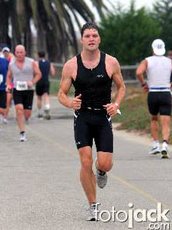
triI didn't really have a single performance goal that meant anything to me until about two years ago. That was when I decided, on a total lark, to join a weekend triathlon camp. I figured I'd go for a few months, do a race or two and then go back to the hardcore lifting-for-looks I'd been doing virtually my whole life. Instead, last weekend I kicked off my second season by shattering a couple of personal records in running and biking in my fifth competitive triathlon. Now, my personal records would send many triathletes into fits of cramp-inducing laughter, but that's not the point: becoming a triathlete has totally revitalized my training.

Instead of exercising to build up my pecs, I exercise to swim faster. To run smoother. To beat last year's time in the L.A. Triathlon. Are these goals reachable? Absolutely. Are they measurable? Sure as the numbers on my stopwatch.

And by the way? When I stopped watching the pot, it boiled at last: without even meaning to, I lost about six pounds. My bodyfat percentage went down. I lost a little muscle bulk here and there, but I don't miss it -- I actually prefer the way I look now.

I prefer it, in a way, because now my body's built do something, not just to look like it does something. It's built for a function, and the form has followed.

Now I'm not out to evangelize about triathlon, but I am going to suggest that everyone, soon, today even, find some kind of club, some kind of event, some kind of healthy, social, fun activity that will force you to exert yourself in a new way, that will get you engaged and involved in using your body regularly. Preferably something with an aspect of competition to it, with events or meets where you can measure your ever-improving performance. And believe me, if you commit to your new activity, you WILL improve.

bbIf you're already involved in something like that, set a new goal. Go for your black belt. Win the intramural championship with your basketball team. Sign up for a century bike ride. Active.com is a great place to start -- hey, you're online now, no time like the present.

You'll either be putting what you've built in the gym to good use or you'll be jump-starting your fitness program with a new, challenging activity you've probably been promising yourself you'd get to for months. Either way, everybody wins.

Good luck, and have a great week--

Andrew

Saturday, March 25, 2006

DF Tip #12: How to Touch Your Toes

to2Wha—? How to touch my toes? Please! What kind of topic is THAT? I've been touching my toes since first grade gym class already! Let's hear about carbo-loading, descending sprint-intervals, heart-rate monitoring! Look, I know how to touch my toes... I'll even show you, just bend down and -- (sound of spine snapping) -- AK! OW! GOFF!

Well, maybe your spine won't snap, exactly. But, believe it or not, most of us need a little primer on how to touch our toes. Because almost everybody does this simple move ineffectively. What we're trying to do, ostensibly, is stretch out an area that is generally tight (the hamstrings) -- but instead wind up stretching another area in a direction that it's already overstretched anyway (the lower back).

Confusing? A few words on flexibility.

ts2Several months back, the famous Tall Ships came through the LA area and I took my daughter, Kate, to go see them. As usual with such outings, Kate only glanced at the ships and fixated on a far more interesting plastic bottle top for the entire afternoon. Kate's indifference notwithstanding, the ships are remarkable vessels, their sails held firmly together in place by what looks like miles of rigging.

Now I'm not the nautical type, but in some ways you can think of your muscular system like one of those old-fashioned sailing ships: each muscle, like each sail on a ship, is held in place by connective tissue that, ideally, is equally taut in all directions. If one side of the rigging is too tight while the other is too loose, you get a sail that's pulled off kilter and doesn't function quite right. Or if both sides are pulled too tight, there's a chance a strong wind or a clumsy deckhand might just rip that sucker right in half.

Same with your muscular system: if you're inflexible, your muscles, joints and bones get pulled off track, making you more susceptible to muscle pulls and injuries. Keep the connective tissue optimally flexible and you'll be able to move freely and easily without pain or strain.

Hey, this analogy's working out better than I thought!

yogHere's where it gets tricky: note I don't say "maximally" flexible. Flexibility for its own sake is dicey and potentially dangerous. Muscles, tendons and ligaments have a fair amount of stretchiness built in, but once you overstretch them, it's hard to get them to snap back -- they can remain permanently lengthened: belaboring the analogy just a bit, your muscles can become like sails flapping ineffectively in the wind. Highly skilled yogis spend decades building up their flexibility so they can perform their feats of contortionism without injury -- but you and I need to proceed with caution. And we need to attempt to keep our bodies equally flexible in all directions: front, back, side, side. We want all our sails well-rigged.

Like that team of well-meaning but slightly bumbling college-intern deckhands hired by a ship captain for the summer, your body adjusts your rigging to accommodate whatever stimulus you throw at it (SAID again!). So, what do most of us, even the most ACTIVE among us, spend most of our time doing? Sitting. And usually, we're sitting with our arms forward, typing or driving.

Picture it -- or more likely, just feel it, where you are right now. Sitting TIGHTENS the hip flexors (where your thighs connect to your torso), the hamstrings (backs of your legs), the chest, shoulder muscles and abdominal muscles; conversely, sitting also LOOSENS the spinal erectors (supporting the lower back), scapular retractors (between your shoulder blades), and gluteals (butt muscles). A physiologist would add a few other hard-to-pronounce muscles, but that's the gist of it.

So by and large, with the exception of the hamstrings, the muscles on the front of your body are tight while those in the back are loose. That's why it always feels so great to open your chest, arch the back, and stretch the arms back and behind you after you've been sitting for awhile. Go ahead and do it now; I'll be here when you get back.

Feel better? Okay. One of my goals when I work with clients is to correct some of the bad habitual rigging that nearly all of us acquire after decades on our tucki. I'm as guilty as anyone: even if I work out ten hours a week -- which I almost never do -- it can only go so far to negate the effects of the other 40-50 hours I spend driving, sitting at my desk and watching TV.

Five to ten minutes of flexibility exercises, however, can work wonders -- at the very least to get you to feel your body properly aligned before you go back to the (sedentary) corporate grind.

So, on to toe-touching. When you reach forward to touch your toes in the usual way -- by rounding your back -- you're stretching two major areas: the hamstrings and the lower back. And for most of us, it's MOSTLY the lower back because we have more mobility there than in the hamstrings. Remember, when we sit (I'm talking slumping here, which, yes, I'm doing at this moment myself), our low-backs are already in forward flexion while our hamstrings are contracted. So stretching the lower back forward even more does most of us very little good. And the poor neglected hamstrings are largely ignored in the process. That's why most of us feel very little in the hamstrings when we do the traditional toe-touch and more often feel a scary pull in the low-back.

What's the remedy? After all that preamble, what's my Holy Grail of a fitness tip this week?

Keep your back straight when you perform the stretch!

Bend from the waist, pushing the butt back behind you, as if you were a mannequin and had no low-back mobility at all. Better yet, keep a natural arch in the low back -- the more arch, the greater (and safer!) the stretch. I teach my clients to brace their hands in the fold of the hips to help them keep the back straight and simultaneously push the upper legs back. Or, if the low-back is feeling tired, I have them support their upper body by placing their hands on a low bench, bending forward and then arching the back. Both methods accomplish the same key goals: they stretch the hamstrings deeply while keeping the low-back out of the equation.

bkHere's the rub: I've pulled a bait-and-switch on you -- you don't get to touch your toes at all. Using my methods, only the freakishly limber will actually reach their toes. Everyone else will just reach TOWARDS them. If you want to touch your toes -- say, to clip your toenails -- bend your knees. As they say in yoga class, release into the universe all attachment to the toe-touching goal. Perform the stretch as suggested and pretty soon you'll be feeling less low-back pain, moving more smoothly, running faster, and standing taller... indeed, like a Tall Ship.

Have a great week--
Andrew

Saturday, March 18, 2006

DF Tip #11: Born to Run...?

la.maraThe Los Angeles Marathon is coming up this Sunday, and in honor of that, and to counterbalance the bizarre fantasia that I sent out as a fitness tip last week, I thought I'd write about running this week, or what I like to call The Workout of the Compulsive Gambler.

bjackI call it that because if running is your primary mode of exercise, the road leads rapidly towards one of two possible paths: glory or oblivion. Running long and hard and frequently will do one of two things to you: get you leaner and more muscular and fit than you ever dreamed possible, OR, alternatively, leave you hobbling around on gimpy knees, wincing at every stab of back pain while you tell your friends AGAIN that it's all worth it because you finally broke 3:45 in the Annual Freckles Valley Marathon back in ought-seven. Guess which outcome is more likely?

Now, I'm not here to slag off on running. I just put in six miles or so yesterday and it felt great. But as with any other form of exercise, there are measures you can take which will increase your likelihood of injury and pain, and others that will increase your likelihood of greater fitness, health and satisfaction. Below are a handful of running tips to maximize you chances before you hit those blackjack tables.

Let's start with the pros of running. Arguably, the fitness industry really started with the running craze that started to heat up as long ago as the 50's and really hasn't stopped since. Running, in all its forms, remains the most popular form of exercise in the world, far surpassing cycling, swimming, weight training or any Bikram-Style-Tae-Yogic-Pilato-Jazzer-Bob-Greene-Jane-Fondercise class you can conceive of as the #1 fitness activity in the world.

runshoesThose millions of people are on to something: running has many unparalleled benefits. For all the fancy elliptical trainers and Hang-From-the-Ceiling-inators out there, there's not much that beats good old-fashioned running for caloric burn, fitness, and, not insignificantly, convenience. All the equipment you'll ever need for this wondrous exercise program is a decent pair of running shoes and some sweats. No memberships, no hidden fees, no trainer balancing you on a rubber ball and throwing weighted plates at you in the name of "functional" training. No matter where you are — home, New Delhi, Alaska — walk out your front door and there's your gym. So running has a lot to recommend it.

But hold on there, cowpoke — there's a dark side to running, and we'd best shed a little light on it before you hit the trail. Told to "get in shape" by a doctor, by your own sense of mortality, by an online fitness nag, usually the first tentative step we take is to start running. We figure we know how to run. I mean, babies run. It's not hard, isn't that sort of the point of it? There's no SKILL to LEARN. So we never consult a pro the way we might if we decided to take up swimming or golf. As a result, the running form we start with on day one of our fitness program is the same form we keep three years later when we've lost 25 pounds and look fabulous.

So what's wrong with that?

Well — a lot, frankly. I see and hear about a lot of running injuries as a trainer: veteran long-distance folks complain of chronic pain in knees, back, necks, even shoulders from the years of pounding. Now, some bodies just can't take running, that's a fact, but I'd wager (we're talking gambling this week, remember) that a lot of these overuse injuries could have been avoided with a little coaching from the start.

Watch a baby run sometime. For sheer form, my two-and-a-half-year-old daughter Kate would give an Olympic track star a run for her money. When she runs, she's relaxed, aligned, joyous. But between the time we start running as babies and the time we initiate our get-in-shape-for-the-beach programs lie several decades of physical misuse. Forget diet — which is certainly a factor — I'm talking about poor postural habits, tension, injuries, plummeting stock market indices, kids and a mortgage — the kind of stuff that makes our shoulders hunch and our hamstrings shorten. Stuff that subtly throws off our gait in ways we might not notice till Month Six and Mile 315 of our running program when suddenly it feels like someone just Nancy Kerrigan-ed our right ACL.

So, yes, shockingly, we really DO have to relearn to run. Most recreational runners have never been coached on form before — and many of them will pay the price years down the line in overuse injuries. These injuries ARE avoidable — if we just pay a little attention to form.

And what's good running form? Essentially, there are four points of focus (cribbed, in large part, I have to admit, from Joe Friel, author of The Triathlete's Training Bible — and countless articles in Runner's World and elsewhere. Thanks, Joe!):

1) Relax the upper body… You don't need 90% of the tension that tends to accumulate above the waist when you run. So relax the face and jaw, relax the hands, let the shoulders swing easily and loosely. Ever seen the faces of elite runners in slo-mo? They look like melting wax. It's not pretty, but that's the look you want to cultivate.

2) …but don't collapse: It's easy to take the above pointer as an excuse to collapse, let gaze fall to your feet and sleepwalk through your running session. Don't go that far. Pretend you've got a cape billowing off your shoulders. Stand up and level your gaze at the horizon. This is called running "proud." Most people run with their butts sticking out behind them, and it's very inefficient: keep your hips right underneath your shoulders, like you're riding a unicycle, and you'll save yourself a lot of energy. In a word, strive for good posture. Hard to do while "relaxing," you say? Try it for awhile and pretty soon running proud will feel easy and natural.

3) Take shorter, quicker steps. The fastest, most efficient runners take about 90 step-cycles (i.e., right-foot strikes) per minute. This is whether they are running quickly or slowly—among elite runners, speed is determined primarily by stride length, not cadence. So take shorter, faster steps, aiming for 90 cycles/minute, and save yourself some pounding. At first you will feel like you're speed walking and it may even feel more tiring. But stick with it — as with running proud, it gets easier and the rewards are great.

4) Think "Kick Back" NOT "Stride Forward." Most runners over-stride — they kick their feet way out in front of them with each step, especially when accelerating. Reaching out with your feet in this way, beyond the plane of your body, is very tough on the knees AND it slows you down: the heel striking the ground decelerates the body and with each step you have to work harder to speed yourself up again. Strive instead for each step to land on a plumb-line directly below your hip and shoulder, then "paw" the ground below you, focusing on kicking each foot back and up, pushing back with the hamstrings and glutes to gain speed.

When you first start trying to run this way, you will undoubtedly feel awkward, more tired, perhaps sore afterwards. You'll wonder why you ever started analyzing your running in this way, and you may have the impulse to send me hate mail.

kenyaBut hang in there: work on the first couple of pointers one day, the second two another day, and pretty soon it will come together for you. You'll be running further, faster, and more efficiently, and before you know it you'll look and feel like the gazelles that front-run at the L.A. Marathon every year.

The race route goes right by my house, and it's become an annual tradition in our house to get up early enough on the Sunday to watch the leaders — Kenyans, inevitably — come loping by a good hour or so ahead of everyone else. If you get the chance, I'd highly recommend taking it in: their form is impeccable. They look like they're flying, you can barely hear their feet touching the ground, even though they're logging sub-five minute miles for over two hours straight. They're running proud, and well they should.

Good luck!

Andrew

Thursday, March 09, 2006

Wednesday, March 01, 2006

DF Tip #9: The Wisdom of Günter

Last week I was off on a tirade about some fitness topic or other -- I can't remember what, since once they're written I feel instantly better and go to my quiet place -- and I mentioned in passing that there is one thing I can be sure to hear at some point from everyone kind enough to hit me up for personal training. Male or female, young or old, they all say:

builder"I don't want to get too big!"

They gesture distastefully towards one of the mammoths that work out at my gym and grimace in fear, as if tentatively hoisting a single dumbbell will endow them with Jurassic proportions.

Here's the final word on that: It's not going to happen.

All respect to the big guys. I know I give them a hard time, probably because no self-respecting, 20-inch-neck bodybuilder would be caught dead reading the fitness wisdom of a 179-pound wastrel like me, so they'll never read my derisive words. But the fact is that most of them are good guys -- albeit with a curious obsession--and the vast majority are drug-free. But ALL of them, yes, even the 'roid-heads, have paid for every muscle cut and striation in blood, sweat, toil and tears. The big guys work hard.

I know because back in my fledgling days, I wanted to be one of them: I wanted to get big and bulky and never have to take no guff from NO ONE, man! (I was young.) But, as I found out, getting big is tough going.

Personally, the biggest I ever got, at 6 feet with relatively low bodyfat, was 192 pounds -- a Lilliputian compared to the 5'9" guys you see at any Gold's who tip the scales at 230 or so. And that was lifting as heavy as I could handle, 5 days a week, eating gluttonously 6 times a day. Mind you, I was only able to sustain that weight for about a week and a half before I had to ease off on the gluttony and the continuous onslaught of heavy iron. In short order, I dropped 10 pounds of beef and I've stayed right around there ever since. Upkeep on that relatively paltry amount of extra bulk was just too much for me, and nowadays I file "muscle-bulk-building" right alongside "memorizing the phone book" in Heffernan's Guide to Worthwhile Ways to Spend Time.

Now there are certainly people -- men, almost exclusively -- whose bodies are, genetically, muscle-building machines. They stay on a fairly sane exercise program and develop huge arms, chests and legs the likes of which I could never compete with on my best day. But these people are in the minority.

Point is that declaring on your first day in the gym that "No matter what, I don't want to look like a bodybuilder!" is a little like telling the coach, on your first day of ski camp, that you don't want to make the Olympic team. Or telling Mr. Jenkins the band teacher that you want to be a pretty good violin player but you don't under any circumstances want to get good enough to play with the London Symphony Orchestra. People with insatiable drive, ambition, and focus spend decades trying to accomplish these things, and even they sometimes fall heartbreakingly short, so it's unlikely -- I won’t say impossible -- that you'll turn your body into a Michelangelo by anything like an accident.

leeI wouldn't get so worked up over this seemingly-minor misconception except that it has unfortunate consequences in the way people approach weight training. Gym newbies and veterans alike assume that because Günter the Megalithic lifts big weights, they shouldn't go near anything over about 12 pounds lest they find themselves, suddenly, looking like Günter. Which, again, is like refusing to practice your karate kicks lest you transmogrify into Bruce Lee by accident.

The weights that the people with this syndrome lift are light. Helium balloon light. It's almost harder to put the weights down than to pick them up, they're so light. And guess what happens to their bodies when they lift those little weights?

Nothing. The fear of "bulking up" has resulted in more ineffective workouts than Richard Simmons has done in his entire life of Sweatin’ to the Oldies. That muscles get stronger and fitter when you overload them with heavier weights that you are used to is one of the surest things in exercise physiology. No overload? No growth.

Here's the deal: whether you're using "light" or "heavy" weight does not change the fact that you should always be working to overload the body. Meaning that if you're shooting for 15 reps, the weight you choose should be all you can handle for those 15 reps. It should not feel like raising a martini glass. You should not be able to tell your trainer an amusing anecdote about your night clubbing with Gore Vidal on Key West while you're lifting it. A good half of my clients balk when I hand them a heavier weight than they're used to, then surprise themselves by pounding out the required 15 reps anyway. Yes, they're grunting and straining around rep 10, but I'll be jiggered if they don't get all 15, and a little healthy glow of accomplishment in the process.

lungeIt's tough, working with high reps in the right way. Back in my bulkier days I always looked forward to heavy days of 8-rep sets because they weren't as painful as long, hard sets with lighter weights that required more endurance and tolerance for pain. But whether you're working "light" or "heavy" (I put that in quotes because my heavy might be your light or vice versa), all sets after your warm-up should be tough. You should work for an overload.

Working like this, you'll certainly get leaner, stronger, more cut and muscular, but unless you lift as heavy as you can 4-6 times a week and scarf down more chicken than John Belushi in The Blues Brothers, you're not going to get too big.

The difference in the way you train and the way Günter trains should really be a difference in degree rather than kind. After all, Günter has good definition, muscle strength and size, all of which you want -- just not to the same extent as Günter. And you never see Günter put down his weights till he's spent, whether he's lifting 50 pounds 20 times or 500 pounds 2 times.

Guess what? Günter's on to something.

Good luck, everyone!

Andrew

PS: Please pass these tips along to interested friends, and/or forward me their email so I can send them directly along! And feel free to shoot me your fitness questions any time.

Thanks -- A

Saturday, February 25, 2006

DF Tip #8: Don't be a Cardio Zombie!

Next time you're in the gym, take a stroll by the folks working out on the cardio machines and conduct a little informal worker-effectiveness survey. Your boss does it to you all the time, might as well get a little of your own back.

treadIf your gym is like most of the health clubs I know, what you'll see is a handful of exercisers sweating themselves silly, many more than that going doggedly but disconnectedly through the motions, and a full half of them barely moving. Their legs might be lazily turning the pedals of some machine, but their focus is elsewhere: they're reading the paper, they're watching TV, they're talking on their cell phones, for Pete’s sake.

You'd think you'd encounter a different vibe in the free weight room, where the hardcore gym elite supposedly toils, scoffing at the efforts of mortals, admiring their crustacean physiques in the mirror. But the cross-section there is no different. Sure, there's more grunting and preening, but anyone who's really pushing their limits, subjecting themselves to a new stimulus which will make their bodies stronger, leaner, faster, more flexible will stand out like Pee-Wee Herman at a biker bar. And, incidentally, such people are often just about as welcome: a gym manager yelled at me once for sweating too much. Not on the equipment, mind you: on the floor.

Oh, the irony.

Look, I applaud anyone’s efforts to get fit. I recognize that the cell-phone stationary biker might have nothing else to give that day. I also recognize that not everyone enjoys pushing his body's limits till he’s a quivering mass of semi-organic goo on a daily basis like I do. I also know that there are people out there who are reasonably happy with how they look and feel and just go to the gym to maintain where they're at, unwind, chat with friends, maybe sit in a steam room and relax a little. Different goals, different personalities.

So why don't I just clam up, do my own frantic, heart-attack-inducing workouts, and keep my judgments to myself, Fitness-Obsesso-Boy?

I really should.

But here's this week's wouldn’t-it-be-nice sentiment: Most people are in the gym to affect change, and very few of the workouts I see people doing are effective in this regard. I can live with that -- begrudgingly. But what baffles me to my core is this: if people are paying good money for gym memberships and then taking valuable time to work out, why in Sam Hill don’t they at least pay attention to the workout itself? Such workouts are like placeholders for the workout that you think you'll have the energy and inclination to do someday…but not today.

In our busy lives, a few stolen hours a week to exercise are golden, friends. Even if you're going to creep like snail unwillingly to fitness-school on the treadmill, even if you're going to keep your weights perpetually light because you "don't want to bulk up!" at least pay attention to what you're doing. At least enjoy moving, enjoy breathing a little harder than usual, at least spend some time appreciating what Fiona Apple calls the "extraordinary machine" we live in. It may be the most rewarding part of exercise.

Long after the days of 250-pound bench presses, I hope I’ll be like the trim, energetic man I met doing laps at the pool the other day, who swims for an hour a day, seven days a week, rain or shine. He looks to be about 15 years younger than his 72 years.

What I'm talking about here is mindfulness, folks. Paying attention, showing up, being in the moment. Our busy lives threaten at every turn to transform our bodies into brain-housing devices, troublesome and demanding mechanisms useful only in moving us around so we can hook up to another machine and perform more income-generating work. For many of us, the only chance we get to remedy this mind-body schism is during those few hours we set aside to exercise. But the cardio- and weight- zombies described above are doing quite the opposite: they're doing one thing with their bodies (exercising) and quite another with their minds (cell phone, TV, chatting with friends), thus widening the very mind-body gap that focused exercise can help to close.

taiSo what's to be done?

Well, working out hard is one solution, and, by now, you can probably guess is the solution that works for me. It's tough to space out too much when you've got hundreds of pounds of iron slung across your shoulders, or when you're staring down the business end of hill number seventeen on Mulholland Drive.

And that’s not the only way: T'ai Chi practitioners are the picture of mindfulness, and their workouts aren't of the sweat-buckets variety. Most martial artists are as well, but I don't think you have to go to the Far East to find mindfulness: check out a spinning class and chances are you'll find the same focused intention I'm talking about.

But really, and I've said this before, the activity itself isn't important. As the 2-man luge and the curling competitors in the Olympics have shown us these last few nights on TV, you can be mindful doing anything — even your same old workout. Give it a try next time — it takes no more time and only marginally more effort. Go ahead and do the same thing you always do, just pay a little more attention: be aware of the space around you, of the way your body feels, of the feel of the weight or the road beneath you. At the end of your workout, whether your pushed your limits or not, you'll feel focused and alert instead of distracted and rushed.

String enough of those workouts together and pretty soon you have a form of practice, something that complements and supports your daily activities rather than serves as yet another distracting obligation. And that's a pretty good feeling.

Have a great week,
Andrew

Tuesday, February 14, 2006

DF Tip #7: Pointing Up the Pointlessness

Zoologist-turned-poet/raconteur David Whyte tells the following story about an early midlife career crisis. Whyte was working for nonprofit conservation organization, putting in long hours, volunteering at every turn for one worthy but thankless job after another, desperately spinning his wheels in the name of altruism. Exhausted, he consulted a wise friend over a pint of Guinness, who listened to Whyte's account of his predicament and said, "David, the solution to exhaustion is not necessarily rest."

Whyte, who felt that a vacation was more than deserved, bristled.

"The solution to exhaustion," the friend continued, "is wholeheartedness."

hikeI may be cutting off my nose to spite my face here, but the fact is that you don't necessarily need weight training and aerobics, as we normally think of them, to achieve optimum fitness. The bodybuilding and fitness magazines would like to you believe otherwise, with their "Great Thighs In Three Moves!" articles, but as I've said before, you can skin the fitness cat just about any way you want. The key is finding the "want" part--that activity you can be wholehearted about.

Let's face it. Or rather, I'm going to have to face it, and you can come along with me on this or not, as you please. Not everyone loves weight training, and not everyone loves running on the treadmill or riding on a stationary bike. Personally--newsflash--I'm something of a fitness geek, so the idea of clanging as much weight as I can handle onto a barbell and trying to figure out a way to get that thing aloft on my own steam holds a kind of masochistic joy for me. It's pointless, of course--I'm not really getting "healthier" in any meaningful sense, and it's not going to make me look much different--but as Justice Antonin Scalia once told a courtroom of golfers asking him to settle some pressing matter about the rules of the game, the point of sports is that they're pointless.

Heretical to say, I suppose, with the Olympic Games raging along in full force, young hopefuls hurtling themselves at alarming speeds along various configurations of frozen water. But I think that's part of the appeal of sports. As with the appeal of drama, we get to watch and engage with an event wherein the stakes appear enormously high, all the while knowing that there are really no stakes at all. The enjoyment is metaphorical. Watch humans invest every fiber of their physical, emotional, and spiritual fortitude in some contrived but enjoyable endeavor, and perhaps we will be inspired to invest just as much force of will into whatever endeavors happen to be taking up time and energy in our own lives.scuba

All this is to defend my personal preference for weight training, running, cycling, and swimming endless miles, even getting on an elliptical machine from time to time and sweating my brains out to get through 20 minutes at level 15. Curse you, elliptical trainer! Spurred on by the exploits of Bode Miller and Apolo Anton Ohno, I WILL conquer you someday. Oh yes, I will, all the while knowing that the rewards of reaching that goal are almost entirely symbolic.

But just because those are the activities I like to do doesn't mean they'll light your fire. There are lots of reasons that weight training and cardio activity are great ways to spend your limited recreation time, but if you don't like doing those things, none of my arguments will convince you otherwise.

So look down on us treadmill-runners as the human gerbils we are if you wish. Scoff at your swimming-obsessed co-worker's crispy, chlorinated coif every time you spy it over her cubicle wall. And yes, as much as he brags about it, you can even think that your marathoner brother-in-law is a blowhard who will have no knee cartilage in another 18 months. He probably is.

jai-alaiJust remember this: there’s nothing inherently noble or ridiculous about ANY athletic endeavor. They're all silly, and they’re all great--in part, arguably, because they ARE silly. Like your ma told you, it's how you play the game. Find something YOU can invest in, something that makes YOU excited, and you're golden. Then you'll never hear yourself say, "Oh my god, another 20 minutes of cardio" again. You'll say, "Hey it's Saturday, time for my softball game!" Or "In two weeks I get to SCUBA dive." Or go on a hike, or play jai-alai, or whatever it may be.

It takes a little more effort, granted, to find the thing that gets you fired up. The fitness industry has made it awfully convenient to walk into one of their emporia of sweat and burn off a few hundred calories. But if you hate those Palaces of Pain, for the love of God, don't go. Find another way. There are too many fitness options out there for ALL of us--and I speak to you as a living cautionary tale--to be forever lost in the health-club labyrinth. The energy you invest in finding something you enjoy is energy you will save down the road once you have found an activity you can be wholehearted about.

Happy Hunting, and have a great week--

Andrew

P.S.: Aside from agreeing with him on the appealing pointlessness of sports--which is a true story, by the way--I share few if any opinions in common with Antonin Scalia.

Thursday, February 09, 2006

DF Tip #6: Eyes on the Prize

God bless my hardworking fitness clients: they sweat buckets, they do gut-busting sets of Bulgarian split squats, they do all the hoisting and twisting and jumping and skipping I ask of them, the whole time looking wistfully across the gym at other folks doing forearm curls and machine glute squeezes, wishing they had it so easy. Though they occasionally complain about it, my clients work as hard as anyone in the gym, and it makes me happy to see them losing fat, getting stronger, feeling and looking better. And if they’re being consistent and watching their diet and resting adequately, they bound to keep making progress.

But occasionally, inevitably, they hit a wall: a plateau of some kind, or even a backslide of a pound or two. And that’s frustrating for both of us, of course. I mean, if they’re not getting better, surely it means we’re doing something wrong! Right?

Well, maybe.

I’m not infallible, and I can’t police my clients 24-7. But the reality is that for all the sweat you put in, for all the careful measuring of food intake and calories burned, sometimes you just have to be patient, hang in there through a plateau while the body makes the internal changes necessary while prepping for the next surge in progress.

graphI’ve seen again and again that linear progress—absolutely rock-solid, straight-up-the-mountain improvement with no plateaus and no switchbacking—is a myth. It doesn’t really happen. We like to believe it can and does, not only in fitness but in all aspects of our lives: career, finances, living situation, family. On some level we believe that everything should be constantly improving, and that those trends just go on and on until we DIE, fabulously rich and famous, running 3-minute miles and benching 1500 pounds, surrounded by beautiful supplicants, a trunkload of Most Improved Player awards in the back of our each one of our seventeen Ferraris.

Far be it from me to critique anyone’s ambitions. Some people want to get in shape to get back at their exes, or so they can intimidate a guy at work, or to flaunt their new fitness to someone they can’t stand. I’ll work with anyone, because hopefully at some point along the way they start to enjoy the process and their gradual progress towards these goals becomes a by-product rather than the driving force behind their new fitness habit. And if their ex ever does encounter them and sees the newly radiant glow of fitness in their skin and the sleek, trim physique they’ve build for themselves, and suddenly regrets leaving them, well, so be it, but hopefully it doesn’t spell the end of exercise for them (…Martha.)

The point is this: long-term goals are essential. Without them, few of us would ever get to gym.

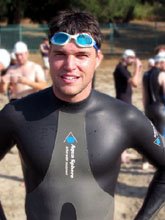
When I started training for triathlons last year, I was so terrified of not making it through the swim portion of the race that I always made my early morning workouts, despite having to get up before 5:00 AM sometimes. My long-term goal got me out of bed, but once in the pool or on the road, my enjoyment of the activity took over, and I just enjoyed whatever swimming, biking, or running workout I had planned for myself that day. By keeping a ‘soft eye’ on my long-term goals while enjoying the day-to-day ‘nothing special’-ness of working out, I had a great time, met some great friends, and even managed to pull off fairly decent rookie season as a triathlete.

Now I’m no psychologist, sports or otherwise, but I’ve recognized that everything I’ve accomplished that’s worthwhile in my life has been the result of a balancing act between a long-term goal and a day-to-day commitment. On one hand, you’ve got to choose a goal that fires you up; on the other hand, you’ve got to have the stomach for the day-to-day work as well.

It’s the everyday thing that sabotages so many fitness promises. Now that we’re into February, lots of people will find themselves flagging on their programs a bit. You may have hit a frustrating plateau and decided maybe this isn’t your year to get in shape. Or maybe your life is busier than you thought it would be and there’s not as much time or energy as you thought there would be way back in December.

Don’t waste any energy beating yourself up for these lapses. Just ease yourself back onto the horse and get yourself moving again. Add up enough days when you choose to exercise instead of watching TV, where you choose to eat well instead of poorly, where you choose to drink water instead of soda, and pretty soon your long-term goals will be well within reach.

Best of luck, and have a great week—

Andrew