
Tuesday, May 15, 2007

Fitness Conference Rundown

perform betterJust got back from Chicago, where I attended a three-day summit put on by PERFORM BETTER, which makes fitness products and puts on educational seminars like this one.

The main thought that ran through my mind throughout the conference was: wow, there are a lot of people in this field who are far smarter, better informed, and richer than I am, and let's face it, Freckles, many of them are about 10 years younger than I am.

These thoughts only occasionally threatened to drive me screaming from the room. In between bouts of hyperventilation and nausea, though, the weekend was pretty terrific.

A few specifics:
FRIDAY, 5/11

I attended a lecture by a guy named Thomas Plummer, who's a multiple gym-owner and zillionaire. He cursed like a sailor while sagely advising trainers to behave courteously. Early in his lecture he warned us that he'd piss us off, and I think he managed that. How could he not? Since he's management at the highest level and most of us are trainer-drones, it was like Donald Trump addressing a roomful of croupiers. Nevertheless, he's a funny guy, and certainly knows the industry. Some rather sobering information about the future of the industry, where we're headed, and who will survive. The upshot: I'm dead.

Next, I attended a workshop given by Ed Thomas called "The Subtle Side of Fitness." Ed's a courtly chap who carries himself like the lifetime martial arts/yoga/old-school fitness devotee that he is. Lots of interesting photos of old-time health clubs, overstuffed with gymnastic equipment, climbing ropes, ladders, balancing towers and the like. His point was that physical awareness and coordination, which used to be the cornerstone of the fitness "industry" (such as it was) should find its way back in. He's right, and those old gyms looked like a lot of fun. Reminded me of some photos I saw of a gym belonging to a guy named Mark Twight, who trained the actors for the movie 300. Twight's place is a converted barn with a bunch of heavy stuff to lift and things to climb and swing from. Give me that over Hammer Strength any day.

Thomas' presentation and photos also made me think of my late paternal grandmother (who was almost 102 when she died five years ago). Kathleen Walsh Heffernan was a P.E. teacher in the early 1900's, and probably worked in environments very like the ones in Ed's presentation: there were photos of young women climbing walls and ladders and hanging upside down in puffy skirts and what looked like ballet shoes, and Ed told us that this was where fitness was heading...again. Somewhere, my grandmother was beaming.

The final lecture on Friday was given by a guy named Bill Parisi on the art of networking. Parisi has a franchaise called "Parisi Speed Schools" that cater mostly to kids and adolescent aspiring athletes. It's a business model based on combatting childhood obesity--and on making Parisi lots of money, which it has done quite effectively. Parisi's one of those big, animated, passionate guys who could probably make millions selling sand in the desert. It doesn't matter if you know he's working Dale Carnegie's principles on you all day and all night: he's irresistible. One of his lessons was that you need to find a niche to market yourself in. After the presentation, I chatted with him a bit and told him I was getting into fitness writing. His immediate response: "THAT'S YOUR NICHE!!"

SATURDAY, 5/12
Got up early to work out at the Hyatt Regency's very civilized gym. Unsurprisingly, about a dozen very fit trainers were already there when I arrived at 6:30 AM, shunning the cumbersome machinery that cluttered up the place. Instead, they stood about performing difficult, full-body stuff that required enormous balance and coordination...not unlike the impassive, shockingly aligned exercisers in Ed Thomas' photos and prints. One female was cranking out more chinups than a Navy SEAL. The wave of the future indeed.

Felt pretty good about the workout I'd put in until about an hour and a half later, when, after a shower and breakfast, I sauntered into Juan Carlos Santana's "Combat Training For Fitness" class. Over the course of a forty-minute workout, he easily flattened the hundred or so trim, muscular training types who showed up. Santana has trained a host of Ultimate Fighter types, and relies primarily on continuous circuits using body weight squats, jumps, lunges, and a few primitive devices like elastic bands and kettlebells--another new-old school workout device--to get the job done. Suffice it to say that I wished I had neither eaten breakfast nor showered before that particular class.

Like Parisi, Santana's another magnetic guy who you could see leading a charge on a battlefield and getting everyone down to the residents of the local retirement community to follow him to certain death. I like to think I push myself pretty hard when I work out, but at Santana's urging I squeezed out more reps with more focus than I dreamed possible.

Amidst all the sweating, grunting and cries of "Oh God," Santana made an interesting point: that, from yogis sitting in lotus position for days on end, to monks who fast for weeks, to Native Americans who suspend themselves on hooks piercing the skin on their backs, the endurance of pain has long been seen as a pathway to spiritual enlightenment. It's a good observation, and ties into something I've been ruminating about for a few weeks now: the crossover between the pursuit of fitness and a deeper, more intangible awareness that turns regular exercise into something approaching a spiritual practice. You don't want to get too "out there" with that line of thinking, but there is something to it. As I've noted before, the language of religion and the language of fitness have lots in common.

Next was Al Vermeil, former trainer for the Chicago Bulls, and I by that I mean THE Jackson-Jordan era Bulls, not the wayward, motley crew of the last few years. Vermeil's job was to keep seven-footers healthy in one of the winningest, most popular franchaises in professional sports. He was good--an older guy with absolutely nothing left to prove, just out there, spreading a little knowledge and wisdom like there's nothing he'd rather be doing. He approaches training from the physical therapy angle, meaning that I've got to race to keep up with all the transverse abdominis, quadratus laborum, and piriformis talk flying about the room.

One interesting point he made was that many back problems and postural issues are the result of poor motor control of the fine muscles around the spine. The general public is often told that "strengthening the abdominals" will rectify back problems, but Al's point was that before you train the larger, superficial muscles of the core, you have to re-teach the smaller muscles--whose names are hard to pronounce, much less spell--to work properly. If you crank out thousands of sit-ups and leg raises without the smaller muscles doing their thing, what you get is a condition known as "global dominance:" big muscles doing the work of small muscles, which is like trying to write by moving at the shoulder joint rather than the wrist and fingers.

Last of the morning lecturers was Mike Boyle, whose book FUNCTIONAL TRAINING FOR SPORTS I've praised to the heavens in this space before. Mike's another highly-accomplished pro-sports trainer who to me, manages to bridge the gap between brilliant, analytical guys like Vermeil and guys like me who just want the lowdown on techniques we can apply to our everyday clients. Boyle has a cohesive fitness philosophy that is based on thousands of in-the-trenches hours keeping highly-paid athletes on the playing field and out of the rehab clinic. He's got a few controversial ideas, such as an incurable distaste for weight-room warhorses like the back squat and the barbell deadlift, but it's hard to argue with a guy who's had this much success and whose methods smack of so much good old-fashioned horse sense. A few months ago I saw a photo of me from when I was training using exclusively Boyle's methods, and even though his training programs are designed for performance and not aesthetics, I actually was looking pretty good at the time; you might have even pegged me as a guy who exercised regularly. Further evidence that if you train for function, form tends to follow.

To my surprise, Mike's lecture even offered some empirical evidence for my "Grow it early and you'll never look squirrelly" theory that I wrote about a couple of weeks back. On one hand it's good to have my instincts validated; on the other hand, now I can't claim it as my personal, unproven pet theory. Bless/curse you, Mike Boyle.

The early afternoon was taken up with more bon mots from Santana and Boyle, and concluded with a lecture by a guy named Ryan Lee, another fitness-industry-marketing machine cut from the Parisi/Santana steamroller-of-a-personality cloth. Lee made it seem like making scads of money in the fitness industry is and should be ridiculously easy. He also made it clear that I should update my blog at least twice a week (Ulp...Well, here's once THIS week). Lee had some great ideas and did make me think that there was plenty more I could be doing to jack up my business, and not just on the training end. So get ready for Andrew Heffernan's SIX PACK BRAND VITAMINS!

SUNDAY, MAY 13th
Didn't get much sleep the previous night because I'd ventured out from the confines of the convention center the previous night to attend a production of TROILUS AND CRESSIDA at the Chicago Shakespeare Theater on Navy Pier. Good show, but, immersed as I was in the world of training, my mind kept wandering to the methods I might use to improve the physiques, posture, and abdominal tone of the actors' physiques. Occupational hazard, I suppose.

Gray Cook was another sports rehab guy, an engaging speaker with a disarming down-home quality that, along with his running I'm-a-redneck joshing, disguises how brilliant he is. He's another physical-therapy guy whose approach I'd like to continue to learn more about. The primary thing I took away from his lecture was to address postural and functional problems before training for strength, or, For God's Sake, Knucklehead, Don't Let Your Clients Use Bad Form! A good lesson.

Alwyn Cosgrove was next, who I would rave about if I hadn't done so seventeen times in this blog space already. Suffice it to say he lives up to his hype, leads a brutal exercise session, and despite having only recently emerged from a barrage of successful chemotherapy treatments, still does a mean one-leg squat. Following the endurance sports models of Team In Training and Avon's Walk For Breast Cancer, Cosgrove has raised a nice chunk of change to fight cancer with his program LiftStrong--an 800 page book-on-CD filled with cutting edge fitness articles, information, and his own, very personal Cancer Diary. Cosgrove is definitely one of the good guys.

Finally, Eric Cressey is a preposterously accomplished guy who, at age 25, is not only a very successful powerlifter but one of the most highly respected trainers around. Just listening to his lecture and getting a sense of the depth and scope of his knowledge made me wonder what the hell I've been doing frittering away these last 36 years. Part of me wanted to jump up on the stage and strangle him in all his youthful, charming, and articulate glory, but one look at his arms and chest made me realize that even that was a futile fantasy. My only comfort is that someday, many, many years after I've fallen into decrepitude, dementia and death, Eric Cressey, too, will die. Sure, there will be streets in Boston named after him, an Eric Cressey annual parade, and hoards of future gold medallists tearfully crediting him with all their success, but he will be dead, and I must be thankful for that one, tiny blessing.

Overall, it was nice to be in an environment where fitness geekhood was the norm rather than a freakish abhorance, and to rub elbows with some of the top people in the field. Credit must be given to Chris Poirier, who was the conference coordinator and responsible for assembling this fitness dream team. The summit is coming to Long Beach and Providence, and it's well worth any trainer's time to check it out.

Tuesday, May 01, 2007

Blame Your Tools

A couple of weeks ago I roused myself from my inveterate tightwadhood, went out to the sports store and sprung for a new pair of swimming trunks and some nice running shoes, making for a purchase of about 130.00 bucks (150.00 if you count the fancy insoles that I was easily talked into buying). Always stings me to spend money on frivolous things like sporting goods--even if it is part of my vocation.

But the next day, I felt I was able to run faster and harder than normal, and the Achilles tendon pain that had been plaguing me for weeks was gone. The day after that, in my new, biker-short style trunks, my swimming was measurably faster. It took me fewer strokes to get across the pool, and unlike my old trunks, the new ones didn't stretch down to my ankles every time I did a kick turn off the wall.

The lesson's an easy one, though not always a cheap one: sometimes, you gotta blame your tools. My old shoes were months past their prime, and my trunks had clearly seen better days as well. If your physical activities are causing you pain, it might very well be a problem with your equipment.

So go ahead--blame your tools. Even if it doesn't make you instantaneously faster or stronger, your fancy new gear just might get you out to the gym, the playing field, or onto your bike a little longer or a little more often. And that's a good thing.

Friday, April 27, 2007

Something I Can't Prove

There's a little party game that's making the rounds among fitness professionals of late called "What do you know that you can’t you prove?" I'm not sure who started it but it's a pretty interesting little exercise, and a lot of the first-string fitness pros have weighed in with some pretty great ideas (T-Nation.com did a roundtable a few weeks ago).

In my tip from a few weeks ago, "A Little Thing Called Science," I talked about the importance of checking sources on any study that purports to offer objective fitness advice; I also warned readers of the prevalence of junk science in our industry, and basically sounded a note of caveat emptor among consumers of fitness information and products. As ever in our field, there are lots of charlatans out there.

That being said, I've just been named the new face of DELISH-O-DIET® Protein Weight Loss Muscle Gain Sex Drive Make A Million Dollars Snake Oil formula, and quite objectively I think everyone should buy a boatload today! It's GREAT!!

Just kidding, though let it be known I am very much available for endorsements.

Okay, anyway. Despite my healthy skepticism for patently unscientific claims, I do think that there's room for good ol' fashioned, hard-earned, learned-in-the-trenches wisdom that accrues from years in this-- or any -- field. You know how in buddy cop movies there's always the young, by-the-book cop and his wily veteran partner who follows his hunches and does things his way, and by the end of the film the by-the-booker has learned a thing or two about chucking procedure and going on instinct? Well now I'm speaking up for those wily veterans. The cantankerous Burgess Merediths out there who just know what they know, who do what they do cause it works, dammit.

Of whom I can hardly count myself one. Still, here's my j.v. version of the "something I know but can't prove" game:

The earlier in your life you get in shape, the easier it is to maintain or get it back.

I'd like to come up with a compact, rhyming version of that little principle, like, "grow it early, and you'll never look squirrelly," but it's still a work in progress.

Now I'm not just talking about "muscle memory." It's widely accepted that it's easier to rebuild lost fitness than it is to build it from scratch. I'm suggesting something further: that there is a window of time, say, from age 12 though age 20, during which, if you get in shape, you're more likely to remain in shape as you get older, and still more able to recover your former glory should you fall off the exercise wagon at any point thereafter.

Hard to prove, I know: I suppose you could do one of those famous "identical twin" studies where you separate a pair of twins at birth, have Twin #1 participate in a fitness program during adolescence and Twin #2 wait till his thirties to get healthy, let them both go to seed, then put them on identical training programs twenty years later and see who responds the best. It would only take a few thousand sets of identical twins willing to do your bidding for life. If you could persuade any reasonable adults to participate in such a preposterous study, I guess what I'm saying is that I bet Twin #1 would clean up.

[Side note: I wonder if you could make a living being an identical twin? With all the genetic studies out there requiring thousands of sets of them, and the relative dearth of such twins, couldn't you just fleece the NIH every time you get a call if you were an identical twin? Seems like the "Good of Science" argument might only work a few times before you'd ask them to pony up. I'm picturing a Will Ferrell movie where Ferrell repeatedly participates in such studies even though he has no twin. He does dozens of these studies for thousands of dollars. Genetic science is thrown completely off because he skews the results of every study he participates in. Hilarity ensues.]

So what proof can I offer for my theory? Well, there was my childhood friend, Derek Dean, whom I still see on occasion. I met Derek when the two of us were in middle school and we became lifting buddies. The keen eye of my teenaged machismo noticed -- and coveted -- his peaked, rounded biceps, which, he claimed he'd built stacking wood (we went to school in woodsy New Hampshire in the 80's, back when wood stoves were considered eco-friendly). Anyway, I saw Deano again a few months ago, and although he's pretty much given up weight training in favor of attempting to break the four-minute mile, the guy still has those enviable biceps.

I also think about other guys I've known who were athletes in college or high school, who, despite years of inactivity, either still look kind of athletic, or get their muscles back after just a few weeks of concerted effort. I suspect those guys drive their gym-rat girlfriends crazy.

Finally, many other physical functions appear to operate similarly. Preadolescence and adolescence are fertile periods (ha, ha…) for just about every kind growth. Child development experts speak of a window for learning a new language, during which retention and comprehension is high, and the child is less likely to forget lessons learned: fill in that language template early, and it's less apt to get erased. Bone growth happens in a similar manner. Exercise physiologists now recommend judicious use of higher-impact activities for young adults in order to achieve a high rate of bone mass in early adulthood. The theory goes that the higher that peak bone mass is as an adolescent -- when conditions for bone formation are optimal -- the less likely the child will be to develop osteoporosis and other skeletal problems in later life. Here again is the ideal window for optimal development occurring in early adolescence.

I suspect muscle tissue operates in a similar fashion: plant the seeds for muscle memory early in life and you can reap greater benefits later.

Admittedly, my theory is not much good for those of us who waited until later in life to make a real run at getting in shape. Still, the argument stands for getting yourself moving sooner rather than later, even if "sooner" means 75 instead of 85.

Furthermore, it's an argument -- along with the bone-growth theory, which actually has a scientific basis, unlike my little piece of armchair-physiologist hypothesizing -- to get our kids out there and active as early as possible. Better yet, let's go out and play with them. My three year old, Kate, has a new favorite game at the park called "obstacle course" where she and I take turns giving the other complex routes to run: through the swings, up the slide, down the slide, swing from the low bar, around the tree three times... etc. I go all out when it's my turn, and so she does too.

Thursday, April 26, 2007

DF Tip #26: Periodization and You

figNow and then I'll be at a party and an acquaintance will sidle up to me at the hors-d'oeuvres table and ask me about my favorite topic. Muttering something about the little-known healing properties of the French bread-with-brie-and-fig-jam that I'm jamming down my gullet, I'll be hit with a question that goes something like this: "How's this fitness routine: I take two soup cans, lift them overhead fifty times. Then I run up my attic stairs and do 10 deep knee bends. Then..."

The fitness freak in me wants to stop them before they go any further, because their question -- "What do you think of this routine?" already tells me there's something amiss. The question implies that their exercise program -— whatever form it takes -- is a static and unchanging habit, like tooth-brushing or fingernail-clipping. Still, I'll usually wait till the end of the speech before I ask, as innocuously as possible, "So how long have you been doing this?"

The answer varies from six months to 12 years, and therein lies the problem.

As I've suggested in the past, getting fitter requires that you overload the body: stress it in a way it's not used to, forcing adaptation and improvement. It's a fairly simple concept, though as I've written at length, people fail to grasp it all the time. Your body is always seeking stasis, and has dozens of functions and systems in place that check and balance one another in an effort to preserve the status quo. Start a new exercise program and you introduce a new stimulus. After a brief period of improvement, your newly strong, supple, and enduring body becomes the new status quo, and you've got to make it adapt again by introducing, you guessed it, a new stimulus. This could take the form of greater resistance in your weight training, more mileage on the bike, more workout sessions a week, or simply, more intensity. Assuming you're resting and eating to support your fitness program, you just keep nudging the stakes higher, surprising the body with new stimuli, getting healthier, shattering plateaus, breaking through to new heights of fitness and performance with each passing year.

That’s the ideal, but so often it fails because people develop these accursed fitness "routines" that they run by their trainer pals at hors-d’oeuvres tables the world over.

Let me pause -- nay, backpedal -- for a moment here to first commend all those people who have fitness regimens going at all. Though I'm convinced there's a better way of doing things, I will say that the folks who have such regimens in place, even unchanging, repetitive ones, are already light-years beyond their sedentary brethren and sistren (?) who are trying to muster the resolve to commit to ANY form of exercise beyond curling mint juleps whilst reclining in their backyard hammocks.

I'd like to start a modest movement, here and now, to wipe the concept of routine from our collective fitness-minded consciousness. What if, instead of seeing our fitness practices as an unchanging daily task, we thought of it as a learning process, akin to practicing a musical instrument?

violinStick with me here: no one in their right mind would practice ONLY the scale they learned on their first day over and over again and expect to get better at anything but that one scale -- and pretty soon they’d even cap out on that simple drill. And no one short of Mozart would expect to become a master at a fingering technique, rhythm or picking style that they'd never tried before. In order to get better, you've got to do new stuff. It doesn't matter if that first day routine were designed and patented by the Phil Jackson of guitar teachers: keep doing it over and over and you'll stagnate, never reaching your goal of playing for writhing masses of screaming groupies.

Yet that's in effect what thousands of exercisers do every day (no, not the screaming groupies part). They repeat the same thing ad infinitum and expect improvement.

The carry-over lesson is that, like learning a new instrument, fitness should be approached not as a rote routine but as a skill you're trying to master, so that each workout is geared not towards maintenance but towards the incremental improvement of some skill or ability.

So progression -- and thereby, variation -- is essential. But the next, quite reasonable question is, how? Just keep lifting more and more all the time until you look like Lou Ferrigno? Run until your friends start referring to you as Mr. or Ms. Gump? Learn one new sport or skill after another until you win the decathlon or get headhunted by Cirque du Soleil?

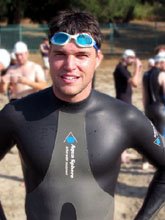
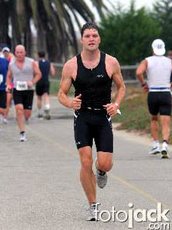
lougumpWell, one short and flippant answer would be... yeah. I don't wholeheartedly suggest this for everyone, but that's sort of how I've stayed in shape for the last 20-odd years: by discovering some activity that interests me, going into it half-cocked until I get bored or intrigued by something else, and then jumping into that new thing with equal abandon. In addition to my decidedly average genetics, a major reason I would never have made much of a pro athlete is that I could never commit to one physical endeavor for very long. The closest I've gotten is triathlon, a sport I've kept up for a whopping two years -- and that's probably because it's actually three sports in one (four, if you count peeing whilst riding the bike). That, and the fact that it allows me to take about half the year off to direct my focus towards strength training, martial arts, and other bright, shiny objects.

cirqueThrough no great plan of my own (I assure you), I've managed to avoid the injuries that many athletically inclined guys my age suffer because I just don't have the attention span to cause myself any serious harm. And, to my astonishment, my athletic tomcatting has actually made me better at the sports I do practice.

A few years ago I discovered that fitness folks have a word for this type of training: they call it (with their usual tin ear for coinage) periodization. And since there's a word for it, it must be good, right?

Periodization was born in professional athletics. The idea was to create a training schedule that would allow athletes to progress steadily, avoid injury, over-training, and burnout; and, most importantly, achieve their peak performance in a given year when the stakes were highest, during the competitive season. The best way to achieve this, they found, was to break the year up into -- wait for it -- periods during which the athlete would focus on one particular aspect of athletic performance, be it endurance, strength, sports skills, agility, or something else. Without getting too much into the details, the point was to bring the athlete, over the course of a year, from general fitness towards greater and greater focus on the specifics of the athlete's competitive sport right up through the end of the season, when the athlete took some well-earned active rest. Such a system worked far better than simply practicing the sport at full tilt all year round, or performing drill after irrelevant drill until the cows came home, and this system remains in use by most trainers of professional athletes the world over.

So okay, you're not a professional athlete, you're not even an amateur athlete, and all you want is to look good, feel good, and stay healthy for as long as you can, and therefore, what does this have to do with you?

Just this: a pro athlete is really just an overpaid, overexposed, spoiled and egotistical version of you and me. Their training needs differ from ours not so much in kind but in degree. Like the pro athlete, the average trainee also wants to avoid injury and burnout, while continuing to improve. Like the athlete, he will also probably have a point in the year when he wants to look or feel particularly good: a trip, a reunion, a wedding, the holidays or the summertime. And like the athlete, he will want to have sex with thousands of beautiful women and make millions of dollars for doing very little work (periodization won’t help with that).

powderImplementing a layman's version of periodization into your training program just takes a little bit of planning: figure out when you want to peak -- look your best, feel your best, or perform your best -- and work backwards from there. Say you've got a reunion in two months. You might spend four weeks focusing on building muscle and another four focused more on losing fat so your newly toned muscles show and you look your best. If you've got more time, you might go through the muscle-gain/fat-loss cycle multiple times before your peaking date so that you arrive in the best shape of your life.

golfIf you do compete in a sport or a recreational activity like golf or skiing, you can structure an entire year of training specifically to get in top shape to play so that you hit the links or the slopes healthy and ready to go. Your off-season might include specific strength, power and flexibility drills to help you peak right when the season begins. When your season is over, take a few weeks off to relax and engage in some alternate activity that you haven't had time for when doing your sport. Then take some time to figure out what you might want to work on for next year's season. If you've got an injury, your off-season could be spent shoring it up so it doesn't hold you back next year. If you have more than one activity you enjoy, say, martial arts and tennis, figure out when you want to be at your best at each sport and cycle your attention accordingly. At no time should you stick with exactly the same program for more than six weeks.

The point is for your training to support your lifestyle, to help you live and enjoy yourself more fully in whatever activities you choose to participate.

Tuesday, April 24, 2007

My Training / Tabata Intervals

Quite some time ago this blog began as a training diary; a couple of people have been mildly interested in my training these days -- which I'll also touch on in a tip that's coming up -- but the bottom line is that I'm training for another season of triathlons. My first will be either June 9th or June 24th. Don't know whether I'm doing the one on the 9th yet, but now that I've written it I suppose I might have to. And I MAY just do one this weekend as well in Loma Linda, though that one's looking less likely as we may have a child care conflict.

So my training consists on a lot of swimming, biking, and running, in all kinds of fiendish combinations: fast bike/slow run one day; long bike up the hills/fast swim intervals; long run followed by sprint combinations... I mix it up. Good for a guy with the limited attention span I have.

My problem as a triathlete has always been that I don't have the patience to do a lot of really long, slow endurance work, so it makes me happy that this type of training has been taking a beating in fitness circles of late anyway. I've always felt a little on the inadequate side as a triathlete because I've never done, nor really aspired to do, an Ironman (2+ miles of swimming, 112 miles biking, 26+ miles running), primarily because, well, it's ALL long, slow distance work... for about 15 hours. Just doesn't interest me; I like speed; I like feeling the muscles working away, I like holding onto a modicum of the muscle mass I try to build in the off-season, so I much prefer the sprint distance: all out for an hour or so, much like a hard gym workout. Get it done, get out, go home.

A few weeks back, while on one of my seven-hour internet searches for new fitness information and techniques (long, slow internet hunting doesn't seem to be a problem for me), I discovered a technique (which was actually formulated and named about 11 years ago) called "Tabata" intervals, which are truly brutal but very effective. Those in the know will already be familiar with Izumi Tabata, Ph.D, a Japanese coach who came up with the 20 seconds on / 10 seconds off interval that sears body fat and raises the VO2 max to new and impossible heights. It's so brutal that the protocol calls for just four minutes of intense work: eight 30-second work/rest intervals in all. As long as you really push your limits during those 20 second intervals, four minutes (following a warmup and preceding a cooldown) is PLENTY. As Tabata himself notes -- with charming detachment -- in his report on the effects of this training protocol, "The subjects lay down on the floor afterwards." Yup, it's hard.

Hardcore gym rats do Tabata intervals with weight training, by choosing a full-body movement, selecting a medium-easy weight for themselves, and doing four minutes of 20 seconds on / 10 seconds off intervals. Front squats and "thrusters" -- a kind of front-squat/barbell-jerk combo -- are popular options. I confess I haven't tried this type of workout in the weight room yet, possibly out of blind fear of the stomach-churning consequences, but it sounds tough as hell. Instead, in the interest of developing greater speed and power for racing, I've been doing them on my bike, at the end of my harder running workouts, and in the pool -- the latter by doing all-out 25 yard sprints, resting 10 seconds at the edge of the pool, and repeating for a 200-yard interval workout at the end of my longer-distance work. As long as you stick to the time and intensity constraints, it seems to work. My swimming has indeed gotten faster and easier -- surprisingly so -- and I find myself able to bike and run at a higher intensity for longer periods as well. As the research suggests, Tabata seems to raise your ceiling a bit, making everything below top intensity a little easier.

The initial studies on Tabata indicated that subjects who performed this type of hardcore interval training experienced fat loss at a rate NINE TIMES faster than that of subjects performing a more traditional steady-state cardio workout. That's a pretty remarkable difference, and a little while ago some marketing genius attempted to capitalize on this little datum. Basically a few blokes built a piece of gym equipment that looked like a space-age exercise bike, claimed that four minutes a day on the machine would get you nine times the fat loss, and -- with a straight face, mind you -- slapped a $12,000.00 price tag on the contraption. This for a single piece of equipment intended for home use. Now I've never used one of these things, so it's possible that working out on it does indeed feel better than winning the lottery and nabbing an Academy Award while having sex with your dream lover, in which case it may well be worth the price tag. But short of that, it seems like you could substitute four minutes of Tabata-style bodyweight squats and save yourself the floor space, as well as a pretty hefty chunk of scratch.

I've been starting to recommend the Tabata interval to my fitter clients of late to see what kind of results they get out of it (Tabata is decidedly not for beginners). It's really a variation on the kind of sprinting work I've recommended in the past, but this particular interval seems to hit a metabolic sweet spot that keeps the body in EPOC mode (Excess Post-exercise Oxygen Consumption, the acronym du jour for us fitness freaks) for an especially long time. And that's a good thing.

Monday, April 23, 2007

Good Gyms

Last weekend I took a couple hours and drove up the 5 freeway to Newhall, where the legendary Alwyn Cosgrove runs a gym called RESULTS FITNESS.

I met Cosgrove a couple of months ago at a seminar and chatted him up. I knew his writing and fitness philosophies; I also know about his gym and expressed an interest in seeing how he ran things; he kindly told me I could drop by any time.

So last Friday, I did.

Given Cosgrove's reputation, I was half-expecting something enormous: a huge, multi-floored fitness emporium equipped with all the latest machines and fitness paraphernalia. A staff of behemoths, with Olympic bars and squat racks as far as the eye could see. People performing esoteric moves with great purpose and intensity. The occasional, massive trainer screaming, randomly, "DO YOU HAVE WHAT IT TAKES?"

I pictured Ivan Drago training in "Rocky IV."

But RESULTS is not that at all: it's actually a fairly unassuming storefront in a strip mall in quaint-ish downtown Newhall. And once inside, it’s immediately clear that the equipment is nothing special either. A nicely-organized rack of dumbbells. A few Olympic bars and benches. A squat rack with a chinning bar. Some cardio equipment. Lots of floor space for stretching. And maybe two or three of the absolutely most basic fitness machines: a lat-pulldown/rowing station and an adjustable-angle cable station are the two I remember seeing.

The one nod to esoteria was a strange device that looked a little like a Pilates rebounder -- and the woman who was showing me around, Donna Bent, told me they'd won that piece of equipment the previous week at some function (no one touched it in the time that I was there).

So in its physical plant, RESULTS is a nuts-and-bolts place, and that really shouldn't have surprised me. In his approach to training, Cosgrove is a nuts-and-bolts guy.

The demographic of the clientele was fairly predictable: unsurprisingly, at 11 AM on a weekday, it was mostly women who either weren't working or whose jobs afforded them time off on a weekday to put in an hour or so at the gym (sort of like my job).

But what impressed me the most were the muscles on these women, and the energy and focus these women were summoning to build them. The one bare midriff I saw (it's not a flesh-baring place) was nicely muscled, as were the arms and shoulders these women sported. They all looked like strong, capable, athletic types, and it's no surprise -- they were doing exercises that required some serious strength and athleticism: chinups, deadlifts, rows, squats, all at a brisk pace, with some pretty serious weights. I heard some hearty grunting while I was in there. I'm not allowed at CURVES, but I don't imagine you hear a lot of grunting there.

I spent about forty-five minutes with Donna (who was very nice and a pretty darn athletic looking specimen herself), and in addition to getting the sense that the training at RESULTS is goal-oriented (hence the name of the place) and intense, I got a good sense of the vibe of the place as well, which is perhaps its most important feature, and the main reason a potential client would choose RESULTS over BALLY’S.

It's similar to a gym called CARL AND SANDRA’s in Santa Fe, New Mexico, which is run by a guy named Carl Miller, a former Olympic weightlifting coach. I visited the gym about a year ago. Carl’s a great guy, very accomplished, and took 90 minutes of his day to work with me and talk about their philosophy.

If I were king of everything, all gyms would be run like RESULTS and CARL AND SANDRA’s. If I ever run a gym, these two gyms are the template I would model my gym after. What makes them different from, say, 24-HOUR FITNESS?

Lots:

1) PERSONAL ATTENTION. Both gyms feel like Cheers: everybody knows your name. They're friendly places where you want to go, want to spend time.

2) RECOGNITION FOR ACCOMPLISHMENT. At RESULTS, there are before-and-after pictures of some of the gym’s more impressive transformations. At CARL and SANDRA's, you get a special notice on the wall the longer you've been a member. The notion of striving for improvement and change is reinforced in both cases.

3) CONTINUED INSTRUCTION. The programs followed by the clients at both gyms are designed by professionals who are aware of each client's goals, injuries, limitations. Each client follows their program to the letter, and every few weeks is given an updated program, thus ensuring progress. Supervision is provided: at RESULTS, it's semi-private; at CARL's, it's one-on-one every few weeks, but trainers -- all of whom share the same training philosophy -- are always on hand to assist.

4) TRAINERS WHO ARE ON THE SAME PAGE. At most gyms, trainers barely know one another, much less each other's clients. Asked to train someone else's client, most trainers would have no idea what to do. But at RESULTS and CARL'S, the training programs are part of a larger training philosophy which underlies everyone's program. So even if you might have a particular trainer that you work with, any trainer at the facility can pinch hit if need be.

5) METICULOUS RECORD KEEPING. Check out the trainers at the average gym. Then check out the trainees. Are they writing down what they do? Unlikely. Yet how can you be sure you're making progress if you don't keep track? That's like playing golf or bowling and not keeping score. Are you getting better or worse? At the good gyms, it just makes sense to keep track. Who said "What is measured, improves"? I don't know, but they probably pumped iron.

6) A FEELING OF "SERIOUS FUN." This is the complement to #1, above. Sure, everyone's nice. But it's not at the expense of the work that everyone's there to do. It's supportive but not distracting.

7) LESS FOCUS ON STUFF. Both gyms have everything they need but not much more. Given the choice between filling up a gym's floor space with a dozen near-useless machines that work tiny muscles in a non-functional way and just having that extra space for stretching, doing ab work, jumping rope, or calisthenics, I know what I'd choose. Cosgrove and Miller have chosen likewise.

8) INSPIRATON. Cosgrove himself is a former Tae Kwon Do champ. The trainer on duty when I visited RESULTS was a competitive powerlifter. Carl Miller coached two American Olympic teams. Cosgrove’s wife, Rachel, brave soul, is training for an Ironman-distance triathlon. These people practice what they preach.

I'm sure there are dozens more points I'm missing here. I don't know whether I would ever want the hassle or worry of owning my own gym, but if I do, this is how I'd want the place to feel.

Sunday, April 22, 2007

BLOG-A-PALOOSA: "Design" Rant

UNINTELLIGIBLE DESIGN?

So for a year or so now I've been posting these tips, and am going to continue to do so, but I've finally become just a little more computer literate, and have been poking around the net quite a bit for other fitness information. Turns out that, to put it mildly, I'm not the only one doing this "fitness blog" thing. Most of the other folks appear to post... pretty darn regularly, rather than waiting around for some enormous inspiration to strike and spending months procrastinating and then figuring out how to phrase their ideas with just les mots justes. Well, I'm doing the same. I've decided that I'm going to post more often, darn it all! Yup, even if it's just to say, hey, here's my next post, I'm going to post more often! Even if the kwalitty of my riting suferrs.

The tips will still come -— don’t worry. I’m going to try to make them monthly instead of "quarterly," as fellow fitness-blogger Lou Schuler recently described my paltry output. But I'm going to do intermediate posts too, for my Mom. I mean, for all my fans (the self-deprecation will continue).

So what am I going to talk about? Same stuff, I'm just going to be a little less precious about it, and I might stray off topic every now and then.

Subscribers will continue to receive TIPS in their mailboxes, but not the more frequent musings posted here.

Aaaanyway —- I wanted to kick things off with a little observation here: remember "intelligent design?" Remember how for about five minutes this form of thinly-veiled creationism was threatening to nudge out legit science in our kids' classrooms? And remember how it was essentially pummeled into submission, first in the popular press, then in the courts, when a Pennsylvania judge ruled that intelligent design, by scientific standards, essentially... wasn't?

And I for one was relieved. A couple of years ago, my wife Heidi and I attended a one woman show called "Mother On Fire" by local artist and NPR commentator Sandra Tsing Loh. The show detailed her frantic search for decent schooling for her elementary school aged kids. After surveying the myriad stratospherically overpriced private-school options in the greater LA area, she begins to consider cheaper parochial schools, concluding that "The teaching of evolution just might not be a luxury my family is able to AFFORD!" My wife and I were a few months away from putting our daughter Kate in preschool, and we laughed hysterically -— probably because for us, hers felt like a dilemma that was just a liiiiittle too close to home.

Anyway, back to I.D. Thankfully, despite the protestations of our wise and moderate president, mainstream America seems to have dodged the intelligent-design-as-science bullet for the time being, and advocates for the cause have disappeared for now, or perhaps, karmically, devolved back into the single-celled-organisms from which they grew some few million years ago.

So I wonder: why do otherwise reasonable, eloquent authors -- some of whom are fitness authors, not usually a bible thumping crowd -- still use the term "the human body was designed to..." [fill in the blank with whatever point the author's trying to make]. I read this phrase all the time, and it perplexes me to no end.

Maybe I'm sounding nitpicky and pedantic: I've done that before. I certainly get what these guys are trying to say -- something along the lines of "the body functions optimally when..." I could stomach that phrasing much easier, because science is evoked, if only faintly. But saying that the body was designed to do this or that is tantamount to saying not only that there was a designer (which may be true but is irrelevant to the discussion at hand), but also that the author happens to have a clear line on just what that designer had in mind when they did the designing, and for you lesser mortals who don't have God on speed-dial, here's the dope.

I'm willing to concede that some of these fitness guys know a hell of a lot more about squatting and curling and omega-3 fatty acids than I do. But I'm not willing to concede that any of them has a direct line as to what the big Strength and Conditioning Coach in the Sky intended when he assembled the human body, the beauty of the world, the paragon of animals, in form and moving so express and admirable.

Friday, March 16, 2007

DF Tip #25: A Little Thing Called "Science"

galileoSo there's this new thing called "science" that has a lot of people talking these days and I thought I'd spend a tip talking about it, just because, gosh, I'm thinking it might have some applicability to the fitness world.

As a personal trainer I am compelled to renew my certification every couple of years by attending continuing education classes. These classes usually take the drab, drone-y form of a remedial driving class: the lecturer either tells you things you've known for decades, or speaks with great vehemence about very questionable things, then concludes by asking you to pony up $49.99 for the Abdomulator. Not my favorite way to pass a weekend.

So a few weeks back, faced with a choice between acquiring some continuing ed. credits or getting pounded with a myofascial foam pad by the Internal Affairs Division of Personal Trainers, I attended a seminar held by a chap called Alan Aragon. Whatever the topic of discussion, I was at least intrigued at the prospect of seeing a fitness presentation led by a fire-breathing dragon.

Girth Control:  The Science of Fat Loss & Muscle Gain Aragon turned out to be far more interesting: his seminar was titled "Girth Control: The Science of Fat Loss & Muscle Gain," and in about 30 seconds I could tell that this guy was no Internet-guru quack, a type I've come down on pretty heavily in the past. Nope, Aragon's one smart cookie, and lucky for anyone he works with, he's also something that we don't see a lot of in the fitness world: a skeptic.

If you've even skimmed a fitness book, sat through a late-night infomercial on weight loss, or glanced at an ad for any muscle gain powder or drink or system or piece of equipment, you'll know that the fitness world is chock-full of whackos whose zeal is almost religious: you've got your gurus, your crazy, hopped-up evangelist types like Bill Phillips, your sacraments in the form of protein powders and Omega-3 supplements, your holy scriptures with titles like Fitness is Religion and Body By God. We strap ourselves into medieval exercise machines and endure whatever pain and suffering they can mete out. Fat is the devil we must exorcise and scorch away; muscle is the shining Holy Grail, pursued with ever-redoubling conviction and fervor. Hallelujah! Praise the lats!

Amidst all the speaking in tongues, Alan Aragon is a fitness agnostic. He's -- what the hell, let’s just belabor the hell out of this analogy, shall we? -- he’s Galileo, insisting that the Catholic Church cede to the empirical evidence and admit that the Earth circles the sun.

Let's just hope that he never recants.

Basically, he's an advocate of applying this "science" thing in pursuit of optimal dieting and exercise techniques. So what's so novel about that?

Well, shockingly, the deluge of fitness advice that is regularly dumped on the public is almost never subjected to much scientific scrutiny. Rather like our current administration, fitness folks tend to just repeat things until everyone slowly decides that they must be true. And I'll admit that in the past I've been guilty of jumping on the trendy train, just because, well, I'm human too, and I get excited about new fitness information just like everyone else.

h20Here's a great example: remember how we grew up thinking that you should drink 8-10 glasses of water a day? We must have heard that a hundred times growing up. Well, you know how many studies to prove that 8-10 glasses a day was optimal for most people?

Zero. As you've probably heard by now, the 8-10 glasses of water a day thing was pretty much pulled out of thin air by a guy with a few letters after his name. He meant well -- someone asked him how much water he thought people should drink and he gave a good-faith estimate based on his experience -- but he never meant for us to parrot him for decades, his ball-park estimate posted on school-nurses' walls nationwide and reprinted in every issue of SELF since Cheryl Tiegs graced its cover.

Modern TimesRemember the scene in Modern Times when Charlie Chapin finishes a long day of tightening lug nuts on an assembly line, and reels around with the lug-nut-tightening twitches, finally assaulting a poor woman with strategically-placed buttons on the front of her jacket? As consumers of fitness advice, we're a little like that. We hear that antioxidants and Omega-3 fats are good for us and we start swilling multivitamins by the fistful and flaxseed oil by the gallon. Meantime, we never bother to read the studies showing, rather convincingly, that too much of some antioxidants can cause stomach problems and too much Omega-3 fat can compromise immune functioning.

Thank god for guys like Alan Aragon: he's out there poring over studies, sifting through them for faults, and revising recommendations as necessary. Aragon reads the fine print, and it usually says, in so many words, "The guys who did this study also stand to profit handsomely from its results." The low-carb industry has lost a little steam lately, but you can bet there are a few dozen aspiring Atkins heirs out there scrambling to get a headline in Men's Health about how women are chemically more drawn to men on low-carb diets than their flour-stuffed brethren.

goodbadIt's ironic -- and no surprise -- that I hadn't heard of Aragon before this seminar. As he pointed out in his talk, a book with "moderation" in the title most likely won't find its way to the bestseller list. No, we like our fitness tips extreme, absolute and universally applicable. Cut fat to lose weight. Cut carbs to lose weight. Eggs are bad. Eggs are the perfect food. Eat only vegetables. Eat only raw foods. Eat only grapefruits. Eat only meats. Eat no meats. Aerobic exercise is the second coming. Aerobic exercise is the scourge of the devil.

With so much money to be made in the fitness industry, it's no wonder there are so many crackpots and snake-oil charlatans claiming to have found the Holy Grail. And some of the manufacturers of these products also happen to publish popular magazines covering the topic of fitness, and if an article in the magazine happens to cover a popular athlete and that athlete happens to use a given product also manufactured by the magazine's publisher, well, I'm no economist, but I'm sensing something of a threat to perfect and absolute journalistic objectivity here.

The antidote? Well, in a word, science. Guys like Alan Aragon make a living sifting through the detritus for useful nuggets of dietary advice, and have a wealth of expertise and experience and to help them do it. But everyone -- myself included -- can be a little more on their guard about blindly following the latest trends, and about taking every blurb on diet and fitness at face value. We can find out the source of the studies that fitness articles cite as evidence for their claims. Using the internet, we can often find the studies themselves and make up our minds for ourselves: does this study really prove what they say it proves? What might they have missed? What biases might be in play? Basically, we don't need to be fitness lemmings, following the carb-deprived crowd right over the cliff.

That was the most useful little nugget I got out of that weekend seminar. Think for yourself. Resist extremism. Use common sense. Moderation is key.

And, this "science" thing is useful.

Thanks, Alan.

Andrew

Saturday, January 27, 2007

DF Tip #24: In Praise of Sprinting

sprintrunWhen was the last time you went outside and ran as fast as you could? If you're like most adults, you're probably groping for a memory that's at least a couple of decades old. You might remember a more recent incident if you take public transportation regularly or if you're the father of a three-year-old with Joyner-Kersee-esque foot speed, as I am. But the vast majority of us -- dedicated exercisers included -- just don’t sprint.

By "sprinting" I'm not only talking about running at 100% effort. I'd also count any cardiovascular type of movement -- swimming, biking, running, stair-climbing, rowing, calisthenics, even circuit weight training -- that you can perform at your absolute limit for a period of at least 20 seconds. Pushing so hard that 30 seconds leaves you an exhausted, panting puddle. That kind of effort.

I suspect that people avoid this type of exercise for one simple reason: it's just too darn hard. Sure, we know hard work is important when we exercise, but there seem to be certain types of exercise that strike us as just plain excessive. Amongst strength exercises, chin-ups, squats, dips, and weighted lunges generally find their way onto most gym-goers' "Too Hard to Bother" list. The Versaclimber, that upright cardio machine that simulates the action of scaling a steep rock wall, is tops on my own list. Can barely spend five minutes on one of those god-awful things without crying like a little girl.

versaBut there's an irony to avoiding tough exercises: the number one reason given for failure to exercise is lack of time. People have careers and families and if they were to squander three precious hours a week on exercise then it would pose a serious threat to the survival of the species, quite possibly the universe. But my question is this: if people are so strapped for time (which we all are, let's face it), why does anyone spend a single second, for instance, on something as useless as a thigh-adductor machine? And why do so many of these free-time-impoverished people scrupulously avoid the very exercises that stand to do them the most good in the least amount of time?

A correlary to the "too darn hard" excuse is this: I think many exercisers find hard work on the order of sprints, squats, and chin-ups faintly embarrassing. They feel it's uncivilized to sweat or pant or push too hard. Far better to spend twenty minutes on the recumbent bike working up a decorous little sweat. There's a civilized level of effort and then there's being narcissistic, causing a fuss, or just plain showing off. I believe people also see sprinting as dangerous, particularly for the over-35 set: all that huffing and puffing and pounding? Can it really be good for you?

The truth is, yes. It is -- REALLY good for you, and that's the real point of this particular tip. As a fitness guy, I of course applaud anyone's efforts to get up and move, whatever form that movement takes. But it's increasingly clear to the scientific community that exercise needs to be pretty vigorous to have a measurable effect on incidence of heart disease, longevity and the like. There's mounting evidence that interval training (trainer-speak for sprint training) outdoes more moderate forms of cardiovascular exercise in nearly every way that matters: in caloric burn and weight loss, in the release of beneficial hormones, and in the building and maintaining of muscle mass.

Although the number of calories burned during a short- to medium- length session of sprint training is the rough equivalent, or possibly lower, than the caloric burn one gets from a longer session of moderate-pace training, the caloric afterburn from sprinting far exceeds what one sees from slower cardio work. And for fat loss, caloric afterburn (or Excess Post-exercise Oxygen Consumption for us fitness geeks) is where the rubber meets the road.

sallyConsider: your resting metabolic rate -- the number of calories you burn just breathing, digesting, and staying alive -- accounts for 60-80% of the energy you burn on the average day (that figure, and most of the others I cite below, are from Lou Schuler and Alwyn Cosgrove’s terrific book, The New Rules of Lifting.) Your RMR is usually estimated by multiplying your weight in pounds by 11. So, for instance, as a 180-pounder, I burn almost 2000 calories a day just sitting on my tuckus. That’s a pretty good number of calories burned just catching up on my TiVo.

Now, let's compare the metabolic effects of two different types of workouts. Let's say on a given day you put in a pretty decent steady-state half-hour on a cardio machine and burn 250 calories. That's the equivalent of a banana and a couple pieces of string cheese, or a small serving of the average, medium-healthy cereal (sans milk), or an apple and some cottage cheese. Let's face it, we’re not talking about a great deal of chow here. You'd have to spend seven hours on that treadmill at that pace to burn off even a single pound of fat -- and that's assuming that everything you burned was fat, which it probably wouldn't be.

fruit and cottage cheeseFor anyone with more than a couple of pounds to lose, those are some pretty harsh numbers. So say that instead of your steady-state workout, you decide that you'll trust this kooky online trainer guy and try doing sprints. Choosing a form of cardio that won't aggravate any chronic injuries you might have, you warm up at an easy pace for five minutes, then crank up the speed and incline till you're pushing the limits of your abilities for a thirty-second sprint. Then you back it off to a recovery pace for 90 seconds, repeating the work-rest pattern for a total of five sprints. Then you ease off for three minutes at recovery pace and call it a day. Including a warm-up and cool-down, you can get through this really effective sprint workout in 18 minutes. Depending on how you structure the workout, you might burn 50 calories more or less doing sprints on than you would doing the steady-state workout above. But the magic really happens when the huffing and puffing is over: unlike a steady-state workout, wherein your metabolism dips back to its normal level shortly after your workout, your RMR now stays elevated for up to TWO DAYS after a sprint workout. You read that right.

How elevated, you ask? That's hard to say: it really depends heavily on how hard you push yourself during your workout. But even if your RMR stays elevated 5% for a period of 24 hours -- a conservative estimate -- your sprint workout burns almost 150% of the calories that are burned doing your steady-state workout. That's a pretty good return for what amounts to a smaller investment of time.

But the advantages don't end there. I've pointed out the physical differences between sprinters and endurance runners before: the former tend to be quite muscular and the latter quite stringy. This is, in part, because sprinting helps build and maintain muscle mass (since your fast-twitch muscle fibers, which grow the most, are called into play during sprinting) and endurance exercise burns through muscle mass (since you don't need a lot of strength and power to jog, so your body breaks down the "unnecessary" muscle tissue for fuel). So in addition to burning calories, sprinting also builds and maintains strength, power, and muscle mass, essential ingredients in looking and feeling good. That additional muscle mass, in turn, burns up more calories, both when you're using the muscles and when you're at rest. To repeat a sentiment I've posted in this space more times than I can count, "building muscle mass" does NOT mean bulking up to massive, bodybuilder proportions. For anyone not chucking around massive quantities of iron whilst regularly whacking synthetic and illegal hormones into their veins, it means looking toned and athletic.

sprint bikeFinally, sprinting just feels fantastic. Or I should say, when you're DONE sprinting, it feels fantastic. Yes, it's hard as hell while you're at it: it burns the muscles, your heart pounds, your urge to stop or slow down is sometimes irresistible, you may even feel a little nauseated. Like I said, fantastic. But you're only at it for about 30 seconds, so a rest period is never far off. And as someone who's spent a fair amount of time working at long, steady state pace workouts AND at sprint workouts, I'd say that for endorphin flow, sprinting beats slow straight-up cardio hands-down. I pushed it pretty hard on my bike early this morning, and I feel alert and charged up even now, seven hours later, right in the middle of my usual afternoon slump. I can feel there's something still going on metabolically as a result of that workout. If I'd gone long and easy, I'd need a nap or a strong cup of coffee right now.

Now, let me throw in my usual ounce-of-prevention for all my gung-ho readers who might think I'm saying that sprinting is the ONE TRUE WAY to fitness and to do it every day all day long. There's a reason that sprint workouts only last 20-30 minutes: they're not only very challenging, they're tough on the joints, too. So if you're doing your sprinting on foot, I'd caution against doing more than three sprint workouts a week. If you're swimming or cycling, you can do as many as five -- but your body will still take a cumulative beating, so take a break if you start to feel achy. Work up to full effort on your sprint intervals over a period of weeks. Don't compare yourself to other exercisers: your sprint speed may be the equivalent of someone else's jogging speed, or vice versa. Remember to pace yourself so that your last sprint interval is as fast as your first. And if after all my exhortations past, you think it's wise to skip a warm up or cool down and jump right into maximum effort, well, I wash my hands of you and your reckless ways.

Start with the simple program outlined above. You can always adjust work periods and rest periods, so the interval system gives you a virtually limitless series of workouts to choose from. Good luck, and let me know your progress!

Andrew

Monday, December 11, 2006

DF Tip #23: Look Out for Gurus!

loch nessThis morning I was reading a well-traveled blog by an exercise guru (I'll call him David), who claims that when it comes to fitness, we've got it all -- or most of it, anyway -- wrong. There are very few topics he isn't willing to take on: fitness, genetics, dental care, the movie industry, economics, the Loch Ness Monster... Okay, not that last one. But it's clear that David fancies himself something of a Renaissance man.

Much of his writing on fitness is about what NOT to do: he hates steady-state cardio activity, he doesn't like high reps or high volume weight training, he doesn't believe in veganism or vegetarianism, doesn't believe in sports drinks or post-workout glycogen replacement in general, doesn't like weight machines. He's totally down on carbs and sugar. He thinks that many weight-room warhorses -- full-range bench presses and wide-grip lat pull-downs, as well as most abdominal exercises -- are dangerous.

croIn place of these chestnuts, he advocates what I'll call Cro-Magnon Fitness (he calls it something else) -- a training system based on his conception of the activity patterns of our hunter-gatherer ancestors: heavy, fast-paced training, one-arm/one-leg movements, low reps, heavy weights, and explosive movements. He favors jumping, leaping, and throwing medicine balls, movements that he contends mimic ancient, high-intensity activities like escaping predators and taking down prey. He likes eating meat and thinks grains are the scourge of the gastrointestinal world.

David isn't short on self-esteem. He spends one entry going into detail about the reaction a female salesclerk had upon seeing him in an Armani suit she was trying to sell him (SPOILER: her reaction was positive); another on the effect that his bounteous testosterone stores have on women, and, more distressingly, on dogs.

We get it: David is a hunk of virility, and if we'd only adhere to his principles of training, if only the misguided fitness industry would listen to him, then this country, nay, the world, could be populated by men and women whose mere essence drives the opposite sex, and much of the animal kingdom, into fits of uncontrollable lust.

Let me backpedal a bit before David’s disciples, hip to the fact that I’m talking about their messiah, come to my house and expose me for the fitness-drink-swilling, carb-eating, long-distance running fitness hack that I apparently am. David does make some good points. He likes a lot of the same stuff I like in the gym. He rightly cautions against extremism and fanaticism in endurance sport. And at 6'1," 195 pounds, 8% body fat, and almost 70 years old (!), he's clearly found a system that works for him. The problem is that he takes the indisputable fact of his own success and assumes that his methods will work for... pretty much everyone. That's where he and I part ways.

mesoAnyone with even a rudimentary understanding of fitness can look at the guy and see that he isn't well suited to long-distance anything. He's a mesomorph, a thick-boned, fast-twitch muscle guy, good at short duration exercise and explosive movement (he once played pro baseball), and not much on endurance. So in a way it makes sense that he would benefit from a system of weight training that is particularly suited to that type of physique -- to wit, very high intensity, heavy weights, low volume -- and abhor the kinds of activities that don't agree with this body type -- namely, endurance sport.

But that's no reason to dismiss endurance sport activities -- and the reams of scientific data that support their benefits -- altogether. Nor does it mean there aren't scores of people out there who benefit from long-distance running, or cycling, or swimming. There are: I've known a few thousand of them personally. But David doesn't talk about them; instead, he takes a head-shaking, I-told-you-so pleasure in posting anecdotes about the rare occasion when an apparently-healthy endurance athlete dies from a heart attack while training.

David's advice on weight training is equally short-sighted. In his blog, and in interviews (which are also accessible via his website), he carefully explains how you only need to lift weights twice a week, performing one hard set per body part per week, using a carefully-worked out system of ascending weight and descending repetitions. He claims that using this system three times a week for forty minutes a session is all that is needed for optimal fitness.

I'm sure many of my clients would love to be in and out of the gym in thirty-five minutes, just twice a week. I'm sure many of them would prefer not to do the three or four grueling sets of squats or deadlifts or chinups that leave many of them sore for days afterwards. And I'd be happy to prescribe such a workout regimen if I believed for a minute that it would be effective.

If only. In practice, the truth is that almost everyone needs more stimulation than David recommends. In my experience, this manner of weight training leads to a particularly precarious combination of under- and over-training: the muscles aren't trained with enough volume or frequency to stimulate growth, but during workouts themselves, the tissues are subjected to such extreme stress that the trained muscles wind up either injured, or at the very least, more vulnerable to injury outside the gym, so a trainee will wind up wrenching their back tying their shoes or doing some equally innocuous physical activity.

Moreover, David's revolutionary ideas have already been advanced, touted, and largely relegated to footnote status in most fitness circles, for many of the same reasons I go into above, starting as long as three decades ago. Arthur Jones, the entrepreneur behind the Nautilus craze, and the late bodybuilding champion Mike Mentzer both advocated similar training systems back in the 80’s. Today, there's a good-natured kook on the Internet who calls this training system -- I kid you not -- the "Doggcrapp" method.

It's not that what they say is worthless. Like any other training technique, heavy, high intensity training has its place. But just because this training system has proved useful for a handful of high-profile athletes does NOT mean that all other training systems -- which have been tried and tested and proven effective by athletes and workaday exercisers everywhere -- are useless and should be thrown out.

crewIf I've learned nothing else in my years as a trainer and athlete, it's that you can't use a cookie cutter to create fitness programs. As ever, it's different strokes for different folks. Sure, David gestures vaguely at the notion of variety in training, but only within the strict parameters of his very limiting recommendations. Maybe some of what's worked for him will work for you, too. But what's misleading about his points, and what I caution all twelve of my readers against, is the one-sidedness of it. He sternly steers us away from one type of fanaticism while slyly advocating another: no machines! No endurance activity! No grains! In pointing out the dangers of overdoing aerobic activity, he effectively makes the point that not all exercise modalities are for everyone -- but then immediately contradicts his own well-taken point by trying to sell us on his own ONE TRUE WAY to fitness. As I've said many times before, there are simply too many bodies out there, and too many useful, effective, and, frankly, really fun ways of exercising, for one system to work optimally for everyone, forever.

loch nessAnother word of caution while I'm on it. The systems that fitness gurus advance are, inevitably, a repackaged form of something others have been doing for a long time. Functional training is a souped-up version of the calisthenics we all did in gym class. Balance training is something that circus performers did centuries ago. Spinning classes? Boxing? Tae Bo? Kettleballs, for the love of Pete? There's value in all these things, but let's not pretend that no one ever thought of them before. These guys might have gone sailing in the Atlantic, and maybe they'll come back with a story or two, but that doesn't make them Columbus.

alaskaThe lesson here is that there's very little that's new under the sun: you've just got to keep searching till you find the thing that's right for YOUR body and YOUR goals, right now. That's why one of my main principles -- in as far as I can say I have any principles -- is to keep exploring, keep challenging yourself, keep expanding your physical repertoire. Sure, go ahead and take up David's principles for awhile. See how they work for you. Then ignore it all and join a crew club for a year. Then do spinning classes. Cycle Alaska. Then take up competitive power lifting.
The body is too complex and fascinating an organism, too inherently curious and adaptable to stay satisfied with one exercise modality for long. Explore long enough and eventually, you'll become something akin to a guru of your own physiology. Maybe you'll stumble on a series of long-forgotten exercises that you become convinced is by far the best and most effective system in existence, and why has no one thought of it before?

At that point, you might feel inclined to start your own blog about how you've discovered the ONE TRUE WAY to get fit and tell everyone about it. All I'll say is if you do, keep your dukes up.

Have a great week,
Andrew